
Canada’s 1931 national census was taken on June 1, 1931 and contains a preserved population schedule with forty questions. It is unusually helpful for seeing families during the Depression: in addition to names and places, the form asks about housing and unemployment, and it includes a question about whether a household owned a radio. Begin with a known location and the whole Schedule 1 image. A name search can fail because some original left margins were clipped before microfilming; when that happened, the missing portion is not recoverable from the digital image. A census entry remains a reported snapshot, not proof of title, income or permanent residence.
Know what survives of the June 1931 enumeration
Library and Archives Canada explains that the seventh national census contained four schedules: Population, Agriculture, Institutions, and Merchandising and Service Establishments. Only Schedule 1, Population, survived. Do not promise a detailed original agricultural or business schedule to a researcher based solely on a published statistical table. The remaining schedule asked forty questions. It used Form 1A in the eastern provinces, Form 1B in the western provinces and a separate Northwest Territories form, so labels and arrangement should be read on the actual page. For the next step, our guide “1921 Canada Census” explains how to find households and separate surviving schedules.
The census geography cannot simply be borrowed from 1921, especially in large cities. LAC notes that the 1931 districts and subdistricts largely follow the 1924 electoral map but differ in places, and no bespoke 1931 map was created. Keep exact district and subdistrict details. In 1955 authorities approved microfilming and destruction of the paper originals for these later censuses, so the microfilm-derived image—not an intact paper return—is the surviving archival form. This matters especially for damage that predates filming.
Search the LAC collection by person and by location
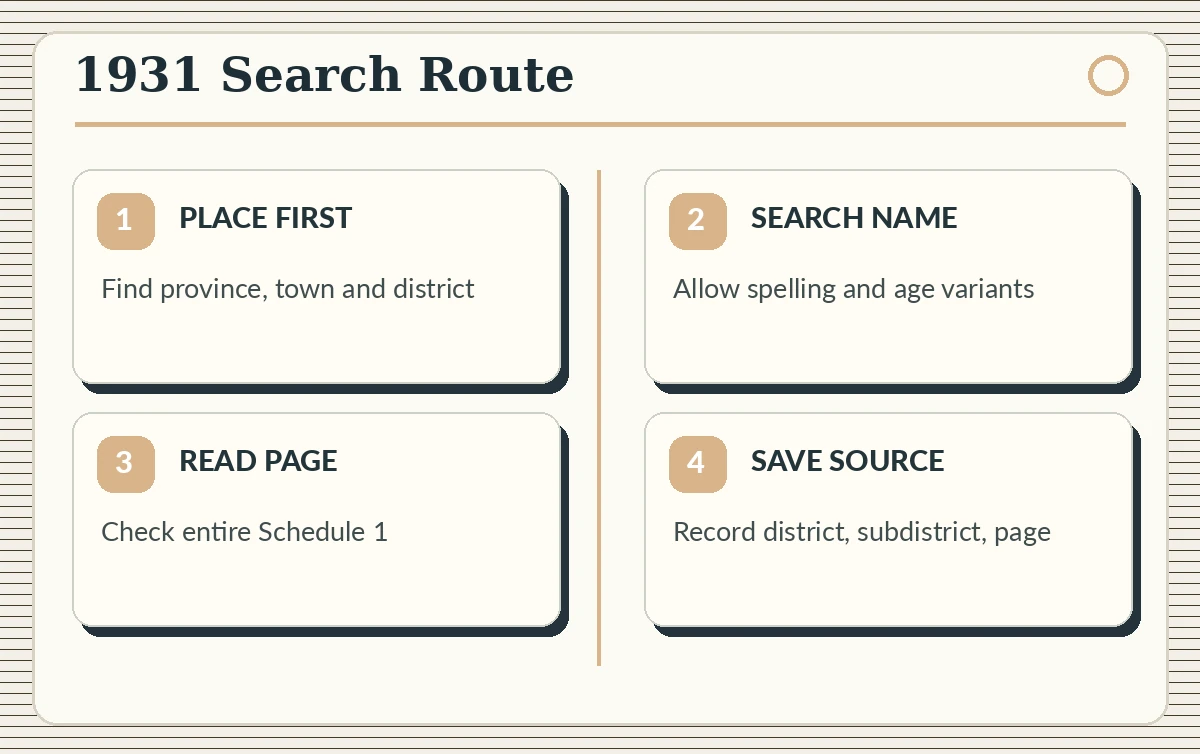
Start with a surname variation, approximate birth year and province, then narrow to city, township or a known district. Record the household line, page, district and subdistrict, together with the census date. If the household is absent from the index, try given names, relatives and neighbors. For an urban address, a contemporary city directory may help identify a ward or adjacent residents; these are separate sources with their own publication dates. Avoid treating a search result that matches only the province as a verified identity.
Browse the entire page to see whether the household starts before or continues after it. Check how the enumerator numbered families and dwellings, including multiple families in the same building. When a subdistrict was combined with another, LAC instructs researchers using the subdistrict search to enter the first of the combined numbers. Save the original image reference and a transcription of uncertain handwriting. Indexes can help locate records but cannot replace a complete visual read of the preserved columns.
Use the 1931 housing and radio fields accurately
The 1931 population schedule asks about housing characteristics and home circumstances, including whether the family owned a radio. These are observations about a household at that time; owning a radio is not a precise measure of wealth, and a description of tenure must not be turned into a land-registry claim. Compare the wording of ownership and rent fields with the form used in that province, rather than importing definitions from another census year or form. A reported occupation describes the source’s classification at enumeration.
For family-history analysis, make a structured transcription: address, household members, residence and home information, radio response, occupation and any relevant education or language entries. Maintain a separate interpretation column. An apparent multi-family dwelling may indicate rental housing, kin sharing or administrative divisions; the census alone may not settle that question. If a current family story describes a prosperous business, the reported 1931 housing and work entries can test but not conclusively prove or disprove the story.
| Evidence step | What to record | What it cannot establish |
|---|---|---|
| PLACE FIRST | Find province, town and district | A name alone establishes identity |
| AGRICULTURE | Separate schedule not preserved | The index replaces a source image |
| IDENTITY | Keep proposed names provisional | An uncertain link is proven |
Read Depression-era unemployment answers without inventing work histories
LAC’s 1931 guide highlights new questions about unemployment, including its duration and causes. Those fields are especially relevant to reconstructing a family during the economic downturn, but the wording and time period in the enumerator instructions control interpretation. A reported spell of unemployment is not a full employment history or a diagnosis of family hardship. Distinguish a person’s usual occupation from what they were doing at the specific reference period. Do not infer that a spouse or older child had no economic contribution because the page records one limited occupation label.
Check a suspected work disruption with dated city directories, local newspapers, employment or relief material where those records survive. Keep potentially sensitive details of living descendants separate from historical research. Descriptive categories in the census reflect the government and its era, including classifications that are now outdated or offensive. Transcribe the original category if necessary for evidence, explain its context, and do not repeat the label as a modern description of a person. A similar decision comes up in our guide “French Military Registres Matricules”, which explains how to find a recruit by class.

Recover a fictional household from a clipped name column
Imagine a fictional Montreal household with a clearly legible address, ages and birthplaces, but its surname is cut off at the left edge. LAC specifically warns that some photographed pages lack part or all of the name column because the original margin was trimmed before microfilming. Do not claim that another image or a higher-resolution download will reveal writing that was already absent from the microfilm. First record what survives, along with district, page, neighbors and household composition.
Then locate the address in a contemporary city directory and independently test likely residents through civil or church records and the 1921 census. Keep the family identification labeled tentative until at least one reliable link connects the proposed name to the preserved 1931 dwelling. If the directory and census disagree, check the dates and the possibility of residents moving within the year. The result is a defensible address-based candidate, not a recreated “original” name written into the missing margin.

How We Research 1931 Canada Census
We checked Library and Archives Canada’s dedicated 1931 guide for June 1, form variants, the four original schedules versus the single surviving population schedule, housing and unemployment fields, and the clipped-name warning. The Montreal household is fictional. Our method treats missing margins as actual source loss and requires an independent address link before identifying an unnamed resident.
More Records and Archives Guides
Official archival research sources for 1931 canada census
Library and Archives Canada: date, surviving Schedule 1, forms, field changes and missing names (www.canada.ca).
Library and Archives Canada: name, place and image search strategies (www.canada.ca).
Also, Library and Archives Canada: Dominion series, record survival and schedule descriptions (www.canada.ca).
This guide provides historical research information, not legal, medical or investment advice. Archive coverage, costs and access may change. These links are editorial references, not paid recommendations; see the GenHis affiliate disclosure. Interpret outdated historical classifications in context and protect details about living people.
The official enumeration date was June 1, 1931.
No. Only Schedule 1, Population, was preserved, although the census had four schedules.
Some left name margins were cut before microfilming, so the missing text is absent from surviving images.
No. Form 1A, Form 1B, and a Northwest Territories form were used in different areas.
No. It records a particular reported possession, which needs broader context.