
The 1916 Census of the Prairie Provinces began on June 1, 1916 and covered Manitoba, Saskatchewan and Alberta. Its surviving 26-column Population Schedule can show household members, township-range-meridian residence, immigration or naturalization year and reported military status. The agricultural schedules do not survive as individual original returns. Start with the correct province and district, inspect the full manuscript page and treat every coded answer as a reported census statement that requires its own verification.
Distinguish the Prairie enumeration from national Canadian censuses
Library and Archives Canada separates the Prairie censuses of 1906, 1916 and 1926 from the nationwide enumerations taken in other years. A 1916 household in Ontario cannot be found by searching this Prairie collection because Ontario was not one of the three provinces counted in it. First check the family’s documented residence around June 1916. A later move to British Columbia or an earlier stay in Québec may require a different enumeration, city directory or provincial source.
Only Schedule 1, the named Population Schedule, survives among the original forms according to LAC. The census also produced agricultural statistics, but a statistical summary is not a recoverable individual farm schedule. Do not claim to have examined a named ancestor’s 1916 agricultural form. The 1916 enumeration had 26 questions, more than a simple household index shows, so the image itself is an essential part of the research. Our guide “Manitoba Census Records” covers a related question.
Find the right subdistrict using a historical land description
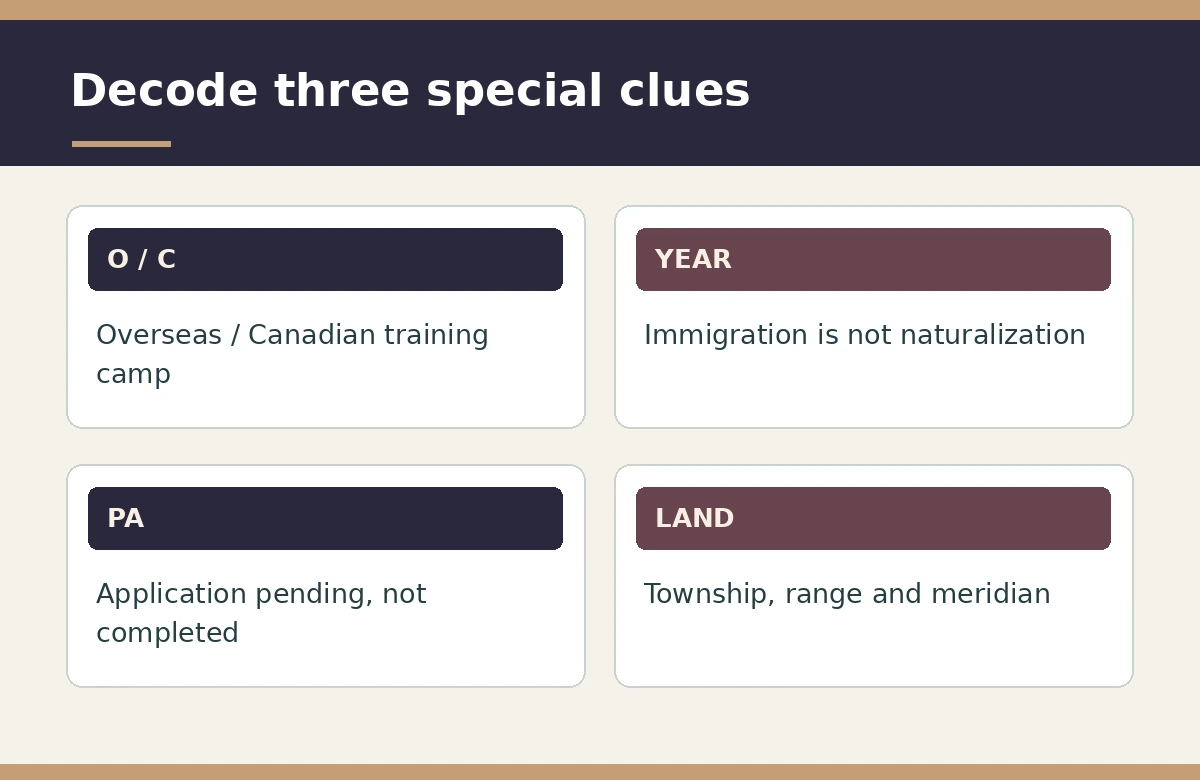
In rural settlements, columns 5–7 may give township, range and meridian; column 8 identifies the municipality or camp-related location where applicable. These grid coordinates are not street addresses. Capture each element, including the meridian, and use the LAC district and subdistrict list to place the household accurately. A township without its range or meridian can refer to many places, especially when the family used a farm name or post office as its usual address.
Search LAC by surname and broad province first, then vary spelling and place filters. If left-margin damage has removed a name, an indexed person may retain only age, birthplace or neighboring family details. LAC warns that some original paper records were destroyed after microfilming, so a missing name on the surviving scan cannot simply be recovered by consulting the destroyed original. Browse adjacent pages and log the affected district before treating a search as negative.

Interpret military-service codes without inventing a war record
The 1916 Population Schedule has a dedicated military-service column. LAC defines O for a person overseas and C for a person in a training camp in Canada, with camp detail in the municipality column. The enumerated family might include someone temporarily away for military service. The code can direct you toward attestation papers or a service file, but it is not itself the soldier’s rank, battalion, date of enlistment or combat history.
For a fictional example, a household entry marked O beside “Thomas L.” supplies a lead. Compare full name, age, birthplace and close relatives with the service file before asserting that it belongs to your target. Common names and inaccurate ages create competing candidates. A C code can suggest Canadian training rather than an overseas location; never substitute one for the other in a family narrative because it sounds more dramatic.
| Source or period | What it can show | What it cannot prove |
|---|---|---|
| Military O/C | Reported overseas or camp location | Not battalion or service duration |
| Immigration and pa | Reported year or pending application | Not arrival document or citizenship |
| Township–range–meridian | Rural place description | Not a deed or farm ownership |
Keep immigration and naturalization years as separate statements
Column 15 can report the year a person came to Canada; LAC notes that the instruction also covered Canadian-born returnees after residence elsewhere. Column 16 reports a naturalization year in the circumstances described by the enumerators, including the abbreviation pa when someone had applied but not completed the process. One is a migration statement and the other an administrative-status clue. Neither proves a ship name, crossing point or the existence of a particular certificate.
Treat nationality, recorded origin and language columns with special care. The original form reflects early-twentieth-century assumptions and sometimes discriminatory categories. Transcribe the historical wording when essential for an evidence argument, but do not assign those categories as a modern person’s identity or ancestry. Cross-check arrival dates with passenger or border-entry records and a reported legal status with the actual naturalization proceedings. Our guide “Canadian Border Entry Records, 1908–1935” shows how to find lists and Form 30 without false negatives.
Build an evidence ledger around household relationships and work
Column 9 describes relationship to the head; an entry for “son” is a reported household status rather than independent genetic or legal proof. The census also distinguishes chief occupation, employer versus worker or working on own account, and the kind of workplace. These fields can help select a directory, land record or trade source, but a single workplace answer does not establish an entire career. Read the full page and inspect everyone sharing the dwelling number before merging the people into a family tree.
Write a claim-level matrix with a row for each reported fact: location, relationship, military code, arrival year and work. For each, record an independent source that could confirm or contradict it. A land description may point to a homestead file; a marriage claim calls for a civil registration; a soldier’s O code suggests military personnel records. This prevents one rich census row from being misrepresented as five independent sources. To go further, our guide “1906 Alberta Census” shows how to read township, post office, and livestock clues.
Recover from damaged pages and cite the actual scanned image
If a surname query fails, browse the full district or subdistrict on the digitized microfilm and try both nearby families and location terms. A record with a sliced left margin can preserve enough details to identify a household provisionally, but uncertainty in the missing name must remain visible. Do not reconstruct a surname solely from a transcription or an adjoining index result without marking it as an inference. Keep the exact page identifier and a note about damage.
A useful citation names the 1916 Census of the Prairie Provinces, province, census district and subdistrict, household or page, image reference and repository. Your conclusion should specify what a person reportedly said or what the enumerator wrote, then the separate source used to verify it. The best next action is rarely another broad name search: it is usually a targeted service file, township land record or arrival document identified by a distinctive column.

How We Research 1916 Canadian Prairie Census Records
To prepare the 1916 Prairie field guide, we read Library and Archives Canada’s individual column definitions and geographic navigation guidance, then checked its note that the original named population form survives while separate agricultural schedules do not. We verified the meanings of O, C and pa against the official instructions, and kept these as reported contemporary categories rather than automatic evidence of overseas combat or legal citizenship. The hypothetical soldier demonstrates a verification decision, not a real personnel-file identification.
More Records and Archives Guides
Official repositories and primary collection guides for 1916 Prairie research
LAC documents the June 1, 1916 enumeration, the 26 columns and military O/C, naturalization and geography definitions (canada.ca).
LAC explains the distinct Prairie enumerations, surviving Population Schedule and archival limitations (canada.ca).
LAC explains geographical browsing and census record versus index interpretation (canada.ca).
This educational census analysis is not sponsored by an archive or subscription provider; see the GenHis affiliate disclosure for the site’s general policy. The 1916 form used racial, national and language labels reflecting its historical setting. We transcribe these only when relevant to a sourced claim and do not use them as present-day identities. Verify image availability, copying policies and access conditions directly with Library and Archives Canada.
Only Manitoba, Saskatchewan and Alberta.
LAC defines O as overseas service and C as a training camp in Canada; neither is a complete service record.
No individual original agricultural schedules from this Prairie enumeration survive; Schedule 1 Population remains.
No. The abbreviation marked an application stage, not completed naturalization.
Some digitized pages reflect cut-off margins in the earlier microfilm. Browse the district and compare independent sources.