
To find an old U.S. birth record, first determine where and approximately when the birth occurred. A statewide certificate, a county birth register, a town book, a religious register and a delayed registration are different sources with different creators and degrees of firsthand knowledge. There is no single federal index that guarantees coverage of all U.S. births. This guide offers a jurisdiction-first route and a clear fallback when civil registration did not exist locally, started late, or omitted the birth you seek. It applies to historical and deceased-person research; access to modern certificates may be restricted by law or policy.
Determine the event jurisdiction before choosing a database
Write down the proposed birth date range and the place as it existed at that time. A modern county name or state boundary may not describe the jurisdiction that maintained the original record. Find out whether births were recorded by a town, county, state or another civil office during the relevant period. The CDC’s “Where to Write for Vital Records” directory identifies current state and territorial contact routes; it is a starting point for current custody, not a guarantee of historical holdings. State archives, county offices and local historical societies may hold older series separately. If you want the full process, read how to find historical U.S. death records, notices, and dates.
NARA explains that ordinary U.S. vital records were typically produced by state and local agencies and are generally not held in the federal National Archives. That avoids a common dead end: asking a federal census repository for an early county birth certificate. Build a repository checklist with jurisdiction, registration date range, surviving series, index availability, original-image availability and any access restrictions. Verify these for the specific place; never carry a coverage date from one state into another state or assume that a “birth records” web heading means continuous statewide registration.
Choose the strongest birth source available for the period
A contemporaneous civil birth entry may provide the child’s name, date, place and parent names, but field sets and reporting practices differed. A baptismal register records a religious event that may mention birth details; the baptism date is not automatically the birth date. A delayed birth certificate may be created many years after the event based on affidavits and other evidence. FamilySearch’s published examples explicitly describe delayed registrations and the documentary evidence sometimes attached. Label each record by its creation date and purpose before using it to prove an earlier event.
Where no civil register exists, search relevant parish or synagogue registers, midwife records where they survive, family Bibles with traceable provenance, contemporary newspaper notices, school admissions and cemetery or probate material as appropriate. Treat each as a clue with different evidentiary weight. For example, an obituary written decades after birth may provide a precise birthday but still be less direct than an original birth register. Absence in one online collection may reflect unindexed images, records held elsewhere, incomplete registration or privacy restrictions—not necessarily an unrecorded birth.
Search names, parent combinations and unindexed images
Begin with the child’s known and variant names, place and a realistic date interval. If the likely parents are known from independent evidence, search their names separately or together; FamilySearch’s historical-record search guidance recommends varying parent fields and broadening restrictive searches. Infants may appear under unfamiliar spellings, initials or a parent surname that changed later. In some registers the mother’s maiden name appears; in others only a married name or no parent field is entered. Never fill a missing mother’s surname from a similarly named family without corroboration.
If an index returns a likely match, inspect the record image or seek a certified copy where appropriate. Note whether the displayed result represents a certificate, an index, a transcript or a user-supplied family tree. Browse neighboring pages of a register when online image sets permit it; the date order may reflect registration rather than event day. Index numbers often differ from image numbers. Record archive, volume, page, certificate or entry number and whether the image has annotations or corrections. If only a search result is visible, state the limitation in the research note.

Handle uncertain birth dates without inventing precision
An age from a census creates an approximate birth interval, not an exact birthday. Different records may report different places or years. Preserve a comparison table: original wording, document creation date, likely informant and reason for disagreement. A date on a modern gravestone may have been supplied by descendants; a delayed certificate may rest on testimony decades later. These are neither worthless nor automatically conclusive. Test whether separate documents truly have independent information sources rather than copying the same family story.
Use an entirely hypothetical case: a supposed birth about 1888 in a rural county, with only a 1900 census age and a later church register entry. Those two observations do not establish the existence of a civil birth certificate. Ask whether the county registered births in that period, whether the church’s entry is a baptism or birth, and whether the candidate parents fit other household evidence. If legal proof is needed for citizenship, benefits or another official purpose, follow the agency’s actual documentary requirements rather than treating a genealogy finding as an acceptable substitute.
Document custody, access limits and next actions
Keep two different targets visible: historical evidence of birth and an official contemporary certificate copy. A historical document may be online without being legally certified; a vital-record office may issue certificates only to eligible requesters. Do not publish certificates or identifying details about living people without permission. For each unsuccessful search, record the repository, year range, exact spelling options and why the absence has limited meaning. Follow up with the record custodian for the correct time period, and check whether records were transferred to a state archive or local library.
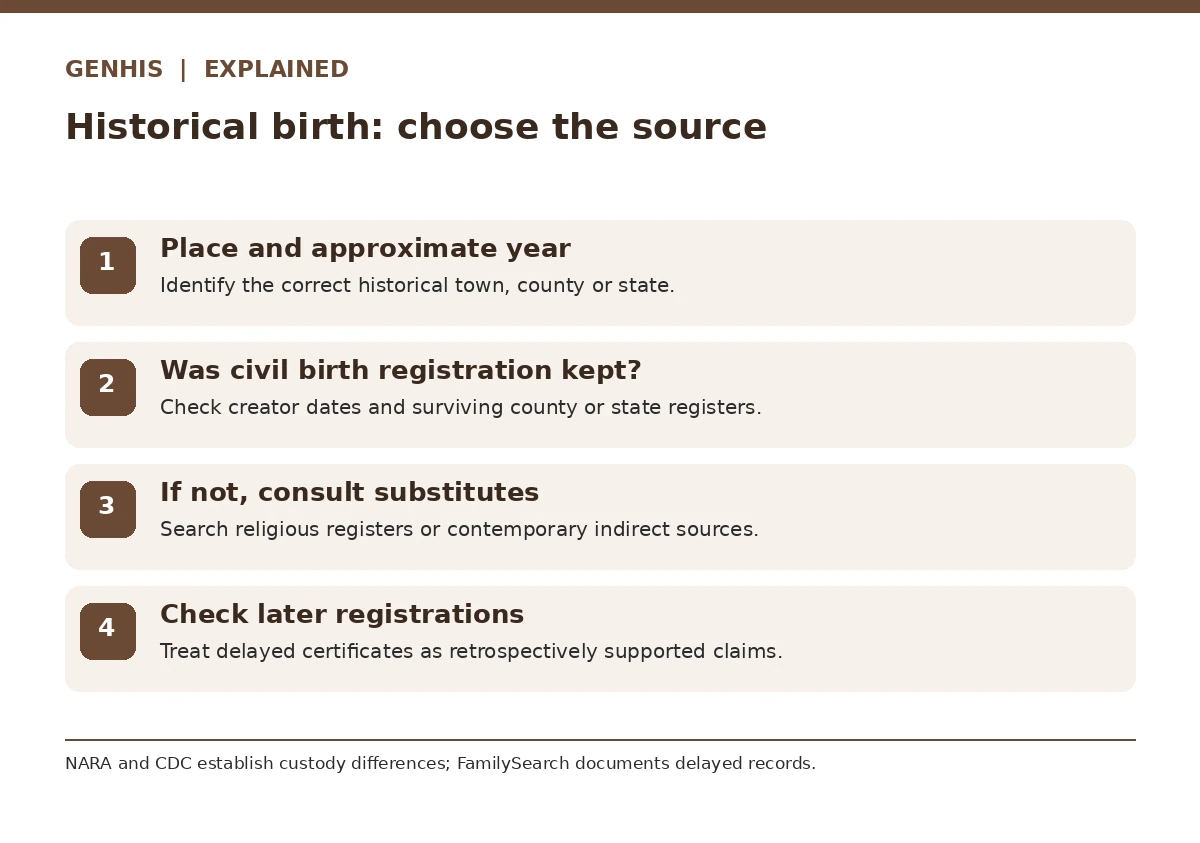
The core decision is straightforward: if civil registration is confirmed for the time and jurisdiction, search its original series and indexes; if not, investigate religious and other contemporaneous sources; if a later certificate exists, inspect the evidence it relied upon. Distinguish firsthand recorded observations from reconstructed claims. A sourced but unresolved birth interval is better genealogy than a made-up day and month. The intended output of this research is a traceable evidence trail, not a perfect-looking birth field in a family tree.

How We Research: custody and source-type checks
We used NARA’s vital-record jurisdiction statement, the CDC’s state contact directory, and FamilySearch’s instructions on historical birth search and delayed certificates. We checked their scope rather than assuming any one repository contains every historical birth. Hypothetical dates are illustrations, not discovered archival entries. Coverage, restrictions and fees must be verified at the specific local record office. See our affiliate disclosure; this educational guide does not promote an unverified record vendor or affiliate route.
More Records and Archives Guides
Official sources and record coverage notes
National Archives — Vital Records — Births, deaths and marriages are generally state/local documents, not federal NARA holdings.
CDC — Where to Write for Vital Records — State-by-state contact directory and federal limitations for certificates and index requests.
FamilySearch — Find Birth Records — Using child, parents, time range and birth/baptism filters for indexed records.
FamilySearch — Washington Birth Records — Specific example of a collection containing delayed registrations created after the birth.
Usually not. Most U.S. birth registrations were created by local or state agencies rather than the federal government.
No. A religious ceremony may happen after birth and must be identified as the event recorded.
It is a registration created after the birth and may rely on later affidavits or other documentary support.
No. Registration coverage, indexing, privacy access and record survival must be checked separately.
Eligibility and privacy restrictions vary by jurisdiction; follow the issuing authority and seek consent where appropriate.