
The first practical route is the Museums of History NSW online 1828 Census guide. It divides scans of the Alphabetical Return into surname ranges. Choose the correct band, then browse the photographed pages, because the archive makes the pages rather than a modern family tree the central source. Record the exact spelling, the nearby entries, the page and the archival series NRS-1272. A surname match is only a candidate; the 1828 colonial population included unrelated residents with similar names. Write down the person’s reported age, status, work, district, religion and arrival information where shown. Enter each datum exactly as it appears, including blank values and uncertain handwriting. Do not merge nearby same-surname lines into a single household solely because they sit together in an alphabetical sequence. The alphabetical arrangement is an index-friendly administrative compilation, not the original residential order.
Decode status abbreviations without inventing a life story
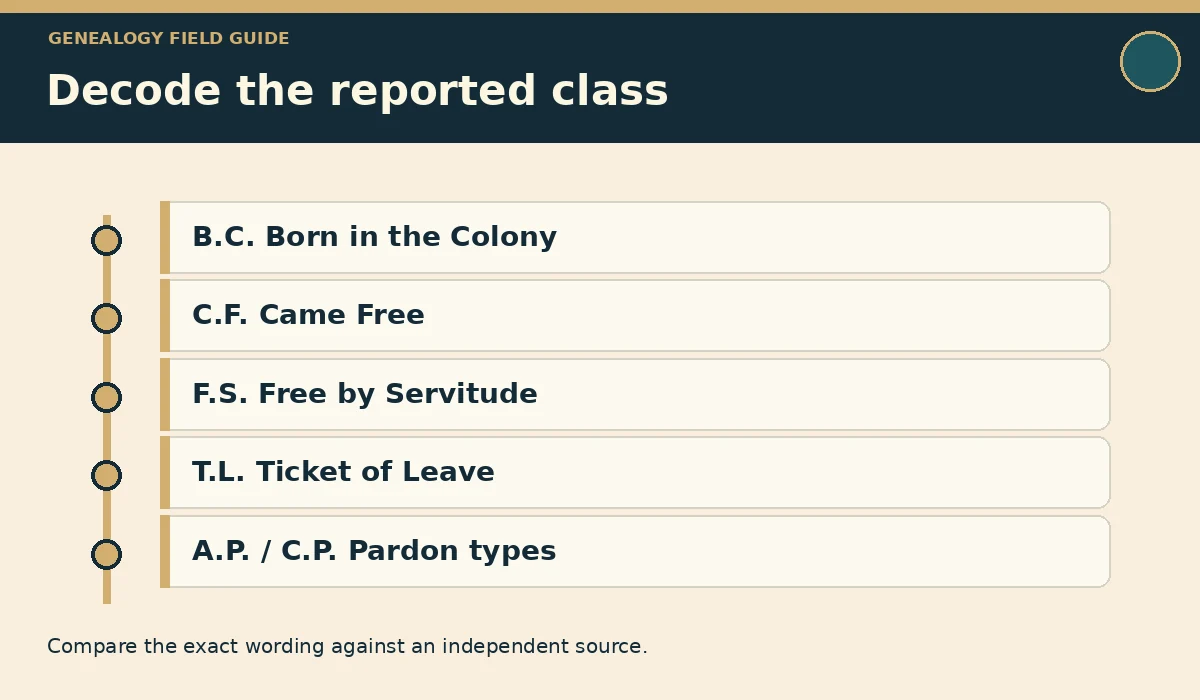
The archive supplies a list of common status abbreviations. B.C. means born in the colony; C.F. means came free; F.S. means free by servitude; A.P. and C.P. distinguish absolute and conditional pardons; T.L. indicates ticket of leave; G.S. designates a government or assigned servant. These labels describe a person’s reported legal position at the time of enumeration, not the entire history of arrival, punishment or employment.
An abbreviation is a precise research clue, not an invitation to create a biography. For instance, T.L. directs a search toward a ticket-of-leave series and a ship name, whereas B.C. suggests a local birth or baptism search. Transcribe ambiguous letters as uncertain instead of selecting the most dramatic status. Changes over time require records from separate dates, because a later certificate or pardon could supersede the census description.
Know the geographic and population boundaries
The archival guide states the census covered about 36,500 free and convict inhabitants in November 1828, including dependent settlements such as Moreton Bay and Norfolk Island. The colonial jurisdiction did not map neatly onto present-day Australian state boundaries. A location now in another jurisdiction must be understood according to its 1828 government administration before the right records can be chosen.
The enumeration was not a complete, representative listing of everyone living in the region. The Australian Memory of the World description notes exclusions including Aboriginal people and military personnel. A missing name therefore cannot support a confident claim that an individual did not live in the territory. If the target was attached to the military establishment or an Indigenous community, locate more appropriate contemporaneous sources and apply culturally responsible interpretation.

Compare NRS-1272 with the surviving householder forms
The alphabetical return has the archive identifier NRS-1272. The separate householders’ returns are NRS-1273, which survive for specified districts and can contain family members and servants on one form. Consult the NSW census and musters guide for its district-by-district list and the relevant microfilm or item details. Not every person in the alphabetical return will have a surviving matching household sheet.
A householder’s entry can suggest shared accommodation, employment or an enumerated family group. It does not independently prove biological relationships between every person recorded together. Match the householder name, district, approximate age and class with the alphabetic record; then transcribe each other named person without assigning a relationship that the form itself does not establish.
Use ship, sentence, work and acreage as separate clues
For someone described as having arrived from overseas, a ship name and year can point toward transportation or passenger evidence. For a colonial-born resident, the absence of a ship is not evidence of a lost voyage. Employment and land figures offer a different window into the 1828 economy: land cultivated, stock numbers or a named employer can distinguish people with matching names but do not establish legal ownership of a parcel. To go further, our guide “NSW Settlers’ Muster Book of 1800” shows how to read land, stock, and family clues.
Build a small evidence grid with source, wording, claim, confidence and independent check. An entry describing a farmer with acreage does not replace the original land grant, lease or deed. A reported employer does not establish kinship with a person at the same address. If two candidates remain plausible, keep separate research profiles rather than forcing them into one inherited family-tree identity.
| Research checkpoint | What to record | What it cannot establish |
|---|---|---|
| NRS-1272 | Exact source date and identifier | A surname hit alone is identity proof |
| NRS-1273 | Original wording and relevant jurisdiction | An administrative step is a final event |
| Independent corroboration | Person, place and dated comparison | Shared names automatically mean kinship |
| Access or coverage gap | Series/item and precise search attempt | No hit proves absence |
Test a fictional namesake across two districts
Imagine two fictional residents called James Carter, one recorded as free by servitude near Parramatta and the other as came free in a different district. A search engine may return both names with similar ages. Start two rows in the comparison sheet and copy each district, legal status, reported occupation and arrival detail. Do not assign a spouse or child to either until an independent event connects the correct person to that family.
Next compare an original marriage or baptism record, a convict certificate if relevant, and a land or employment record near the right date. If the ship and year disagree, record the disagreement rather than averaging ages or quietly dropping the poorer match. A sound conclusion might be “probable same person pending parish confirmation,” which is more valuable than an unsupported certainty.
Plan a fallback when the name is absent or illegible
Search variant spellings, old letter forms and likely aliases across adjacent pages. If the person is absent from the NRS-1272 band, check the whole relevant section and the archive’s guidance on householders’ returns before treating it as a negative result. There are separate colonial musters and later censuses, but they have different purposes and survival patterns; a result from 1825 or 1841 is not an alternative page from 1828.
Use the local history of the district to identify parish registers, court files, land and stock books or employment documents. Log the exact page range reviewed and why the selected series should have included the target. A name not found in an incomplete or excluded group provides weak negative evidence. A well-documented failure can still narrow the next source and prevent repeated surname-only searching.

Preserve a citation and a modest, defensible conclusion
For an alphabetical entry, save the series NRS-1272, exact page or image position, stated name, range browsed, archive name and access date. For a matching householders’ return, cite NRS-1273, district and available item or reel reference separately. An online transcription is a useful finding aid but should not be cited as if it were the photographed manuscript. For the next step, our guide “NSW District Constables’ Notebooks, 1822–1824” explains how to find houses and people.
Finish with three labeled statements: observed census wording, reasonable identity inference, and unresolved questions. If you have only a line in the alphabetical return, say exactly that. If a surviving district form supports co-residence, say it supports co-residence—not automatically parentage. Make the next search a record capable of resolving the biggest surviving contradiction. Our guide “New Zealand Freeholders Return, 1882” shows how to find owners and test land clues.
How We Research The 1828 NSW Census
We reviewed the repository descriptions and historical finding aids cited below on October 22, 2026, and compared the intended question with prior GenHis article topics. The example names and situations in this guide are fictional and do not reproduce original named people’s private records. Administrative sources can be incomplete or affected by access restrictions; we describe each reported field and date as applicable to its specific series, not as a universal guarantee. Check the current item-level catalogue, rights, fees and restrictions before requesting or publishing information.
More Records and Archives Guides
Original catalogues and archive guides for The 1828 NSW Census
Museums of History NSW: digitised NRS-1272 alphabetic returns, search bands, classifications and recorded fields (mhnsw.au).
NSW State Archives census and musters guide: NRS-1272, NRS-1273 surviving districts and differences from musters (mhnsw.au).
UNESCO Australian Memory of the World entry: scope of the historical census and constituent archival series (www.amw.org.au).
Editorial and affiliate disclosure: This independent educational article is not sponsored by the repositories listed here, and it includes no paid partner links. Verify original documents and respect any restrictions affecting living individuals, historical allegations or medical information. Read the GenHis affiliate disclosure for the site-wide commercial-link policy.
Museums of History NSW provides digitised alphabetical returns grouped into surname ranges for NRS-1272.
No. The surviving enumeration has known exclusions, including Indigenous peoples and the military establishment.
No. NRS-1273 preserves distinct district householder forms and has limited survival; NRS-1272 is the alphabetic compilation.
Ticket of leave, according to the NSW archive abbreviation guide. Confirm the individual in separate convict documents.
No. A householder form can include servants and other residents; use additional records to establish relationships.