
Begin With the 202 Northwest Color Slides
The National Archives identifies a distinct collection of 202 color slides in Record Group 35, series K. Wilfred J. Mead photographed Civilian Conservation Corps enrollee activities in Idaho, Oregon, and Washington in 1941. That precise combination of creator, region, format, and year is more useful than a broad search for CCC photographs. Begin with this series description, then seek a specific slide and its original caption. The catalog entry is not a list of every person in the photographs.
Treat 1941 as the date assigned to this collection, not automatically the day each scene was exposed. A color slide may illustrate tree planting, camp maintenance, roadwork, or daily life; the scene alone cannot establish a participant’s full assignment history. Copy any local identifier exactly and record whether a place, camp number, county, agency, or photographer credit comes from the archive record or from a later description. Keep those two kinds of annotation visibly separate.
First ask whether the research question concerns Idaho, Oregon, or Washington. If it concerns another state, the K slides should not be treated as a national survey. If the interest is an individual’s service record rather than an image, begin a separate personnel search. The distinction prevents a plausible Northwest landscape from becoming a claimed family connection. Similar uniforms, field equipment, and barracks appear at unrelated camps; matching visual style is not evidence of identical people.

Find the Camp Without Inventing a Crew Roster
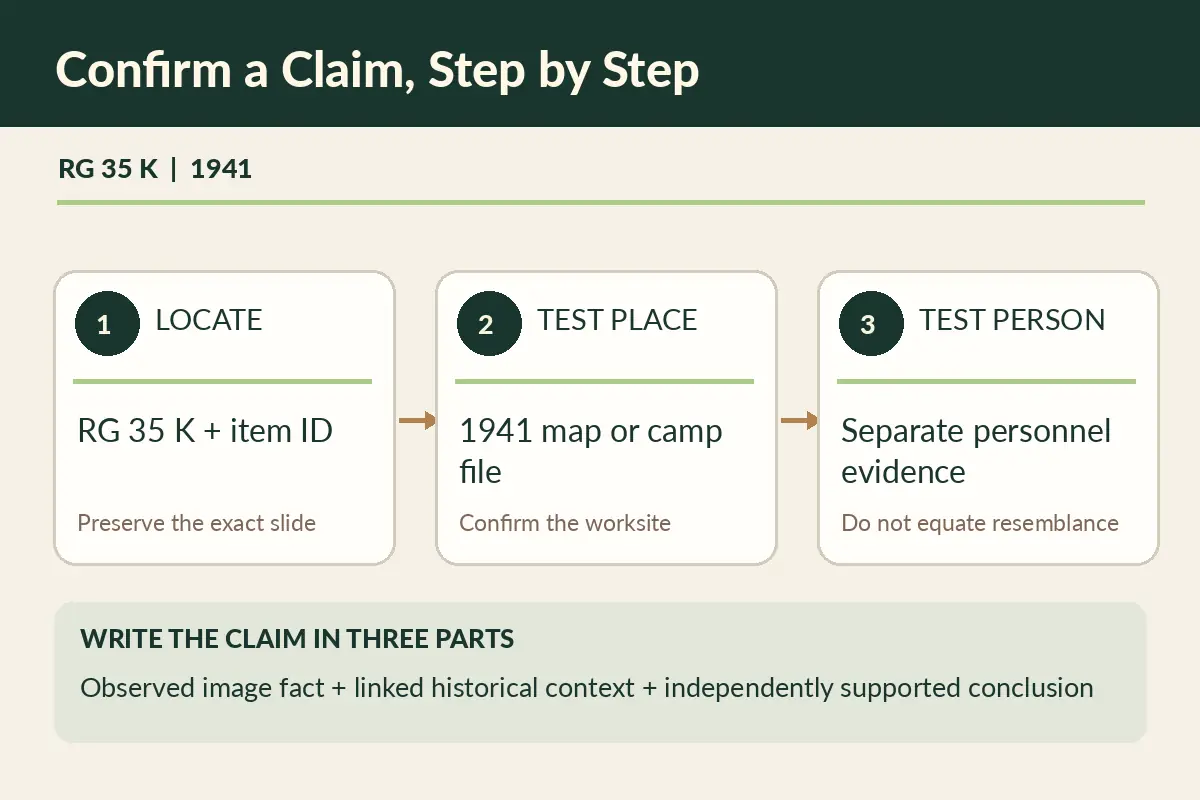
Build a slide ledger with six fields: original image identifier, exact caption, assigned date, state and place, observable activity, and confidence in the location. Add another field for a map or camp document consulted later. Captions that name a camp and those that only show a forest road have different evidentiary value. A camp identifier may be reused in modern online posts without its original context, so prioritize the archive’s own local identification when available.
To test a site, compare contour, stream alignment, road junctions, and vegetation with a map dated near 1941. County boundaries and park jurisdictions can have changed since the CCC period. Use a modern map for orientation, not as sole proof of a period location. If a slide shows a structure, do not assume it survives; track whether its footprint appears on a contemporary camp plan or historical aerial image. A resemblance between buildings is only a lead.
A CCC camp could include enrollees, military personnel, civilian supervisors, and visiting officials. A photograph showing a group of men is not proof that every person was an enrollee. Even a named individual in a caption needs evaluation: is the name attached to a particular figure, or merely to a camp? Make a two-column identity note separating the archivist’s description from the researcher’s hypothesis, then list what additional source would settle the question.

Distinguish Photographs From Service Documents
Personnel evidence requires a different route. Search an individual CCC record or comparable administrative record by a verified name, relevant date, and camp association, then compare details against independent family information. Avoid presenting an unsourced camp roster assembled online as if it were an original register. For Native participants, note that CCC–Indian Division records followed a separate administrative route; a photograph of a conservation project does not tell you which program administered an individual’s employment.
The National Archives’ photographic examples show why complete local identifiers matter: two images with similar subjects can belong to different series or work sites. Preserve the full citation for a slide rather than writing only “CCC, 1941.” If an online crop has removed signs or landscape context, seek the full frame. A handwritten caption copied from a family album may be valuable oral-history evidence, but it should not silently replace the archive’s title.
Create a source comparison before making a person-level claim: the RG 35 K slide establishes an image and a likely documented setting; a camp list may establish a company at a site; an individual personnel file may establish a person’s enrollment. The sources answer different questions and may not cover the same day. If the service file points to a different state in 1941, the similarity of a family photograph is not enough to override it.
Publish a Location Claim With Appropriate Limits
An accurate historical caption can be useful even if nobody is named. Write “CCC activity in a 1941 Northwest slide series, RG 35 K; particular camp still under investigation” when the item does not supply a definitive location. Do not write “Grandfather working at this camp” merely because the family story includes Northwest CCC service. It is better to preserve the open question than to introduce a durable error into a family history.
Consider how the slide was made. A staged demonstration, inspection visit, or publicity photograph might show an activity selected to represent the program rather than a complete record of daily work. The appearance of equipment does not prove that a specific project was finished, safe, or staffed continuously. The color medium is also subject to fading and later scanning changes. A color visible in a digital derivative should not be used as an exact period paint specification.
When requesting a higher-resolution file or asking a reference archivist a question, supply RG 35, series K, whatever item identifier you have, and the caption transcription. Describe uncertainty plainly. Ask whether an original mount or adjacent slides contain more information, not whether the archive can simply identify unnamed faces. Save the answer with your research notes, including the date and any archive-specific instructions for further inspection.
For published research, separate an observation from a conclusion: “The frame shows a roadway beside a CCC camp building” is an observation; “this is the camp where a named relative served” is a conclusion requiring independent evidence. Quote brief labels only where relevant and link to the official series guide. An original, accurately cited unresolved location can still help another researcher recognize a landmark without claiming to have proved a biography.
More Records and Archives Guides
How We Research This Evidence
For this guide we checked the exact record-group and series descriptions at NARA, then compared the related evidence in an independent official context source and the still-picture reference instructions. The archive listings support a series description, not an assertion that every image is digitized, fully captioned, or personally identified. Our approach records the verbatim item identifier, treats a later interpretation as a hypothesis, and requires a separate source for every claim about a particular person, place, date, or legal status. The review was completed November 15, 2026, and checked for topic overlap against the supplied WordPress inventory and recent GenHis batches. We add no unconfirmed commercial offers. For editorial relationships see the affiliate disclosure.
A distinct NARA color-slide series of 202 images by Wilfred J. Mead showing CCC activity in Idaho, Oregon, and Washington in 1941.
No. A series description and even a caption may omit individual names; an independent service record is needed.
No. The collection date does not substitute for an individual enrollment or discharge record.
Transcribe the complete slide caption and identifier, then test terrain, camp numbers, and period maps.
No. They can follow separate administrative record pathways and must not be conflated.