
The National Archives guide to Record Group 90, section 90.16, identifies nine posters, designated SP, concerning hookworm disease and the need for improved sanitation in 1920. These are public-health communication artifacts created or collected by the Public Health Service, not individual medical records. Their value for family and local history lies in what they reveal about the messaging of an era, the behavior officials wished to encourage and the visual language used to explain sanitation.
A researcher might recognize a poster illustration from a family scrapbook and assume that a relative suffered from hookworm or that the poster was displayed at a particular school. The archival guide supports neither claim. First identify the exact poster, date, slogan and provenance. A public warning can discuss a health risk without documenting infections in the community where a surviving print was found. Separate campaign content, actual distribution, medical diagnosis and household circumstances into different questions.
Identify the 1920 SP Poster Set Precisely

Begin with RG 90, section 90.16, the SP identifier and the nine posters dated 1920. The same photographic section describes a much larger general PHS photo collection, Civil War prints and a 1906 Central American port-health album. They are not components of the nine-item poster set. Search by “hookworm,” “sanitation,” “1920” and “SP,” but check the item’s actual title and date before writing a caption. Do not treat an undated internet reproduction as one of the nine without an archival connection.
A set described as nine posters need not represent nine distribution campaigns, nine locations or nine separate diseases. The inventory provides the subject and year but not the complete printed wording of each sheet. Read each original or faithful reproduction before asserting that it used a specific image, phrase or medical claim. Record whether an item is a design, proof, reprint or distributed original if that distinction can be established from its own descriptive evidence.
Read Visual Messages Without Adopting Their Assumptions

Transcribe slogans and visible explanations exactly, including historically specific terminology, then distinguish what the poster says from what modern medical or historical research establishes. Public-health graphics simplify complicated conditions to persuade a broad audience. A drawing of a rural house, an infected person or a sanitation practice may be symbolic. It is not proof that any pictured figure was a known patient or that a specific household followed the behavior being recommended.
Describe clothing, layout, typography and printed institutions as visual facts, but avoid diagnosing depicted people or presenting stigma as evidence. The intended audience may be inferred cautiously from language and distribution context, not automatically from an illustration’s style. If a family member recalled seeing such a poster at school, record the oral history as a separate source and test location and time against local public-health department or school records when available.
Differentiate Publicity From Disease Surveillance
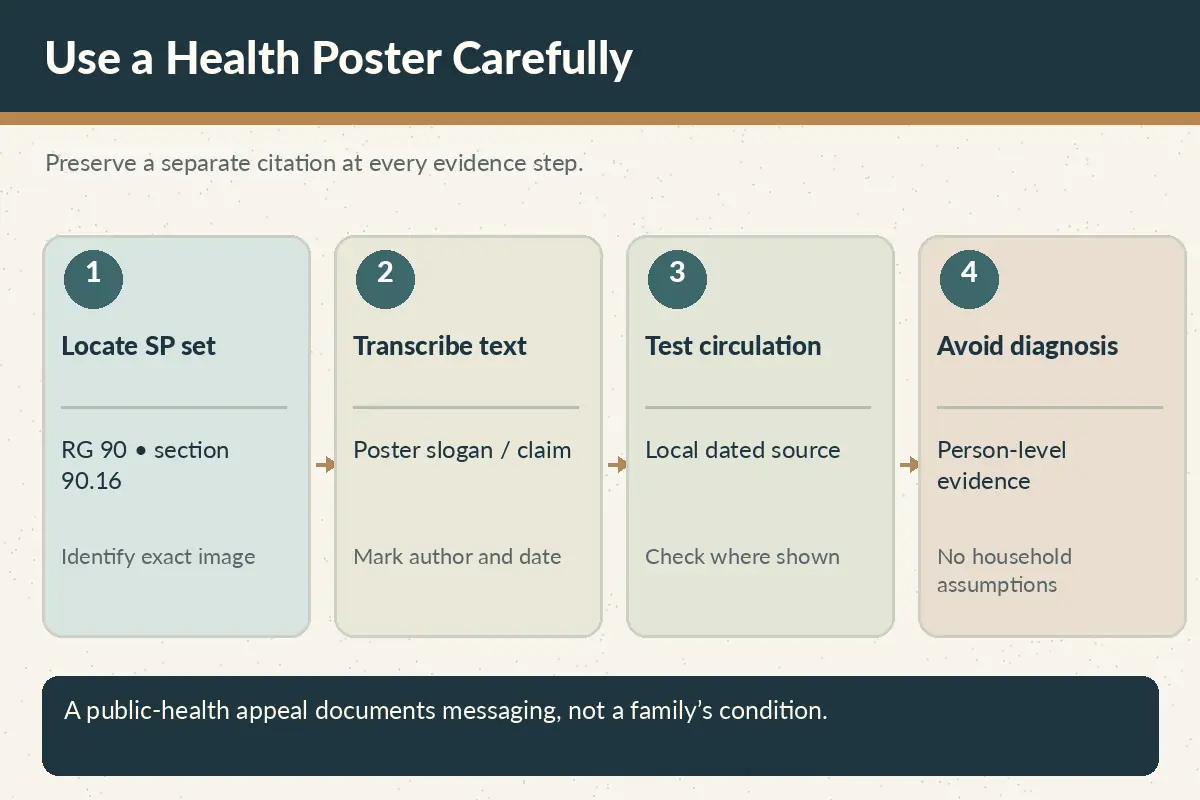
A poster can document public advice in 1920; it cannot report infection prevalence in a county, establish a named patient’s symptoms or prove the success of sanitation measures. Those questions require public-health reports, surveys or medical records created for different purposes. Even if a poster includes a numerical statement, cite it as the campaign’s assertion until you find the underlying study and its geography. Avoid converting a national message into a local epidemic narrative.
Do not conclude that the mere existence of hookworm posters meant a particular community was unusually affected. Conversely, a town with no surviving poster may still have participated in sanitation work. The archive contains selected surviving material, not a universal distribution list. If you find local health officer correspondence or a newspaper notice about an exhibition, use it to establish what happened in that town rather than treating the national image as direct local evidence.
Trace Distribution Separately From Production
Look for a printer credit, agency attribution, publication number or distribution notice on the physical sheet. Such markings may identify who made or sponsored the poster, but not necessarily where every copy was displayed. A file containing a retained specimen demonstrates preservation of that specimen; it does not confirm delivery to a classroom, clinic, workplace or household. When a family scrapbook has a similar image, compare text and formatting to determine whether it is the same edition.
For a place-specific conclusion, seek records of local health departments, school boards, charitable campaigns or contemporary newspapers. A dated request to obtain posters is not proof they arrived; a shipment receipt is stronger distribution evidence if authentic, but still does not prove public viewing or behavior change. Preserve each stage: design, printing, dispatch, receipt and display. Those stages are separate claims, not an automatic chain of events.
Find Poster Images and Record Their Provenance
Search the National Archives Catalog for RG 90, SP, hookworm and 1920, then open the precise still-picture description. If a digitized image appears, record its title, identifier and source context. A modern blog or museum image may be a later reproduction; inspect its credited repository and item number before linking it to NARA’s SP set. The guide does not promise that all nine posters have searchable text or image downloads.
If an item cannot be viewed online, NARA’s copying guidance explains how to ask about specific still-picture holdings. Supply RG 90, section 90.16, the SP designation and any poster title or item identifier found. Ask about reproduction availability and rights information rather than assuming public-domain status or inventing a high-resolution URL. Keep any image editing separate from the original evidence so printed words remain verifiable.
Connect a Public Campaign to a Family Story Responsibly
Use a three-layer evidence matrix: the national poster’s message, documented local availability and the family-specific fact to be established. If a household had a documented sanitation improvement, an independently dated building permit or home inspection might support that work, but the national poster alone does not explain the family’s motivation. If a relative later described illness, treat their testimony respectfully and avoid retrospective diagnosis from publicity imagery. Medical assertions need an appropriately specific source.
A careful caption might say that the Public Health Service retained nine hookworm and sanitation posters dated 1920, and that a particular design illustrates federal prevention messaging. If you can separately prove it appeared in a local newspaper or school program, cite that event in a second sentence. Avoid assigning blame for disease, describing a household as unsanitary or declaring a treatment successful without evidence. Historic public-health sources are informative when their persuasive purpose remains explicit.
More Research Method Guides
How We Research These Federal Holdings
Our starting authority is the National Archives RG guide, especially section 90.16, which supports the specific dates and record categories described above. We then use NARA’s Catalog instructions to distinguish record-group, series, file-unit and item descriptions, and consult its reproduction guidance if an item is not available online. The guide is an inventory, not a complete transcript, digitization guarantee, individual name index or certification of a family connection. Each statement about a named person needs independent support and a traceable document citation. The site’s affiliate disclosure explains our editorial and relationship policy; the public archive links here are not claimed as paid partnerships.
No. NARA describes public-health posters, not named case histories or clinical charts.
No. Distribution or local health conditions need separate place-specific evidence.
The RG 90 guide does not establish locations or totals of distribution.
No. Inspect the individual posters; the summary identifies their subject and date.
Use RG 90, section 90.16, SP, the individual poster title, 1920 and an actual item or image identifier.