
The National Archives guide to RG 90, section 90.14, identifies twelve reels of *Science of Life* programs about life science education and personal hygiene, dated 1924. The same guide lists a separate assortment of public-health films for 1938–1950. Those are not one uninterrupted film series. An educational film can document what its producer taught; it does not establish that a named household saw it, that a particular school used it or that anyone received treatment after a screening.
Start by locating the actual reel or verified film description and record its exact title, credited producer, date, duration and available content description. If the reel can be viewed, distinguish on-screen health statements from the narrator’s rhetoric and from later medical knowledge. A 1924 hygiene lesson is evidence of historical messaging, not necessarily a valid contemporary medical recommendation. For genealogy, the most useful next question may be where and how such materials circulated locally—not a guess about an ancestor’s personal health.
Keep the Twelve 1924 Reels Separate From Later Films

NARA presents the *Science of Life* programs as twelve reels in 1924, then describes additional public-health films with topics such as nursing, sanitation and communicable diseases in 1938–1950. A search hit for a later PHS documentary is not automatically part of *Science of Life*. Copy the series title and each independently documented reel title before labeling content. A combined search result might be a record-group landing page summarizing many unrelated productions rather than the individual item you need.
Create a film chronology with at least three dates: production, any later revision or redistribution, and a documented screening. The NARA inventory gives the first group date, not a complete exhibition calendar. If a copied digital film carries later captions, do not treat them as spoken words from 1924 without checking the source. Number of reels is not number of distinct audiences, schools or patients. Where a title remains unidentified, state that the relevant subject is listed at group level only.
Read the Historical Health Message as a Source
Describe the documentary’s actual instructions, illustrations and terminology using the original source and time period. A classroom depiction may demonstrate handwashing or family hygiene ideals, yet it cannot tell you whether a particular child or community followed them. Some early-twentieth-century health messaging may reflect social assumptions or discriminatory policies; analyze those claims critically rather than repeating them as modern guidance. Historical films are sources about institutions and public communication, not substitutes for up-to-date medical advice.
If a reel is visible, note timestamps for scenes that support your statements. Distinguish narrator claims, title cards, staged examples and actual documentary footage. A staged household on screen should not be identified as a real patient family unless an original credit provides evidence. When quoting period terminology, make attribution clear and keep excerpts brief. Where a reel’s content has not been accessed, use “NARA describes programs about” rather than reconstructing a fictional lesson or dialogue.
Find Evidence of a Real Screening

The gap between production and distribution is substantial. A film in federal custody may have been circulated, exhibited locally, stored or later copied. To prove that a particular school, civic group or community saw it, seek a dated screening program, school board minute, newspaper announcement, lending register or institutional report naming the title and venue. An official agency film list alone is not confirmation that it was shown in your town. If no screening document exists, the correct conclusion is that local exhibition remains unverified.
For named individuals, distinguish roles: producer, narrator, actor, agency official, teacher, patient and audience member. A name on an opening credit can establish participation in production, subject to checking the original, but not attendance at a hometown screening. If a school yearbook mentions a health-film day without a title, it may support the general practice while failing to identify a particular reel. Avoid bridging that gap merely because dates are close and the subject matter seems plausible.
Search Moving-Image Holdings Without Inventing Access
In the National Archives Catalog, combine “Science of Life,” 1924, RG 90 and motion pictures with any documented film title. Inspect catalog hierarchy, format, rights statements and reproduction notes. An online result may describe a series but omit the reel itself, and a clip on a video platform may be edited, misdated or taken from a different PHS production. Keep source labels alongside any excerpts and avoid promising downloadable copies when the NARA guide does not say so.
When an item is not viewable, document the archival question for the moving-image specialists: which reel, available format, reel number, item title and finding aid should be consulted? Ask whether a viewing copy exists rather than assuming preservation film can be directly handled. For family researchers, note when a local archive or newspaper may be the better source for exhibition evidence. A repository inventory can describe a federal production while local use remains undocumented at the federal level.
Build a Production–Screening–Audience Matrix
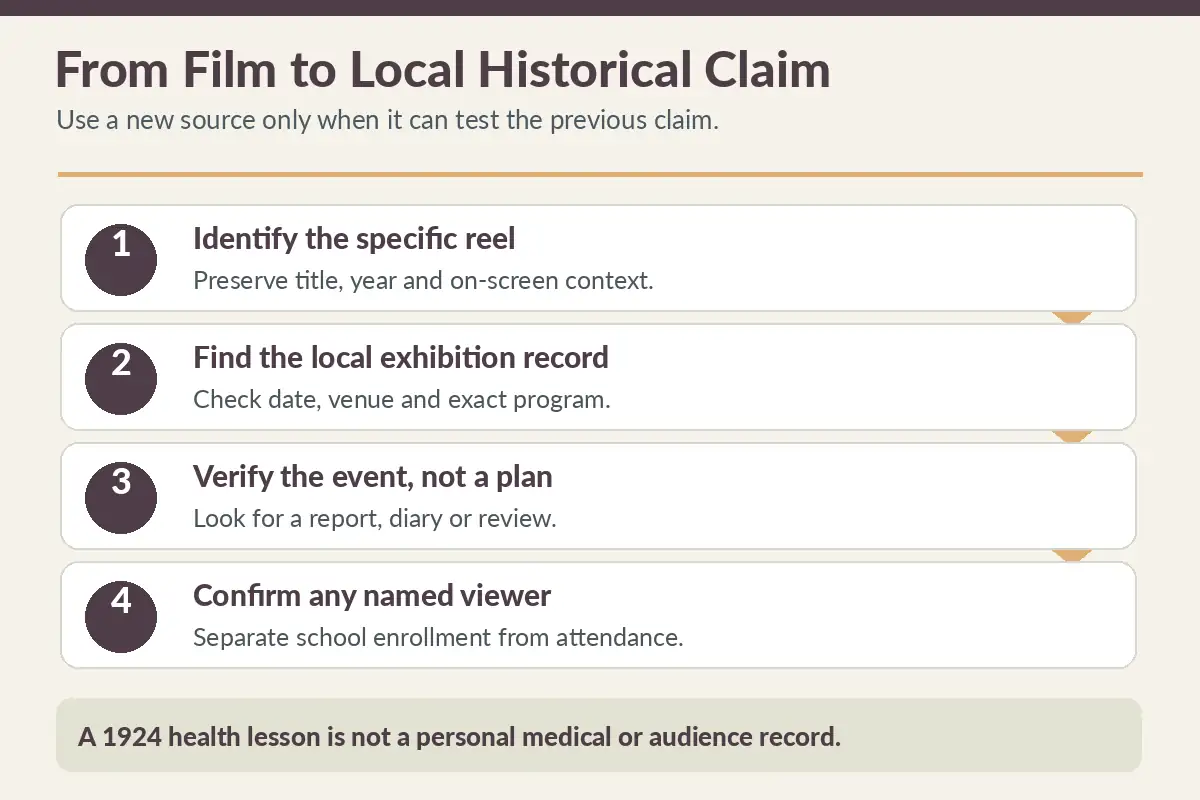
Use three columns for each claim: the federal reel establishes an educational production; a dated local record can establish a screening; a named attendance or firsthand account may establish a person’s presence. Do not treat an announcement as proof that the advertised event occurred without checking follow-up documentation. Even a confirmed showing does not prove that every child in a school was present. Phrase outcomes at the level of the actual document, such as “the school announced a screening” versus “the class attended.”
When researching changing public-health attitudes, compare a 1924 film statement with independent contemporaneous educational standards and later scientific revisions. Preserve the chronology: present-day guidelines should not be attributed backward to the Public Health Service. One reel might be sufficient to establish that a message existed; a claim that a campaign transformed community health would need statistics and a causal research design not supplied by an educational film. The point is to make small, testable historical claims rather than big speculative ones.
Worked Search: Did a School Show the Film in 1924?
Imagine that a local history says the community’s elementary school showed a federal hygiene film in autumn 1924. The NARA RG 90 inventory confirms that a group called *Science of Life* existed in that year, but not that the school borrowed it. Locate an exact reel title and compare it with any newspaper notice, school calendar or minutes from the named district. If the local notice simply says “a hygiene picture,” record the ambiguity rather than selecting the best-sounding reel.
If a dated program specifically names *Science of Life*, you may report that the showing was advertised or scheduled. Seek a review, diary or school report before stating that the showing actually occurred. A family member listed as enrolled at the school does not automatically become a confirmed viewer that day. Report the film’s national existence, the documentary evidence for the local event and any personal attendance record as distinct links in the evidence chain.
More Research Method Guides
How We Research and Verify the Archive
We read RG 90.14 in the NARA federal-records guide, verified the count of twelve 1924 *Science of Life* reels and separated them from the separately dated 1938–1950 PHS film programs. We have not viewed all twelve original moving-image items or verified a distribution schedule. Accordingly, this article does not invent individual titles, fictional scripts or an audience for any reel. The graphics distinguish source existence, screening evidence and personal attendance.
The NARA Catalog guide informs the item-level follow-up. Historical health advice requires period attribution and is not current medical guidance. No referral purchase is part of this research method; see the affiliate disclosure.
Twelve reels in the 1924 motion-picture grouping of RG 90.14.
NARA describes them separately; do not automatically merge the two groups.
No. Find a local screening program or other dated evidence.
No. It documents historical messaging; consult present-day sources for healthcare decisions.
Not on its own. A roster and a specific screening date are different records.