
RAIL 1157 contains the Tomlinson Collection, photographs and related materials used by W. W. Tomlinson in preparing and illustrating his history of the North Eastern Railway, published in 1914. The National Archives notes that many photographs are undated and represent subjects from the mid-nineteenth century to the First World War. A photograph’s appearance in that book gives a publication context, not its exact exposure date or the identity of anyone depicted. Start with the individual item, not the book date.
Identify the Original Item Behind a Printed Illustration
Treat a printed engraving, halftone, album print and modern scan as potentially different stages of the same image. The Tomlinson materials include photographs of stations, equipment, staff, locomotives and related industries, along with other objects such as tickets, medals and paintings. A caption in the 1914 history may help find a candidate item, but it is not automatically the caption written on an original photograph. Record the source format whenever it can be determined.
The National Archives photography guide lists RAIL 1157 as the Tomlinson Collection and says numerous photographs survive among papers. Its broad record span is not a date assigned to each individual view. Search for place names, station buildings, company terminology, rolling-stock types or a captioned event, then record the exact piece reference. If the catalog describes a file generally, inspecting the actual pages or photographic prints may be necessary to locate the right item.
Do not assume Tomlinson took the photographs. The material was assembled for a history, so collection creator, photographer, original owner, later compiler and publisher are roles that may involve different people. Preserve attribution only where the source supplies it. If a credit is absent, write “photograph reproduced in the Tomlinson Collection” rather than inventing a camera operator or a company commission.
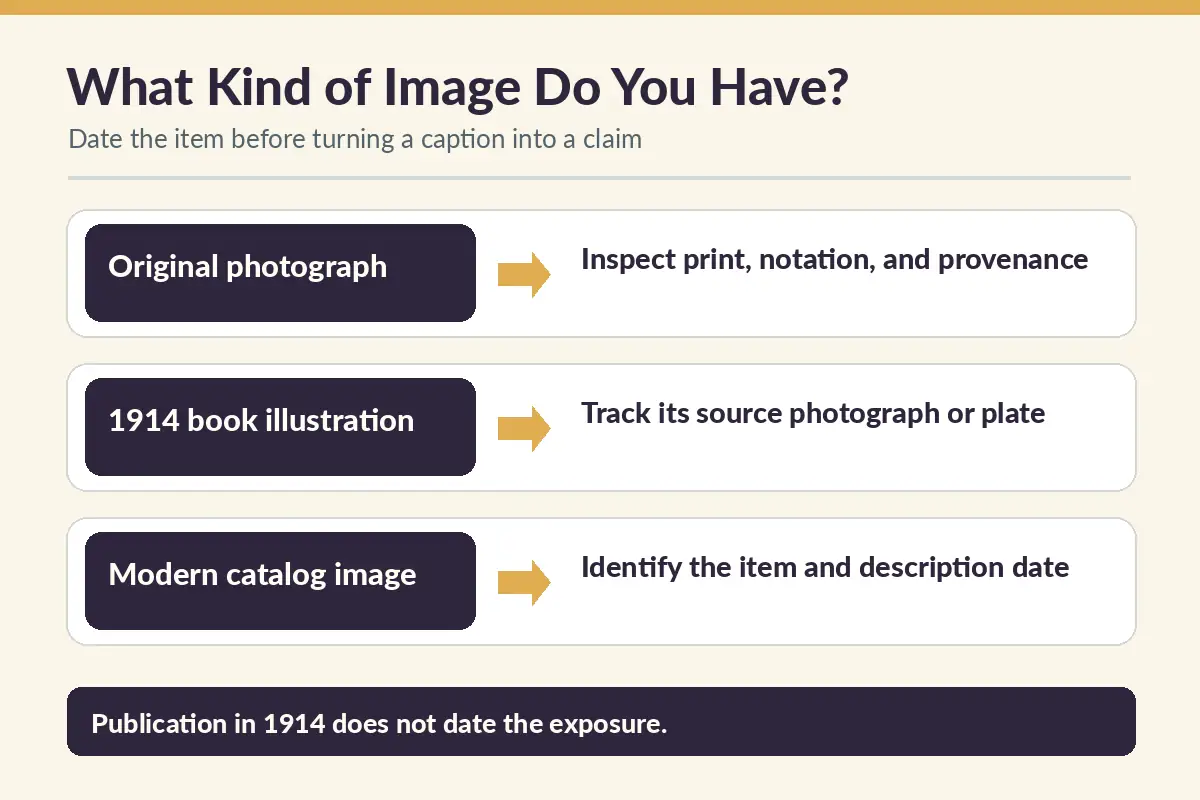
Separate Photograph Date From Book Publication
A 1914 book contains material created earlier. The same image can be printed years after a station opened or a locomotive was withdrawn, and the history might illustrate a building in an earlier state. Record at least three dates: any documented photograph date, date of the event or object shown, and date of the printed publication. If one is unknown, do not substitute another. Dates added by a later archivist should be described as catalog metadata, not necessarily original evidence.
Use physical clues carefully. A locomotive’s number, a station name board, company livery or a visible building alteration may establish a possible time window. The clues need independent dated records, and a locomotive can be renumbered or repainted. Film and print process may indicate a broad period but rarely a precise year. Do not read small lettering from a damaged scan with false certainty; confirm it from a better copy or mark the transcription uncertain.
A negative number, publisher credit or caption change can link two reproductions, but it may also reveal retouching, reversing or cropping. Compare margins, track geometry, window arrangements and defects in the print. Save the earliest documented version and document why two images appear to be the same exposure. A match in subject matter alone, such as two trains at the same platform, is insufficient to merge them.

Read Workers and Buildings Without Imagined Biographies
The collection includes pictures of staff and workplaces, yet a group photograph does not act as a staff register. An individual in a uniform may be an employee, a visitor or a contractor. Even when a caption gives a group name, check whether that name describes the workplace or the people. Use dated employment records, newspaper identifications or a reliably labeled photograph from another source before naming a specific worker.
Location has similar limits. A photograph of a station proves that the camera depicted some version of that station, subject to correct attribution. It does not prove a particular person traveled through it or lived nearby. Compare building outlines with dated plans, railway maps, directories and company records. When a station was rebuilt, an old photograph may be the best proof of an earlier appearance but not of which replacement work had already been authorized.
If you are researching a family member said to have worked on the North Eastern Railway, assemble a candidate table with independently verified name, role, date and location. Then test any proposed identification against a contemporary caption or employee record. Present unverified identifications as questions for further research, not captions that readers may later copy as facts.
Compare Catalog Descriptions With the Original Image
The National Archives explains that its Discovery catalog is built from descriptions; it generally cannot search text inside an undigitized photograph or a pasted album caption. A person not appearing in a keyword search therefore tells you little about whether their likeness could occur in the collection. Browse at the file or piece level and use geography, object type and relevant date ranges to reduce the search area.
For each candidate, record what you saw and the medium: original photographic print, reproduction, printed plate or catalog thumbnail. A catalog title may have been assigned by an archivist; quotes should indicate whether a phrase is an original inscription or a later description. Reproduce the precise reference if a copy is available, plus page or image position so another researcher can find the same scene.
Keep a two-column source note for “visible in the image” and “reported by the caption.” A painted station sign might be visible; the year may come only from a modern description. These observations have different credibility and can be contradicted separately. This distinction makes your work durable when a high-resolution copy or new identification later becomes available.

Make a Defensible Railway Image Citation
A useful citation includes The National Archives, RAIL 1157, complete piece and item locator if available, observed caption, type of image, and how it was accessed. When referring to the 1914 illustrated history, cite its page or plate separately. That way a future reader can distinguish an archival item from an interpretation or a published reproduction. Neither one should be represented as a newly discovered personal photograph without evidence.
Archival photographs may have reproduction conditions or rights beyond simple possession of a digital copy. Verify applicable permission for publication; a research sketch that records visual relationships can be more appropriate for an educational workflow than distributing a potentially protected scan. Take care not to turn a stylized reconstruction into a supposedly authentic historic image.
A sound conclusion might say that a pictured locomotive design is consistent with a documented operating period and that a Tomlinson photograph illustrates a particular station before rebuilding. It should not say that the driver was a named ancestor unless a reliable independent source establishes that identity. Preserve both the attractive image and the evidence needed to understand it.
More Family Story and Preservation Guides
How We Research This Record Series
We checked The National Archives’ official subject guide for the series name, stated range and record type, and its Discovery research guidance for catalog-search and access limits on November 8, 2026. Our process separates the catalog’s claim, the content of a particular original and any inference requiring another source. We have not treated a suggested example as proof that a named person, ship or building can be found in a given piece.
For every cited item, our audit stores the full reference, the precise wording used by the source, the date of the underlying event and the date the document was produced. We record the scope of missing or unexamined material and compare competing interpretations. Our affiliate disclosure explains editorial and commercial relationships; the links in this guide are informational, not evidence of an affiliate partnership.
No. The 1914 date belongs to Tomlinson’s published history; most images were made earlier and many lack precise dates.
The collection was assembled for his work. Authorship of any individual photograph requires separate attribution.
Not without a trustworthy identification and independent evidence linking the person to the railway at the relevant time.
Discovery searches catalog descriptions; inscriptions and unidentified faces within images are not necessarily indexed.
Use the exact RAIL 1157 reference and the item, caption, medium, access method, and any separately cited printed plate.