
CUST 10 contains British customs export ledgers for foreign and colonial merchandise, broadly 1809–1899, organized by destination country. The tables can show quantities, values and—in some earlier columns—whether merchandise moved on British or foreign ships. They are aggregate trade statistics, not individual bills of lading. Use them to test a destination-and-commodity pattern, not to conclude that a named ancestor shipped or purchased the goods.
Distinguish Re-Exports From British Goods
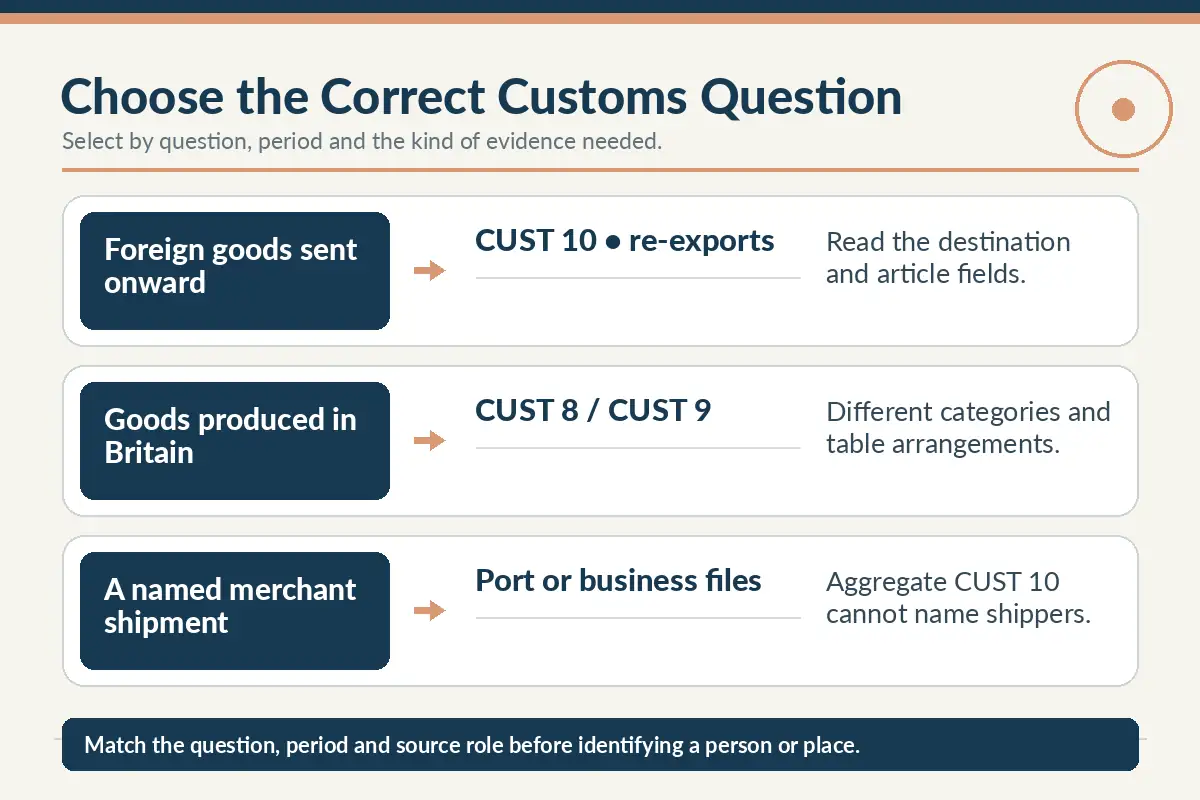
Begin with the merchandise category. The National Archives describes CUST 10 as exports of foreign and colonial merchandise under countries, a different question from exports of British-manufactured goods. A shipment of imported sugar later sent abroad and a shipment of British-produced textiles might appear in different statistical series. Mixing them makes a trade trend misleading before any calculation begins. Define the historical commodity wording found in the ledger instead of silently replacing it with a modern tariff category.
Write a question with a year, the recorded destination and the commercial category. For example, “What quantity and stated value of an identified re-exported item was recorded for one destination in this ledger year?” is testable. “Did my great-grandfather export this product?” is not answered by an aggregate table without separate business or ship evidence. Build the extraction sheet before opening the digital volume to keep the columns intact.
The series spans much of the nineteenth century, but changes in customs practice and reporting can make columns different from one edition to another. Do not assume a statistic from 1815 has exactly the same definition as a statistic from 1885. Read the printed notes and headings on each original volume and record any change in units, territory or classification. A year in a catalogue description is a place to start, not a warrant to reproduce every figure without looking at the ledger.
Select Destination, Year, and Original Piece
The National Archives includes CUST 10 among records available as digital microfilm. Such material is often browsed page by page rather than searched as names within full-text documents. Select the year at series and piece level; preserve the complete CUST 10 reference and locate the printed country heading in the actual scan. Do not rely on a modern automated search snippet that may be unable to read column labels or page footnotes.
Map historical destinations carefully. A country heading may reflect contemporary political or colonial administration, not today’s sovereign borders. If a destination changed name or status, quote the ledger heading verbatim and explain the modern identification separately. A country total should not be silently divided into today’s provinces or ports. Where a question concerns one harbor, check port records or shipping documents instead of assuming the country total came through that port.
When copying a statistic, capture four linked elements: ledger year, country column or section, exact commodity heading and the unit plus value definition. Photograph or screenshot the full header and relevant row, with appropriate rights and a complete citation. A table that retains only the number cannot be reproduced or audited and might confuse pounds as weight with pounds sterling as money. Keep blank cells and notes rather than replacing them with zeros.

Read Quantity, Value, and Vessel Categories
The official CUST 10 summary says the ledgers list the quantity and value of articles shipped to various countries. The meaning of a value column must be determined from the original heading: it may reflect an official valuation or another administrative convention. State the unit and any valuation explanation before comparing across years. A multiplication that produces a plausible number cannot correct a misread heading.
The same archival description indicates that, until about 1870, ledgers can also distinguish shipment in British versus foreign ships. This is a statistical classification of transport, not a passenger or crew list. A reported quantity in British shipping cannot identify a named captain. It also does not show where goods were made, who financed their purchase or which named merchant made a profit. Separate the movement category from the individual’s history.
If figures are copied from two or more years, normalize only what is explicitly comparable. Record whether the commodity description changes, whether the geographic heading is stable and whether the table uses the same units. If the answer changes because of a documented administrative revision, report the revision rather than inventing a sudden economic event. A carefully annotated two-year comparison is more informative than an unsupported graph extending across the entire century.

Build a Merchant Claim From Independent Evidence
A family letter may mention selling produce overseas, while a business directory places a merchant near a port. Neither can be tied to a CUST 10 destination total without a narrower transaction record. Look for shipping manifests, customs entry books, cargo notices in newspapers, firm correspondence, account books or port authority papers, depending on period and locality. Some are privately held and may never have survived. This survival limit is an ordinary archival constraint, not evidence that trade did not occur.
Create a two-level evidence ledger. The upper level contains the published aggregate claim: the table, date, commodity, destination, quantity and value. The lower level contains transaction-specific sources: a named exporter, ship, consignor, commodity, port and date. Allow the two levels to support each other only when compatible facts actually connect them. Shared words such as “tea” or “Jamaica” are not a sufficient identity match.
A sound conclusion is: “A CUST 10 ledger reports an export statistic for this foreign or colonial commodity to the listed country in the specified year. No identified shipment connects the statistic with the proposed merchant.” This gives descendants historical context while protecting the distinction between a broad economic system and one family’s documented activity. It also tells the next reader exactly what private or local record would change the answer.
More Records and Archives Guides
How We Research Historic Customs Ledgers
The official digital microfilm guide supplies the precise CUST 10 description and its export fields, including the earlier British-versus-foreign ship distinction. We use Discovery search instructions for locating original pieces and historic-map guidance when country names have shifted.
The commercial ledger artwork is an original teaching illustration, not a reproduction or invented numerical transcript. We deliberately give no real totals without reading a specified original piece. Our affiliate disclosure describes the site’s editorial arrangements.
Exports of foreign and colonial merchandise under destination countries, with quantities and values, across the series dated broadly 1809–1899.
No. Its principal category is foreign and colonial merchandise. British-origin exports are a different statistical question and require appropriate series.
Not from the destination-led aggregate figures alone. Seek a separate transaction-specific source with a name, date, ship or firm.
The National Archives notes this distinction in earlier CUST 10 reporting up to around 1870; it counts vessel categories, not identified crews.
Only after checking that the commodity heading, unit, valuation practice and destination definition remain comparable.