
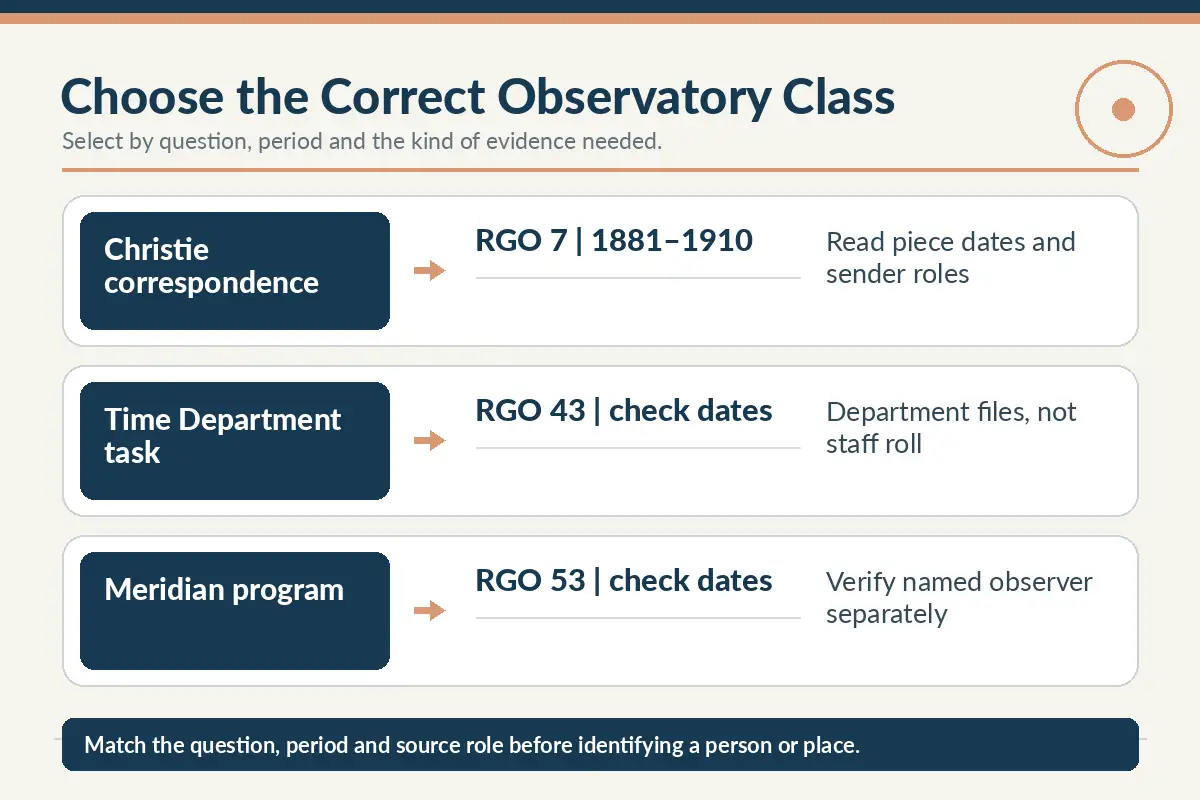
RGO 7 is the Cambridge University Library class for papers of William Christie, Astronomer Royal from 1881 to 1910. It is a source for observatory correspondence and administration, not a complete employment roll. Search a named task, instrument, correspondent or period, record an exact RGO 7 piece, and then decide whether later departmental papers are better suited to the question. A person appearing in a letter is not necessarily an employed observer, assistant or resident of the Greenwich site.
Place RGO 7 in the Observatory Archive
Cambridge University Library holds the historical paper archives of the Royal Observatory, Greenwich. Its public guide identifies the earliest RGO classes largely by the tenure of individual Astronomers Royal: George Airy in RGO 6 for 1835–1881, William Christie in RGO 7 for 1881–1910, and other classes for subsequent directors. These ranges describe the organizing periods of the archive. Individual documents or later annotations may fall outside the neat dates printed in a class title.
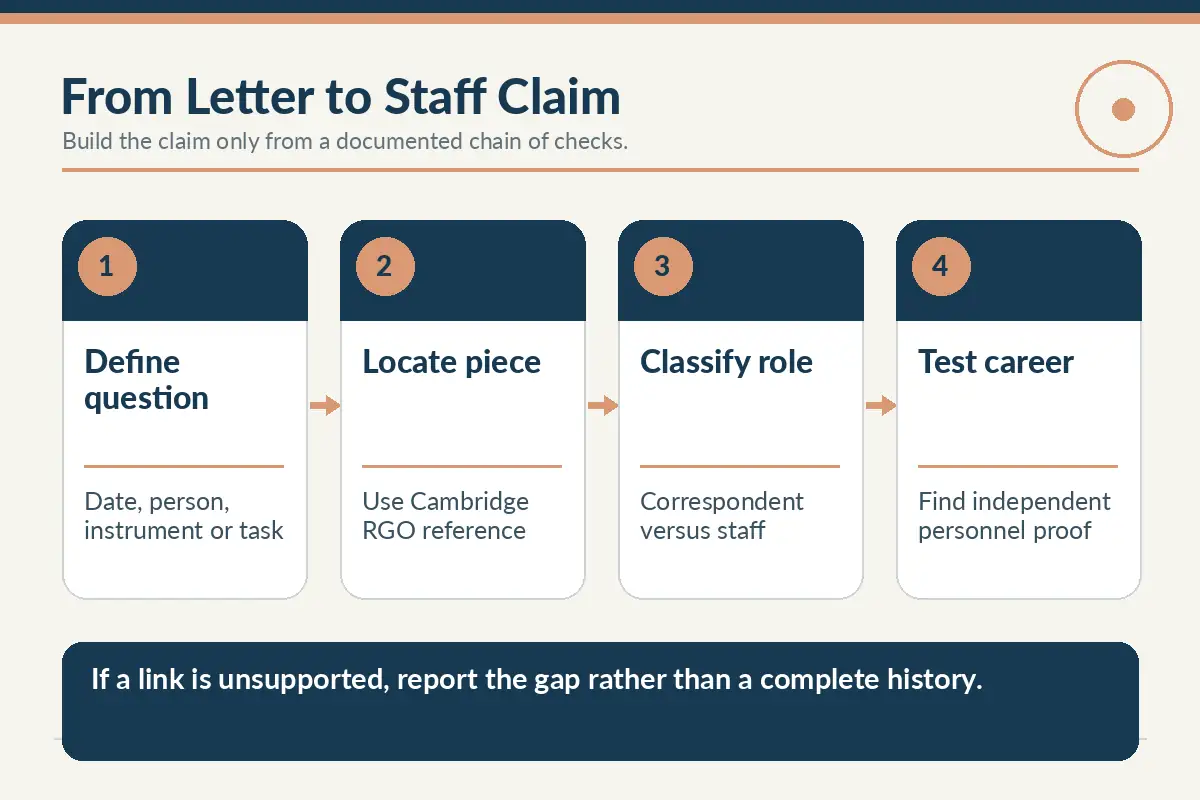
Start by recording the question in plain terms. Are you looking for an observation made on one date, an instrument acquired for the observatory, a letter sent to Christie, or a person said to have been on the scientific staff? Search each issue differently. A published observation table could record scientific results without identifying who took a reading. A letter signed by an outside scientist can establish correspondence but not an employment relationship. A residence in Greenwich alone says nothing about observatory work.
Cambridge explains that powerful new instruments and expanding departments made the observatory’s records more fragmented during Christie’s tenure. Earlier Astronomer Royal papers may encompass much of the institutional business; later RGO classes cannot be treated as one complete central office file. If the name search in RGO 7 fails, a relevant departmental class may still exist. Cite which catalogue or original page you actually consulted before concluding that a person or instrument is absent.
Distinguish Correspondence From Observatory Employment
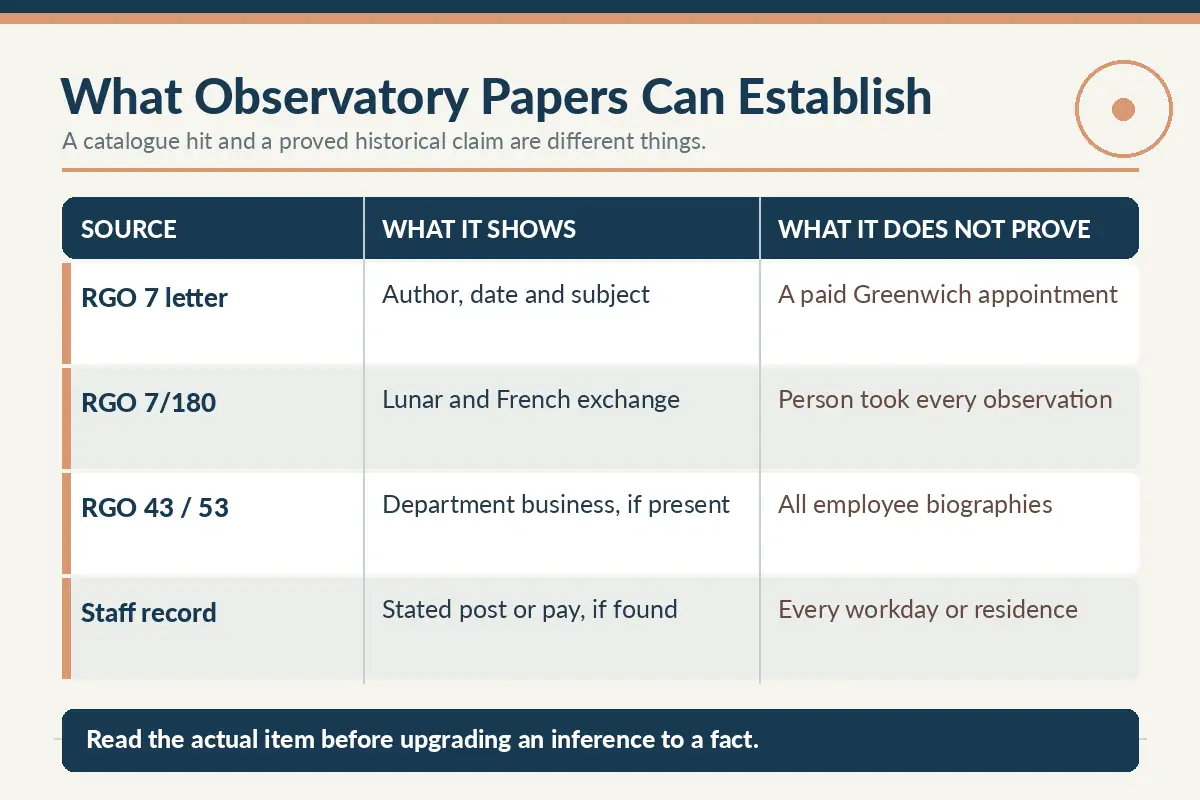
A strong first example is the Cambridge French-manuscripts guide, which identifies RGO 7/180 as holding material on errors of the Moon and correspondence involving the Bureau des longitudes and the French Army Geodetic Service. Its examples show that an RGO 7 piece can document a scientific exchange across institutions. The dates specified in those piece descriptions include 1907–1911, reminding the reader that items need not stop exactly at the nominal 1910 class boundary.
RGO 7/224 is also listed by Cambridge for correspondence with scientific societies, including the Bureau des longitudes and other French-language institutions. If researching a named correspondent, copy the sender, addressee, letter date, precise document reference and the capacity in which the individual signed. The exchange might concern an observation, instrument, correction or institutional obligation. It does not, without further documentation, establish that the correspondent was salaried by Greenwich.
To test a proposed staff career, create a separate row for appointment or engagement, work performed and salary or service duration. An official appointment list, a dated personnel file, payroll or other independent administrative source can substantiate one of those rows. Even a signed observatory memorandum proves that its author produced that memorandum; whether the author held a particular post depends on what the document actually says and on any corroboration. Avoid reconstructing a full career from repeated correspondence alone.
Use Departmental Classes Only When They Fit
The Cambridge archive guide identifies examples of specialized classes, including RGO 43 for the Time Department and RGO 53 for the Meridian Department, along with solar, chronometer and engineering material under other codes. These are not replacement names for RGO 7. They represent different creators or functions, many of them twentieth-century. Choose a class from the described subject of the question rather than assuming the next RGO number is the next year of a continuous series.
Suppose a family letter says an ancestor adjusted clocks at the observatory in 1905. That date is within Christie’s tenure, so RGO 7 might provide relevant administrative context; however, a timekeeping assignment could be documented in a Time Department class or records outside Cambridge. Verify the dating and provenance of any departmental file before searching. An instrument location or departmental budget does not itself prove that a named employee operated the clock.
Likewise, a reference to an astronomical photograph should not lead to the assumption that the photograph itself is deposited in the same paper archive. Cambridge explicitly notes that some observations created on glass plates or machine-readable media are not held in the University Library. Keep the record medium and the repository separate. A catalogue reference for paper correspondence can point toward a photographic or observational problem without supplying the original data from that observation.
Check Evidence, Custody and Access Conditions
An RGO catalogue description may identify a piece without providing a full digital facsimile. Cambridge says the archives are available to consult in its Special Collections Reading Room, with selected material digitized in Cambridge Digital Library. Confirm current access rules and whether the requested piece needs advance notice. Do not cite a digitized image as though you reviewed it merely because a catalogue offers a link. Conversely, limited online discovery does not imply that no paper record survives.
Separate the created date of the document from dates of later cataloguing or storage. A file may contain older enclosures copied for later discussion. Transcribe historical titles and personal names exactly, then explain them in modern, readable language. If two staff members have similar initials, resist merging them without a document that supplies full names and dates. A single initials-only reference is insufficient to connect someone to your family tree.
A practical evidence sheet has fields for proposition, archival repository, class and piece, creator, form, document date, named role and uncertainty. For instance, “Christie corresponded with a French institution in a certain year” may be documentable; “my great-grandfather observed the same event from Greenwich” remains unsupported unless a person-level source says so. This approach turns an evocative scientific record into careful family and workplace history.
More Records and Archives Guides
How We Research Astronomer Royal Papers
Our scope comes from Cambridge University Library’s Royal Greenwich Observatory guide. Cambridge’s French scientific-manuscripts guide provides RGO 7/180 and RGO 7/224 examples. The university research guide corroborates the custodian and specialized collection context. We do not infer a complete staff list from a departmental document.
Illustrations here are original explanatory drawings rather than reproductions of observatory documents or glass plates. We identify the scope of each archive class and distinguish named correspondents from documented employment. See the site’s affiliate disclosure.
Cambridge University Library designates RGO 7 as the papers of William Christie, Astronomer Royal, associated with 1881–1910.
No. Many individuals can be external correspondents, observers, suppliers or institutional representatives.
The class title gives an organizational period, while individual descriptions can include later correspondence or enclosures.
Cambridge identifies specialized Time Department RGO 43 and Meridian Department RGO 53 classes; check their individual dates and scope.
No. Cambridge notes that nonpaper observational records such as glass plates are not necessarily held in its paper archive.