
LAB 20 contains Ministry of Labour files on disabled persons, with relevant records spanning 1919–1978 according to The National Archives’ disability-history guide. These are records for studying administration and policy, not a complete index of individual workers with disabilities. A scheme mentioned in a policy file is evidence that officials discussed or administered it; the existence of that scheme does not prove a particular relative was accepted for training, placed in employment or paid by an employer.
Start With the Employment Question, Not a Diagnosis
First state what you need to know. Was a workplace adapted, was a government training scheme offered, did a named person receive help after an injury, or did a family member work for a particular employer? An official policy file may be strong evidence for how a scheme was designed and weak evidence for whether a single person participated. Keep the question distinct from family assumptions about medical diagnosis, impairment or legal eligibility.
The National Archives identifies Ministry of Labour files relating to disabled people in LAB 20 for 1919–1978. The dates describe surviving subject material, not complete, continuous coverage or a guarantee that an individual’s name appears. Search by older departmental terminology found in period descriptions, but use respectful contemporary wording in the conclusion. Historic classification terms can reflect administrative assumptions, not the person’s own identity or experience.
In Discovery, restrict the search to LAB 20 and combine a locality, employer, scheme, organization or policy phrase with a likely period. If a surname produces no result, do not conclude that person never worked. The catalogue often gives file titles rather than a name index to correspondence inside. Record the exact piece reference, stated creation dates, any access restrictions, and the original file title before making a claim.
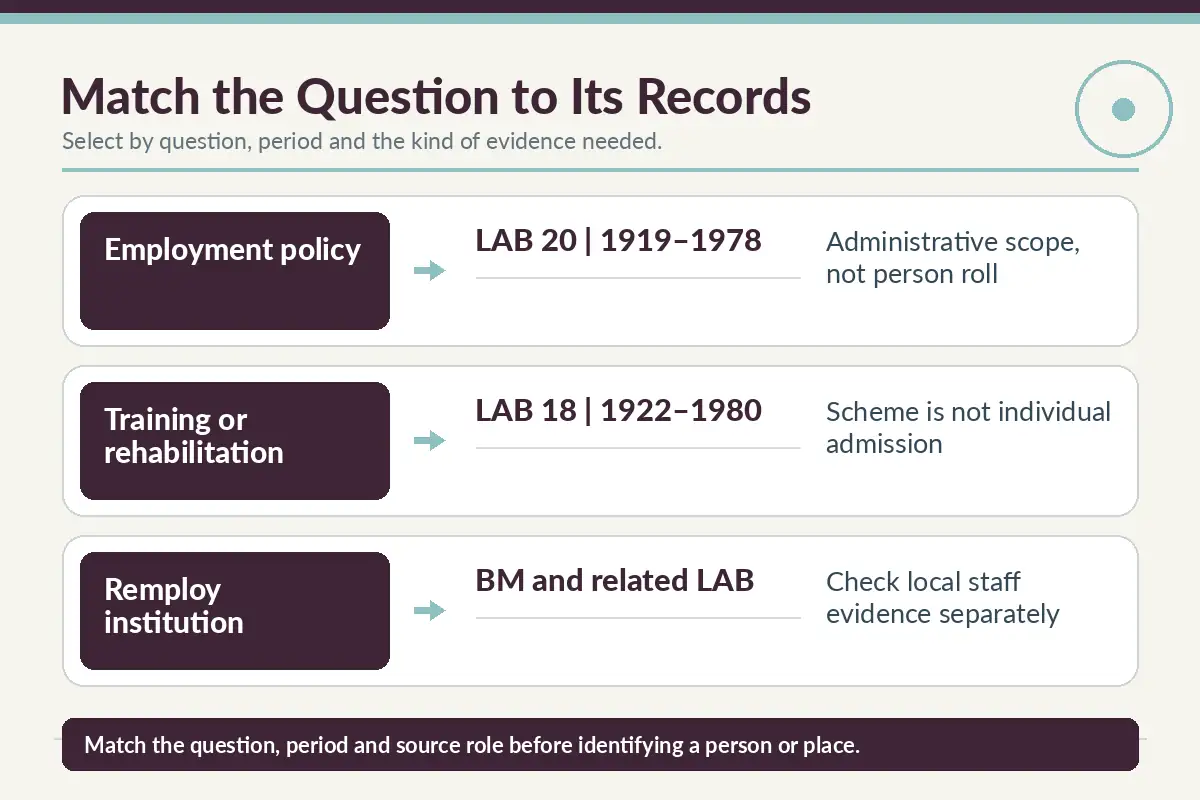
Route Rehabilitation Questions to the Right Records
Policy, training and employment are separate evidentiary stages. The disability-history research guide places rehabilitation training schemes in LAB 18, with material spanning 1922–1980, while LAB 20 covers wider files about disabled persons. A LAB 20 discussion of training could lead to LAB 18, but neither series should be treated as an automatic list of every trainee or subsequent job. Select by the stated research question, not by sequential series numbers.
For the period after the Disabled Persons (Employment) Act 1944, the archive guide points researchers toward the Disabled Persons Employment Corporation and Remploy records under department code BM, with related material in LAB 9, LAB 16 and LAB 20. These sources can reveal institutional decisions, program design or local facilities. They do not, without person-specific documentation, identify everyone who was employed by a Remploy workplace or the date each worker arrived.
A helpful worksheet has four rows: scheme announced, eligibility criteria described, local facility operating, and individual participation documented. Enter the source that actually supports each row. A government memorandum can establish a proposed scheme, a dated institutional annual report may support operation, and a surviving employee record can potentially support a named worker. Missing evidence in one row should remain an explicit blank rather than an implied yes.
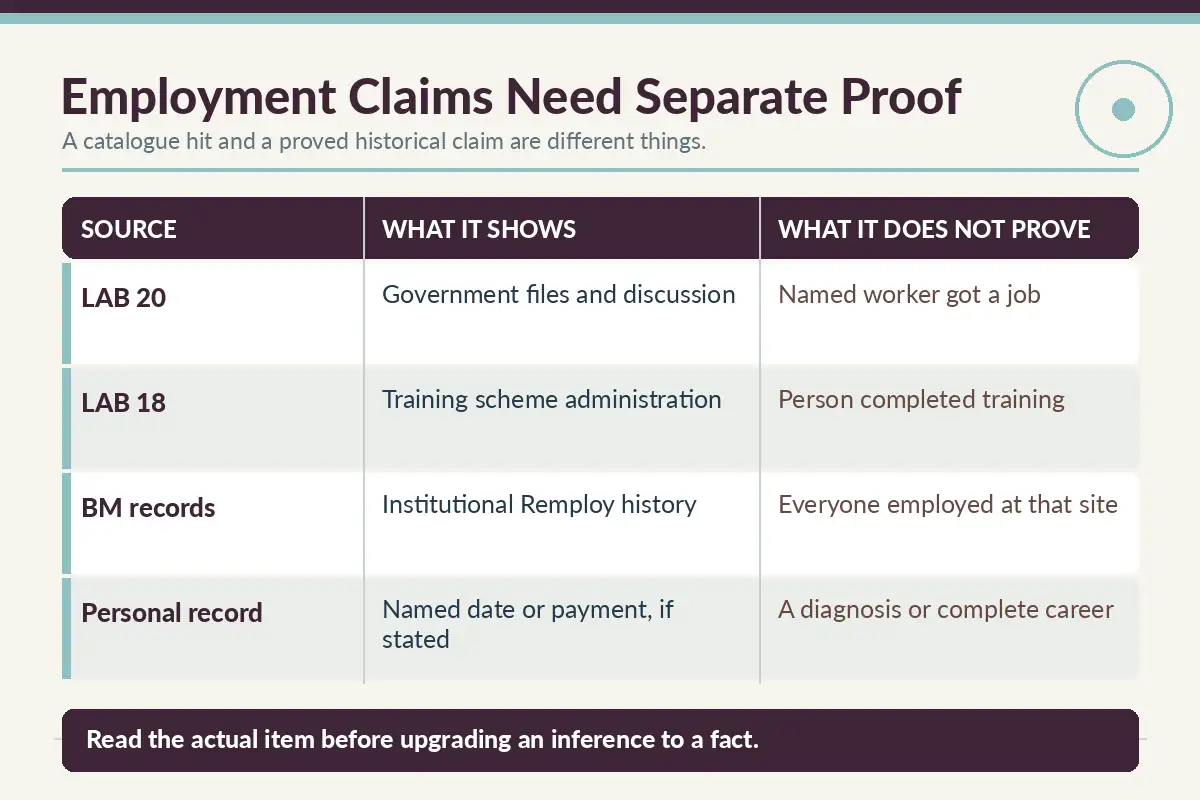
Read Old File Titles Without Repeating Their Assumptions
Administrative language changes across decades, and the vocabulary in 1920 can differ sharply from that in 1970. Transcribe historical terms accurately when citing file titles, placing them in quotation marks if needed; do not treat them as medical diagnoses today. Ask whether the item records policy discussion, parliamentary preparation, applications, public reporting or an actual administrative decision. These acts differ in authority and in what they reveal about an individual.
Look closely at who created the document and for whom. An internal proposal to improve employment prospects is not proof that funding was released. A ministerial response may report an intention or an aggregate count without documenting each participant. A local employer’s correspondence can describe perceived problems from the employer’s viewpoint and still lack the worker’s own voice. Distinguish reported testimony from independent proof, and note whether the source records a claim, a response or an outcome.
Access restrictions matter especially when a file contains sensitive information about identifiable individuals. A catalogue entry may be open, closed, partially redacted or subject to a request process. Respect the stated access status and avoid inventing diagnoses, diagnoses from occupations, or personal medical details about living people. If you see a closed piece listed in Discovery, that confirms a catalogue record exists, not that its contents can be assumed or obtained immediately.
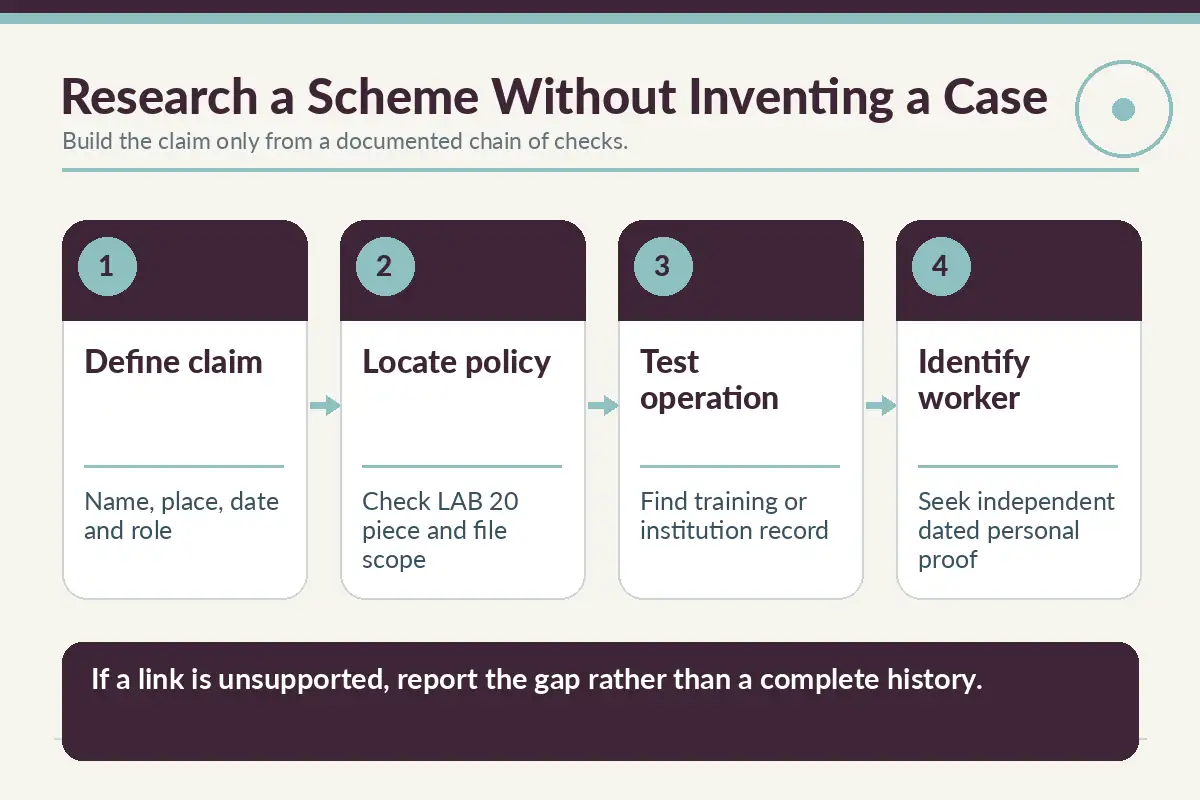
Separate Collective History From a Family Biography
Suppose a grandfather recalls a sheltered workshop in the 1950s. LAB 20 can help establish the policy environment and the wording officials used, while BM or local employer material may relate more closely to the named institution. That does not identify the grandfather as an employee. To connect him, seek a surviving dated appointment letter, wage record, union membership entry, personal correspondence, trade directory or other individual-level source appropriate to the period.
Construct a chronology with columns for policy, local implementation and individual documentation. Use the exact dates that the sources state, resisting the temptation to assign the publication year of a policy paper as a person’s starting date. A family photograph at a workplace may document presence, but it may show visitors or a social gathering; a listed occupational label may describe an earlier job rather than a government scheme. Uncertain interpretations belong in the notes, not the headline.
Use absence carefully. No LAB 20 search result for a person can mean that the series was not indexed by name, the relevant file was not selected for preservation, the activity was dealt with locally, or the record is closed. A defensible finding says which catalogue ranges, keywords and alternate repositories were searched. It does not turn a negative web search into a statement about someone’s disability, employment, benefits or family life.
More Research Method Guides
How We Research Disability Employment Records
We follow The National Archives’ disability-history guide for the LAB 20, LAB 18 and BM distinctions. The Discovery guide supplies the catalogue and access checks. The civil-servants guide illustrates the broader preservation limit of official personnel files, not a claim about individual disability case files.
We make no assumptions about a living person’s health, eligibility or employment and do not portray hypothetical examples as discovered biographies. The diagrams use original illustrations rather than copies of sensitive files. Our affiliate disclosure explains editorial relationships.
The National Archives identifies it as Ministry of Labour files on disabled people spanning 1919–1978; exact holdings vary by file.
No. Policy and registered administrative files are not a complete nominal roll of participants.
LAB 18 contains training-scheme records spanning 1922–1980; search there if the question concerns scheme administration.
The Archives points to the BM department for the Disabled Persons Employment Corporation and Remploy, with related LAB series.
No. Catalogue descriptions, closures, local custody and selective survival may all explain a missing name.