
ED 145 can help answer a specific historical question, but the series title alone is not evidence that a named person, road, site, or event existed exactly as family tradition describes. The starting point is to understand the record creator, the kind of source preserved, and its limits. This guide provides a source-first method for finding the appropriate record, tracing its date and jurisdiction, and corroborating a claim without transforming an index, proposal, recommendation, or report into a fact it cannot establish.
Identify the Question Behind the James Report
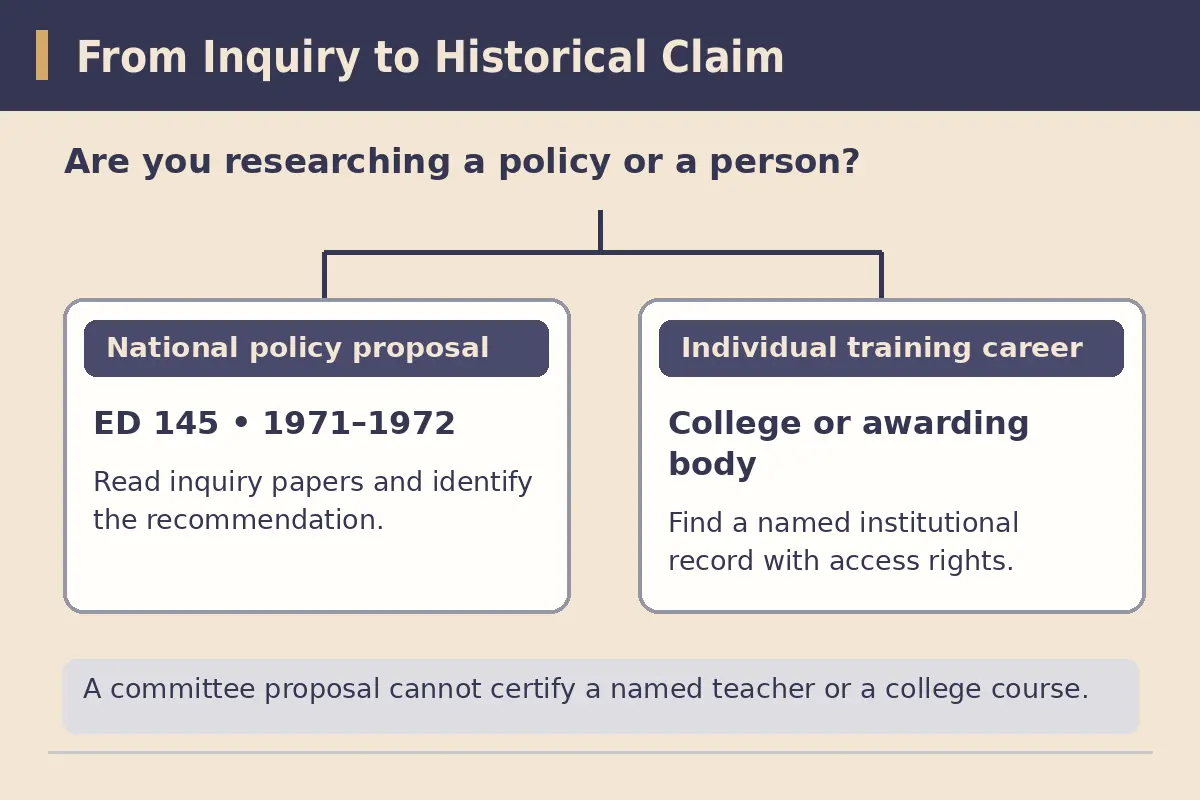
ED 145 contains the minutes, papers, and report of the James Committee of Inquiry into Teacher Training, 1971–1972, according to The National Archives’ teacher-training guide. It is the right starting point for a question about what the committee considered or recommended. It is not a register of people qualified as teachers in the 1970s. Begin by separating a national policy claim, a college-level change, and a personal career claim. Each requires a different document with a different creator and date.
Write the exact proposition you intend to prove: for example, “The committee proposed a particular sequence of education and professional training,” rather than “All new teachers followed this sequence in 1972.” Specify whether you seek the committee’s discussions, published recommendation, government response, or later institutional action. A report’s date is not an implementation date. If the family story concerns a particular teacher, collect the college name, training years, awarding body and professional role before browsing national inquiry papers.
Read Minutes, Submissions, and Reports as Different Sources
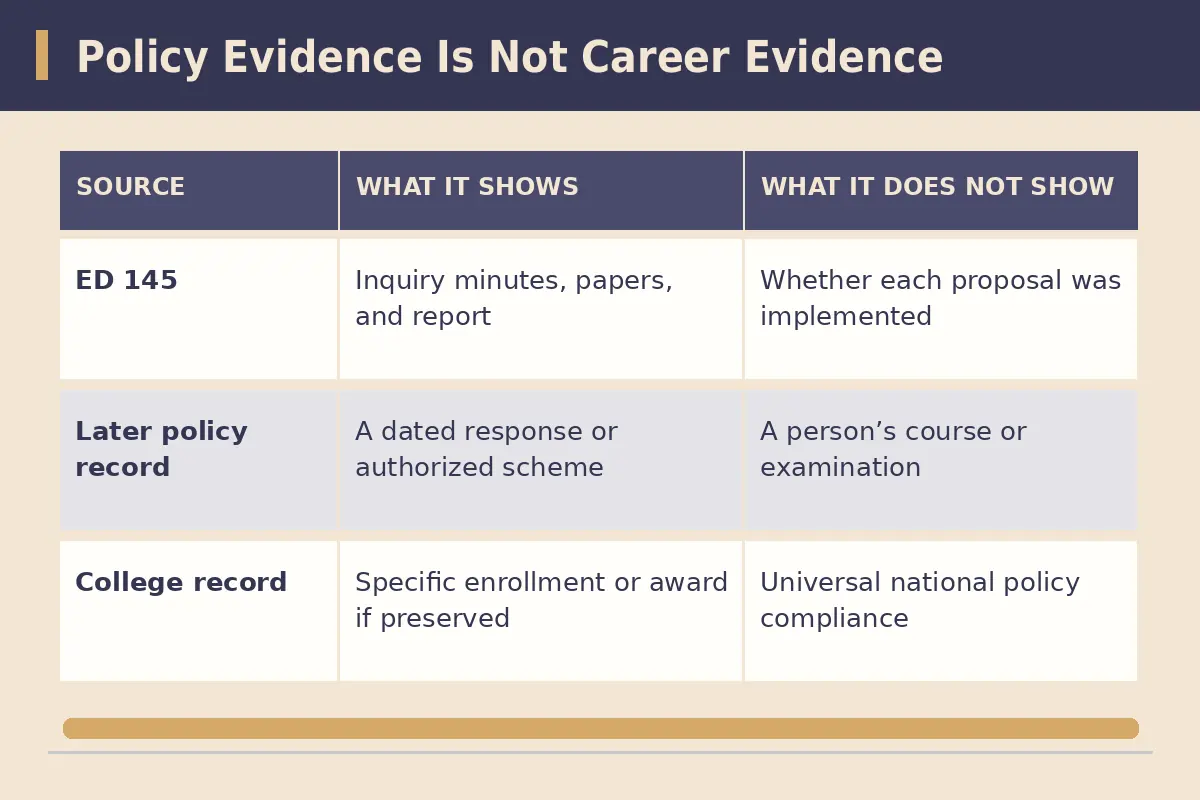
A committee archive can contain records made at different stages of an inquiry. Minutes document meetings and deliberation; working papers or submissions can contain evidence and arguments supplied to the committee; a final report states the committee’s conclusions or recommendations. Even where all three discuss the same reform, they do not have identical evidential weight. Transcribe the document title, date, authorship and intended audience, and record whether a sentence is a question, a witness’s statement, a draft suggestion, or an adopted recommendation.
An argument made in evidence is not a committee finding. Likewise, a draft text may differ from the final wording. When quoting a proposal, state its condition and scope: Did it concern all teachers, a particular qualification stage, a type of college, or a proposed future system? If a numerical target appears, note whether it is a projection, a cost calculation or an administrative count. A useful table gives columns for document, date, formulation, authority, and subsequent test.
Be cautious with institutional names. A training college may have merged, changed its governing authority, or become a university department. Search under the historical name used during 1971–72 as well as successor names, and document how you established institutional continuity. A modern website may preserve a timeline but should not replace a dated record of the specific proposal.
Locate Related Education Administration Series
The National Archives identifies neighboring series on training-college policy and postwar teacher supply: ED 86 for teachers’ branch policy, ED 143 for emergency postwar training, ED 119 for university-related training matters, and ED 159 for Area Training Organizations. Their coverage and purposes differ, so do not treat all ED references as duplicates of ED 145. Use them only where the question demands a comparison between a 1971–72 recommendation and an earlier policy or a later institutional arrangement.
Search Discovery with the exact phrase from a recommendation together with a date window and relevant department or institution. The catalogue searches descriptions, not every line of the underlying minutes. A failed keyword search therefore should prompt browsing by reference or comparing institutional terminology, rather than declaring the reform undocumented. Save complete piece references so another researcher can retrieve the paper. Check current access details before suggesting that a full image is online.
Find Decisions and Local Implementation Separately
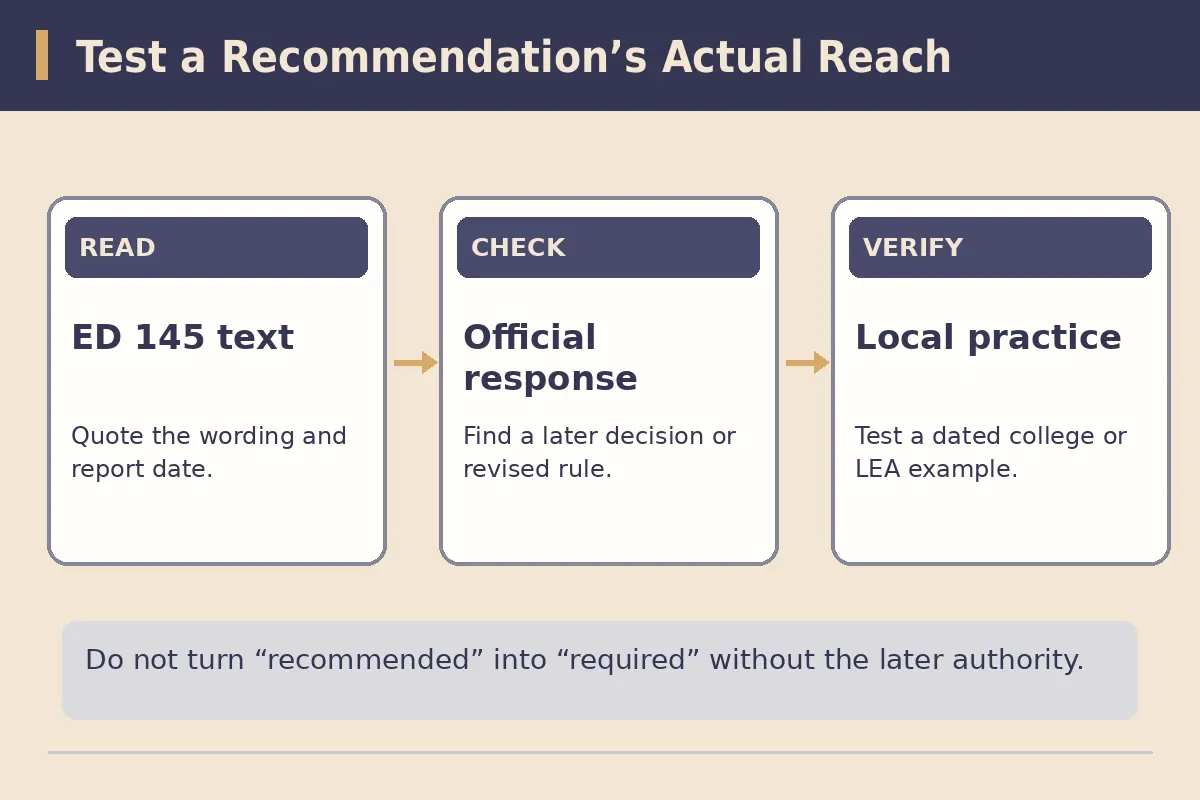
A policy timeline should not jump from the James report straight to an assumption that every teacher training college changed its curriculum. Locate a dated government response, circular, regulations or funding decision and distinguish announcement from legal or administrative commencement. Then inspect an individual college prospectus, committee minute, annual report, course handbook, or local education authority record where surviving. Institutions may have had transitional arrangements and different course structures. A national debate explains the context but does not replace local evidence.
Suppose a family member recalls a three-stage training scheme. If an ED 145 recommendation used similar language, the overlap supports a contextual hypothesis only. The person’s own college records or certificate would be needed to establish the actual course followed. If you find a later departmental circular, compare its precise instructions with the report’s wording and dates. Record modifications and exemptions; do not force a smooth timeline when the policy was contested, revised or only partially adopted.
Keep Personal Careers Out of a Policy File
The official archive guide explicitly warns that teacher-training policy collections at The National Archives are not a substitute for individual teachers’ or students’ records. A named career may be traced through institutional records, registers held by relevant bodies, professional papers or documents preserved privately, subject to access rules. An inquiry submission naming a lecturer does not alone establish that all views expressed were institutional policy. Nor does it prove that a teacher held a post for an entire decade.
When summarizing your findings, distinguish three levels: “committee considered,” “government or authority decided,” and “institution or individual did.” Give each level its own citation and its own known date. Include what you have not checked, such as local papers or records still closed for privacy. This approach creates a useful account of how educational ideas could influence training while preventing a national inquiry from becoming an invented biography.
Before using an apparent lack of evidence as a conclusion, note the scope of the searched pieces and whether the relevant minutes, appendices and reports were all examined. A negative keyword result is not proof the committee never discussed a subject. Describe the limits in plain language, then identify the next piece or archival custodian that could resolve the question.
More Research Method Guides
How We Research This Archive Series
This guide starts with the official description in The National Archives’ research guidance, not a claim that we have inspected a particular person’s private file or a specific original piece. The archival statements here concern the series or research method. A hypothetical example is labelled as such; it is not a newly discovered historical event. We use the Discovery search guidance to distinguish keyword matches from archive holdings and document contents, because catalogue descriptions do not transcribe every word of an original.
For every real candidate, record its historical place or person’s name, the creator, document type, date, full ED 145 piece or item reference, access restrictions, and the exact claim being tested. The official citation guide explains how to document those references so another researcher can retrace them. An unread document remains a catalogue lead, never proof of imagined details. If a record is missing, preserve the searched terms and dates and examine survival and alternate custodians before interpreting the gap.
Before sharing a conclusion, audit the difference between original source wording and your interpretation. Require independent evidence for any further claim about an individual, property owner, legal effect, or completed action. Respect archival access limits and living people’s privacy. This website also provides an affiliate disclosure; no paid partnership or commercial access is implied by these archival references.
The National Archives identifies ED 145 as the minutes, papers, and report of the James Committee of Inquiry into Teacher Training, 1971–1972.
No. Test later government decisions, instructions, and commencement dates independently.
No. It is a national inquiry archive, not a complete student or teacher register.
Look for surviving college records, local education authority papers, course handbooks, and relevant awarding-body documentation.
Discovery searches catalogue descriptions, not necessarily the text of every document; browsing by reference can be essential.