
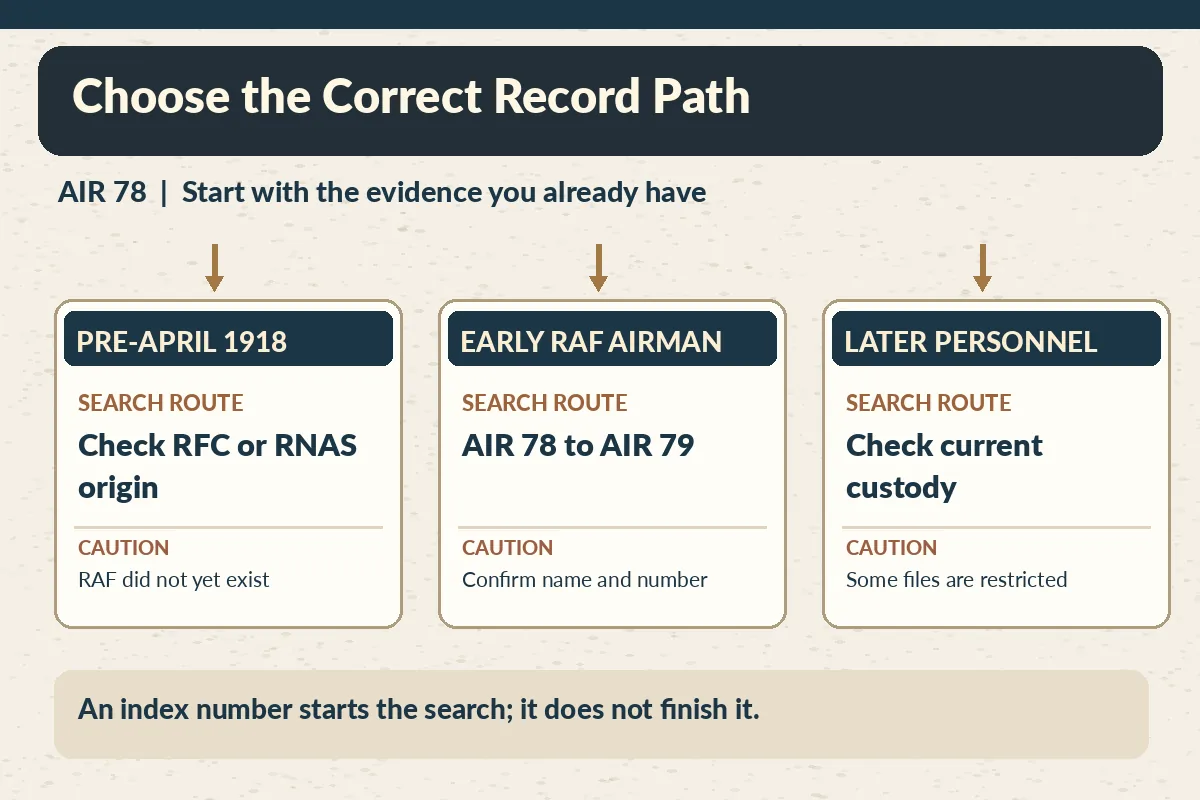
AIR 78 is a name index to Royal Air Force personnel, not a complete service biography. Use a person’s surname and initials or given names to locate the indexed service number; then use that number to find a service record in the appropriate series. For many early enlisted airmen the next destination is AIR 79, but dates, service branch and later Ministry of Defence transfers can change the route. The National Archives specifically recommends AIR 78 when an RAF or Royal Flying Corps airman’s service number is unknown. The RAF personnel guide is the best place to confirm the current custody and access path.
Begin With the Person, Not an Assumed Aircraft
Record the name, approximate birth year, home address if known, and the earliest reliable evidence of military involvement. Names and initials on an index slip can be similar, so do not assume the first matching surname belongs to your ancestor. Preserve the precise spelling as printed, including a middle initial or alternate surname. If a family photograph shows a uniform, identify the uniform and its approximate period separately from the index search; an RAF insignia does not establish an enlistment date.
The RAF was formed on 1 April 1918 from the Royal Flying Corps and Royal Naval Air Service. Someone who served before that date might have Army or Royal Navy paperwork and a later RAF number. Write a short timeline with separate entries for RFC, RNAS and RAF rather than describing all three as one uninterrupted service record. That guards against attributing early wartime experiences to a service that did not yet exist.
Use AIR 78 to Find a Number
The index is particularly useful when a researcher has only a name and no service number. Work through the relevant alphabetical material and record the form of the name beside the number actually shown. A card or filmed index slip is a locator: it can help identify the relevant personnel file, but it rarely supplies the detailed appointments, unit movements or family information needed for a biography. Do not describe a number found in AIR 78 as an independent list of every posting.
Where the surname is common, gather two independent identity anchors before accepting the match. A dated family letter, birth year or address can narrow the candidates; a number alone cannot. Keep a column for every possible index hit and eliminate candidates based on contradictions instead of convenience. If an index entry cannot be found, record the coverage and spelling searched and pursue other personnel lists; absence from one search is not proof the person never served.
Check AIR 79 and the Number Range
The National Archives describes AIR 79 service records primarily for airmen who served before 1939, including service numbers 1–562875. Such files can contain dates and places of birth, relatives, appointments, units, promotions and discharge information. Compare the AIR 78 number with the actual file before attributing any of those facts to the person. Some records include later service; the chronological end of a particular file must be read rather than assumed from the series title.
Certain number sequences are particularly informative. Numbers 313001–316000 are associated with former Royal Naval Air Service personnel who transferred to the RAF, prompting a separate search for earlier naval records. A number in that range does not itself prove the exact naval unit, ship or flight. For a man who was discharged before April 1918, surviving Army service or pension material might be the better starting point than AIR 79. Always choose custody according to the event date.
Separate Officers and Women From the Airmen Route
AIR 79 is not a universal personnel ledger for every RAF officer or airwoman. An officer’s file may follow a different archival route, and the Women’s Royal Air Force has dedicated material such as AIR 80. Identify rank category and service period before selecting a series. A result matching a woman’s name in AIR 78 is a useful clue, but it does not erase the need to check women’s service records. Avoid silently recategorizing a civilian worker as an enlisted person.
Personnel records after 1939 have different transfer, catalogue and access arrangements. The National Archives reports that later RAF records are being transferred from the Ministry of Defence and that some are not yet catalogued or open. If the person served later, search current guidance for the relevant file or request route. A missing online hit may be a custody or access problem. Record the search date and actual archive response, especially when writing about someone who might still be living.

Test a Worked Example With Two Similar Names
Imagine two index slips reading ‘J. R. Ellis’ with different RAF numbers. One family document gives a 1901 birth and an address in Yorkshire; the other clue is an undated photograph. First copy both index slips and separate the numbers. Next check the corresponding personnel records to see whether one contains the expected birth date or family contact. Only then connect a number with a particular person. If both candidates remain plausible, leave the identification open.
Even a confidently matched AIR 79 file may show unit assignments without proving participation in a particular sortie. For that next claim, identify the exact unit and date and examine operational records such as AIR 27 where appropriate. Likewise, a stated occupation in an enlistment paper describes what the person reported at that point, not a verified lifelong career. The goal is to build a sequence of distinct, dated claims with sources at the right level.
Keep the Index, File and Independent Evidence Separate
A reproducible citation should include the exact AIR 78 index reference, the transcription of the number, and the AIR 79 record or other personnel file actually consulted. Do not merge the two into a fictional single document. Note whether a service record was viewed through an archive, a partner platform or an official request, and preserve any page or image locator needed to revisit it. Where a later file is restricted, acknowledge the restriction instead of guessing its contents.
Finally compare service dates with civil birth and marriage registration, contemporary letters, unit records or a memorial if relevant. These sources answer different questions, so a contradiction should be investigated rather than concealed. The correct conclusion can be that AIR 78 provides a probable number and that the corresponding service record is not yet verified. That limited conclusion is more useful than a confident but unsupported RAF biography.

More Records and Archives Guides
How We Research and Verify This Archive Series
Our source check starts with The National Archives research guidance and a second reference, this complementary finding aid. We record the original series, piece or item, date, creator and access method before making a personal or legal inference. Documented statements and independently corroborated outcomes are separate categories. Where a file is missing, unindexed, closed or not inspected, we say so rather than manufacturing negative evidence. A cited catalogue lead does not mean we have seen every folio. For disclosure of any commercial relationships, see our affiliate disclosure.
No. It is a name index used to locate numbers and potentially the underlying personnel file.
AIR 79 for many airmen serving before 1939, subject to the person and number range.
No. Compare the number with birth details and other independent identifiers.
Earlier Royal Naval Air Service records may document the pre-RAF period.
Follow current National Archives guidance for transferred or restricted Ministry of Defence files.