
A name search for the 1810 U.S. census can fail for three very different reasons: the original household was not recorded, the relevant schedule has not survived, or the record exists but a modern index cannot find its spelling. The third census named household heads rather than everyone at an address. A reliable search therefore begins with an 1810 map of jurisdiction and preservation, proceeds to the handwritten tally, and ends with local documents that distinguish people sharing a name. Those steps matter more than a broad nationwide search.
Begin with the official August 1810 snapshot
The official census day was August 6, 1810; enumeration proceeded over subsequent months. People were intended to be recorded according to their usual residence on that reference day, even if an assistant marshal actually visited later. Write a time-specific target: ‘residing near Salem, Massachusetts in August 1810,’ rather than ‘lived there sometime in the 1810s.’ That distinction prevents an 1814 deed from being treated as direct proof of residence at the earlier census date.
A married woman, child, free laborer or other resident may not appear by personal name on the schedule. Search for potential heads, both male and female, and for neighbors established through tax, land or probate records. Do not assume every head was male, nor that a household with the same surname must be part of the family branch already in your tree. Head-of-household indexes are only a starting point for document identification.
Separate absent regions from merely absent surnames
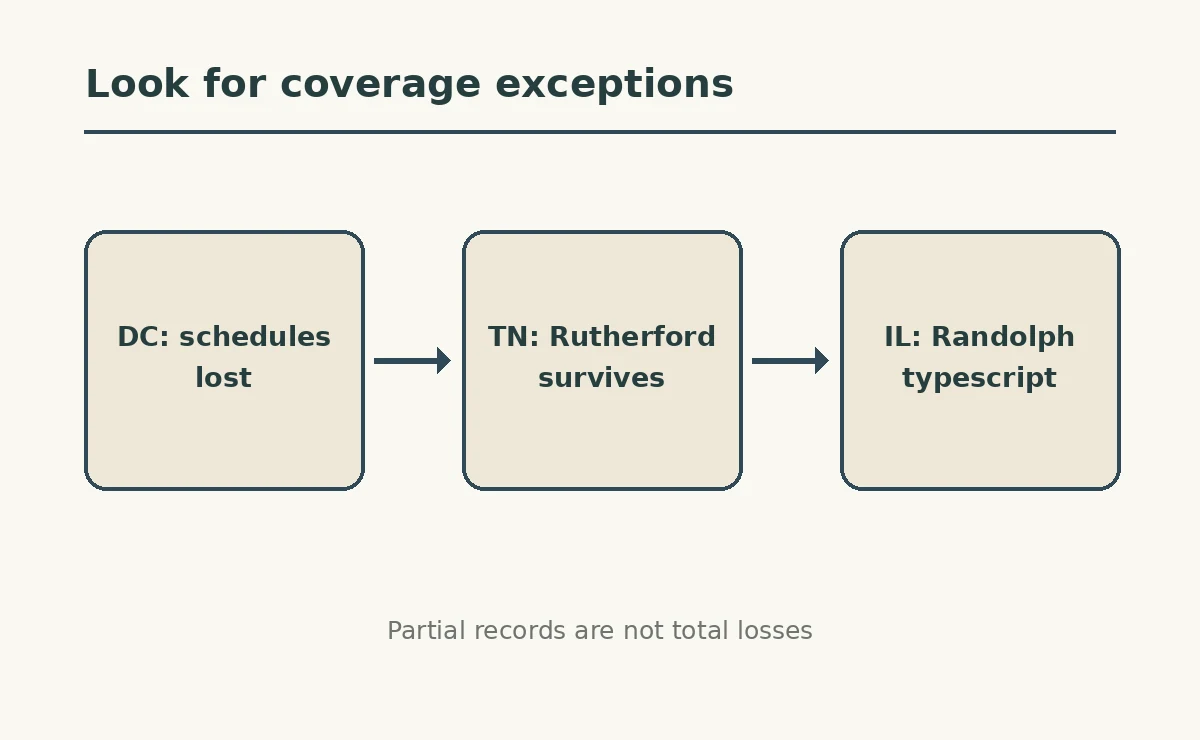
NARA lists no surviving 1810 population schedules for the District of Columbia, Georgia, New Jersey, Ohio, or most of Tennessee; several territorial returns were also lost. Rutherford County, Tennessee is a notable surviving exception, and Randolph County in Illinois Territory has a separately preserved typescript. These distinctions prevent an all-or-nothing answer such as ‘the 1810 Illinois census was lost’ from hiding a surviving local source. Check the specific county and archival description before you give up. Our guide to Illinois state census records shows how to use 1855 and 1865 returns.
An empty search in Ohio is not a negative finding about whether a person lived there. A tax digest or court minute book may place the ancestor in the expected county even though the federal named schedule is missing. Conversely, finding a surname in a surviving Virginia return tells you little unless the neighborhood, age pattern and associates correspond to the known person. Keep ‘not extant,’ ‘not indexed’ and ‘searched with no result’ as three distinct notes.
Read the same five male and female age divisions
For free white males and females, the 1810 form counted under ten; ten to fifteen; sixteen to twenty-five; twenty-six to forty-four; and forty-five upward. The free-head name and two additional broad population columns complete the essential population information. You can infer a plausible age interval but not a precise birthday. For example, a female reported in the twenty-six-to-forty-four group might have been born approximately 1765–1784. That interval should remain provisional.
The enumeration separated enslaved people and other free persons numerically, without individual names in the usual household return. Treat these as reports of a social and legal system, not pedigrees. The grouped counts cannot reveal who was related to a free head or who may have moved between households. If researching an enslaved ancestor, locate documents that identify people individually, with particular caution about assumed surnames and links to owners.
Search handwriting variants and nearby households
An assistant marshal could render a surname phonetically, shorten a forename or use inconsistent spelling across pages. Search variations in vowels and consonants, then browse pages for known neighbors and property holders. Look at adjacent household heads because a shared land transaction or witnessing relationship can distinguish the right Joseph Miller from another man in the county. But physical adjacency on a census page alone does not establish literal next-door residence or kinship.
NARA identifies its 1810 microfilm as M252. In your notes include the source image, location and page details actually visible, not just the database’s preferred spelling. When possible compare the handwritten head against a signed deed or other independently created signature, remembering that a different person might have supplied information to the census taker. A weak surname transcription should not overrule a strong chronological contradiction.
Reconcile a changed household with 1800 and 1820
A family with one youth aged sixteen-to-twenty-five in 1810 may have multiple possible candidates in an 1800 count. Age bands are broad, and a person could leave the residence by 1820. Write competing models rather than fitting all counts to a single fixed nuclear family. A remarriage, relative staying temporarily or household split can alter the pattern without requiring two census entries to refer to different heads. For the fuller picture, see our guide “1790 U.S. Census”.
The 1820 return introduces questions that 1810 did not ask, including counts of people not naturalized. Do not retrospectively infer that status in 1810 because a later column happens to exist. Treat new questions as new observations, not missing observations in the earlier form. A continuity table can include a ‘not asked’ value; that is preferable to a guessed zero.
Write an archival search conclusion with honest limits
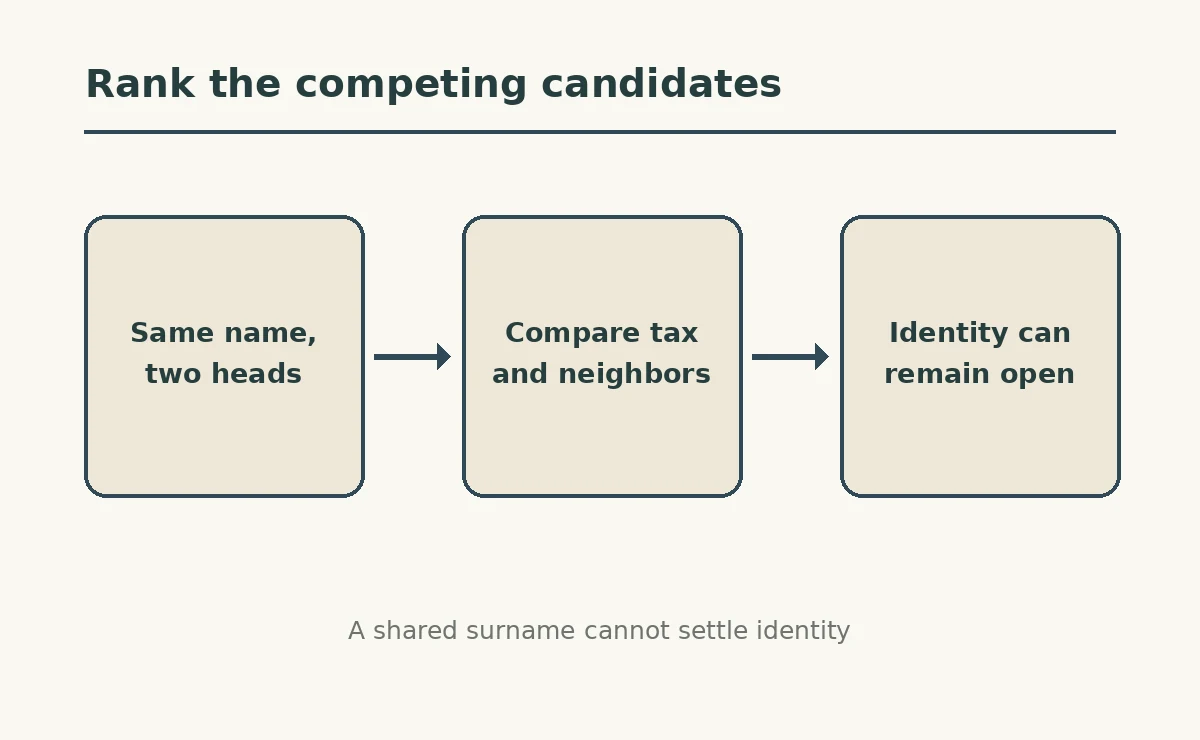
Imagine two William Reed households indexed in North Carolina and a deed naming William Reed near the target creek. First map the deed’s historical county and neighbors, then compare the two census images, household age bands and nearby names. The matching surname is low-weight evidence; alignment of multiple independent clues matters more. Keep both candidate households if they remain plausible and record which document might separate them. Our guide “1800 U.S. Census” adds more detail on this.
A useful finished note might say: ‘The recorded head and surrounding district align with a tax entry; the unnamed family members are still hypotheses.’ If the locality lacks a surviving schedule, instead state exactly which jurisdiction and NARA coverage list you checked and move to a separate record group. It is not a research failure to leave an identity unknown when the archive cannot support a stronger conclusion.
Apply a final 1810 research cross-check
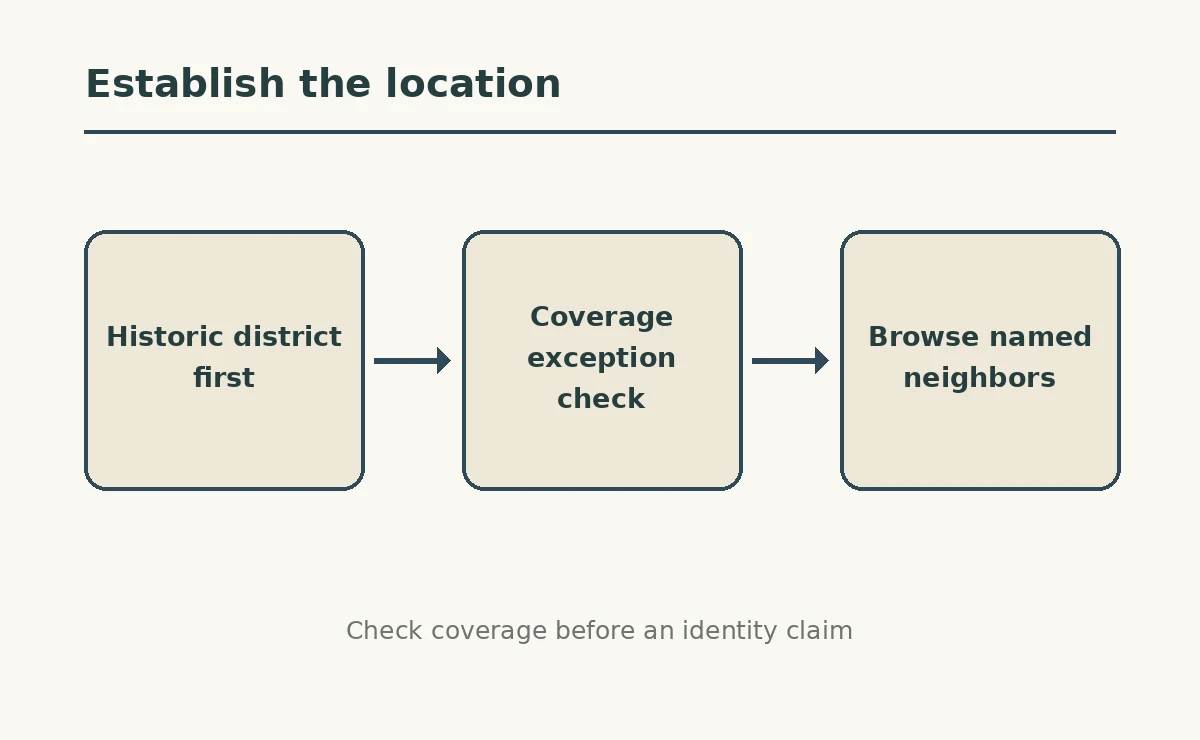
Search a locality through its historical naming sequence. A territory might later have become a state; a county might have changed its borders; a township label might differ from a later vital record. Establish the boundaries using a historical map before using a surname count as evidence. In a fragmented census, geographic work is not optional context; it is how you determine whether a named schedule should ever have existed.
A missing index hit can be investigated systematically: try a different surname rendering, remove the first name, browse the reported county images, then check the documented survival list. If all original schedules are lost for the jurisdiction, stop retrying equivalent modern databases. Switch record type. Record both the search attempts and why the next source was chosen, so later readers know your negative finding has a scope.
How We Research the 1810 Evidence
The geographic failure cases here were checked against the National Archives’ 1810 census reference, particularly its listing of Rutherford County and Randolph County exceptions. We read the general survival explanation in the NARA population-schedule catalog and used the Census Bureau’s history of hand-written forms to interpret the headings. The William Reed case is an invented example showing competing identification paths, not a factual pedigree.
More Records and Archives Guides
Sources, limitations, and disclosure
When citing an actual 1810 head, record the M252 census image, historical district and archival image location. NARA additionally describes exceptional material for Illinois Territory and Salem; these do not fill every territorial loss. An archive may retain only a typescript or fragment and not the general federal schedule. Recheck the precise collection description instead of treating all digital versions as independent sources for the same claim.
This 1810 article links to educational archive resources, not to a paid research vendor. GenHis publishes broader relationship disclosures at its standing disclosure URL. The accompanying drawings do not depict a genuine historical family’s documents. A reconstructed route to the correct locality is a research method; it must never be sold as proof that an individual was enumerated.
August 6, 1810, according to the National Archives.
No. NARA identifies entire states and territories with losses, as well as partial local exceptions.
It is the Tennessee county with surviving 1810 schedules identified by NARA.
No. Typically the return names a household head and counts other persons in age and status categories.
Compare exact county, neighboring heads, land and tax evidence, and age-band consistency across years.