
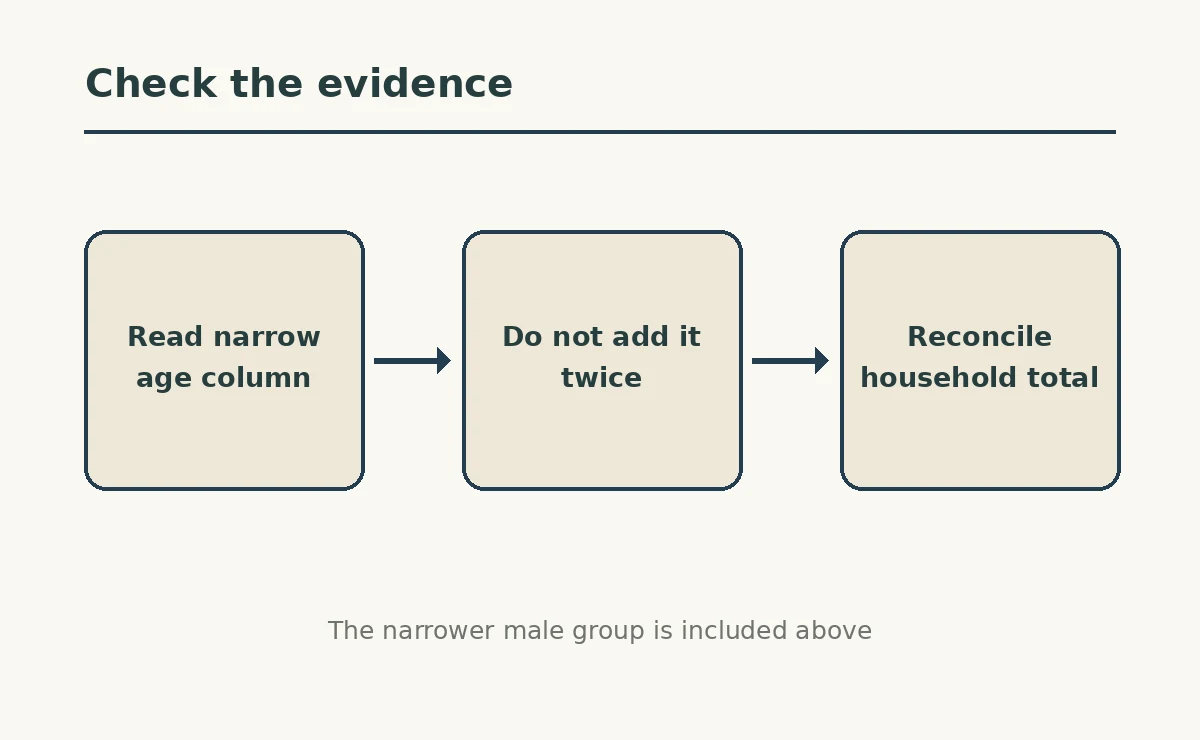
The most costly 1820 census reading mistake is adding two male age columns that overlap. A count of boys sixteen or seventeen is also included in the broader sixteen-to-twenty-five group; summing both invents household residents. The 1820 return also introduced counts of foreigners not naturalized and people engaged in broad work categories. Those figures can generate leads, but they identify neither a specific resident nor an occupation for the named head. The best use of this census is a carefully annotated tally, with its unique questions treated separately.
Spot the overlapping male age question immediately
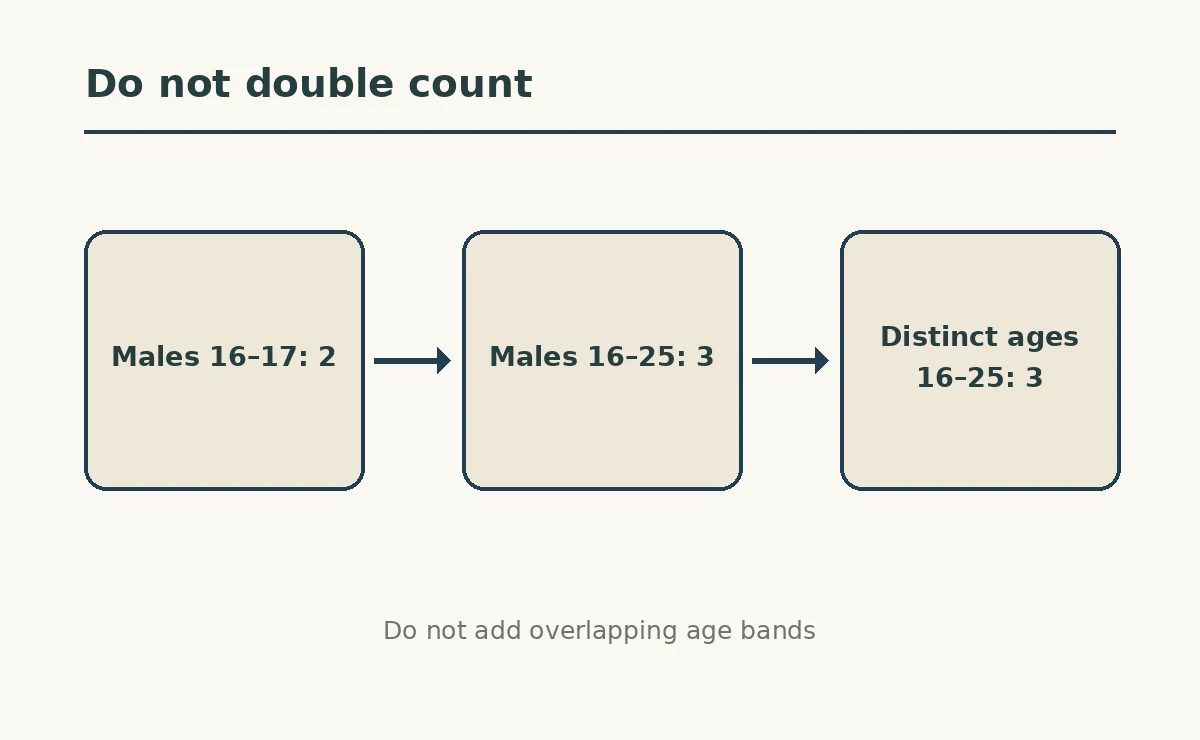
NARA lists two relevant 1820 questions for free white males: sixteen to under eighteen and sixteen to under twenty-six. The first is a subset of the second. Suppose a hypothetical page reports two males in the sixteen-to-under-eighteen group and three in sixteen-to-under-twenty-six. The older band already includes the two teenagers; the combined distinct total for ages sixteen to twenty-five is three, not five. This is a rule for decoding the form, not an estimate about anyone’s identity.
Make a transcription where the narrow group is annotated as ‘included within wider group.’ If a genealogy program demands a total number of males, do not sum columns mechanically. Check the original column headings in the photographed schedule; handwritten formats differ. A numerical transcription without a note about this overlap can quietly generate a false sibling in later family-tree software.
Interpret nonnaturalized and employment numbers carefully
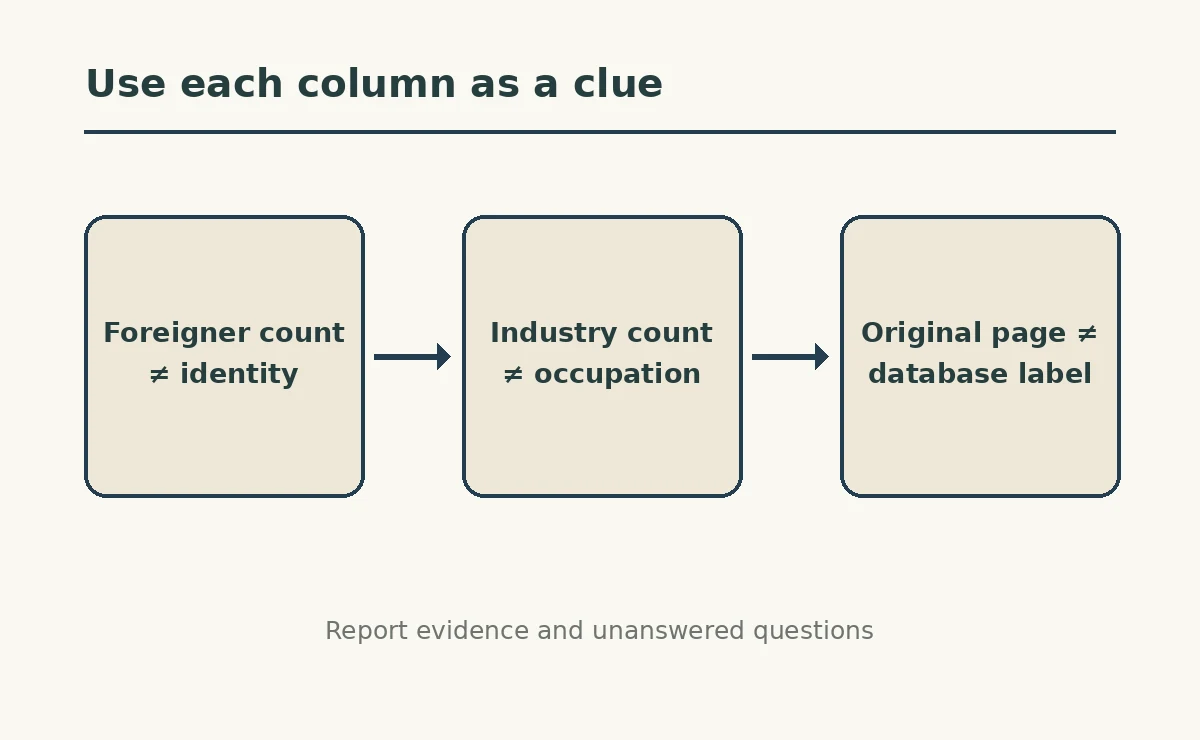
The 1820 questions added a count of foreigners not naturalized, but no names for the people represented by that count. It is not equivalent to a naturalization certificate, nor does it identify an immigrant head. An American-born householder could include a nonnaturalized person; conversely a person later naturalized might appear under another household. Use the figure as a hypothesis that directs you to court petitions, declarations or later citizenship entries where documents actually name someone.
Separate columns counted people engaged in agriculture, commerce and manufactures. These are household-level counts, not modern standardized job titles. An agriculture mark does not prove the indexed head owned land or farmed full time. A tenant, apprentice, adult child or worker may have supplied the labor. Test an occupational lead with land and tax assessments, account books, business notices or court files created near the same date.
Respect early classifications and missing personal names
The form contains age-and-sex categories for enslaved people and free people categorized as colored, along with another residual population question. These headings describe discriminatory historical administration. The absence of a personal name is an archival limitation rather than evidence of a person’s lack of identity. A household’s numerical count cannot identify which enslaved people lived there or assign a parent-child relationship, and status categories may be inconsistently applied by local marshals.
Researchers following African American ancestry should carefully distinguish the named enslaver or head from persons counted in the same row. Probate distributions, deeds, church registers and later post-emancipation records may provide names that the federal tally does not. Many of those sources also have biases and omissions; agreement across independently created records is the stronger method. Never label a counted person as a relative simply because the age approximates a suspected ancestor. For the fuller picture, see our guide “1840 U.S. Census”.
Check page context and known archival defects
Several 1820 returns were handwritten rather than standardized federal forms. National Archives documentation cautions that in portions of New York, particularly Suffolk County, old rebindings intermixed portions of different towns on the same filmed page. The place at the top of a page can therefore misdescribe the people in the lower half. Inspect section headers and any shift in the writing, not only the database’s locality string.
NARA also identifies missing schedules in multiple counties and reports a small group of Virginia pages absent from the standard M33 microfilm. These are different conditions: lost original schedules are not recoverable by changing websites, while a page omitted during microfilming may exist through alternate references. Write down which kind of absence applies before relying on a negative result. The distinction can determine whether you search substitute county tax records or another archival reproduction.
Build an 1820 evidence worksheet for each candidate
Use four columns in your own log: stated question; raw mark; permissible inference; next independent document. A male count of one in the sixteen-to-under-eighteen field yields ‘one person in that band as enumerated,’ not ‘son William aged seventeen.’ A nonnaturalized count yields ‘the household contained one such reported person,’ not a named immigrant. A manufacturing count suggests an economic lead, not property ownership. This translation exercise is the article’s central safeguard.
Choose a case where a suspected grandfather appears as a named head in 1820 and again in an 1830 return. The later form changed age divisions, so compare overlapping possible ranges instead of insisting on identical columns. If the 1820 marks do not fit your assumed children, seek a guardianship record or marriage entry before rejecting the household. Transient relatives and servants are possible; record them as alternatives until documented.
Record a result that another researcher can reproduce
Cite the NARA M33 collection or exact image and the visible county, town and page. Preserve the source’s original language when making a diplomatic transcription, but separate that wording from your own respectful narrative. Also preserve the line above and below the target entry when handwriting or alignment is ambiguous. An exported database citation alone may omit the very column positions on which your interpretation depends. To go further, our guide “1830 U.S. Census” shows how to read printed age columns and county gaps.
A balanced finding says what the row supports and what remains unproved. The name of a head is an observable fact on an image; the likely identity of a counted teenager is an inference; a person’s birthplace or parentage is unknown from this form alone. State what could falsify your proposed identification—perhaps a birth year in a church register, or a probate bond naming a different parent.
Apply a final 1820 research cross-check
The overlap problem can be visualized by writing each age band as a set of integers. The narrow set contains ages sixteen and seventeen; the larger contains sixteen through twenty-five. Their union equals the larger set, not the sum of the two sets. This matters whenever household totals are compared across years. Do not use a special-purpose age count as if it represented extra residents; the Census Bureau and FamilySearch both warn of this trap. For the next step, our guide “1810 U.S. Census” explains how to find households despite territorial record gaps.
Names and locations still need source criticism. A 1820 handwritten schedule might carry a later stamped page number and a modern place tag that derives from a rebound volume. If the apparent town does not fit deeds or church records, inspect the full page and adjacent images. Some misunderstandings arise from physical archival processing rather than a family moving or a clerical error in an ancestor’s surname.
How We Research the 1820 Evidence
The overlap calculation was checked using the National Archives’ 1820 list of original population questions and FamilySearch’s worked reading guidance. Both distinguish the narrower sixteen-to-seventeen count from the enclosing sixteen-to-twenty-five group. We also examined NARA’s Suffolk County rebinding note before recommending checks of a page’s top and bottom place labels. The illustrative counts in this text are arithmetic examples, not transcriptions of a named census household.
More Records and Archives Guides
Sources, limitations, and disclosure
The federal microfilm series guide places 1820 schedules in the broader run of early population censuses. The year-specific NARA page identifies M33 and explains both missing localities and Virginia pages omitted from that filmed copy. The important research action is to distinguish a damaged or lost original from an incomplete copy; their replacement strategies differ fundamentally.
We receive no commission for demonstrating a column-counting rule. The general GenHis disclosure statement is linked for transparency. The colored age cards in this article are diagrams made for instruction, not photographs of manuscript columns. Any real-world finding must be checked with original page context and relevant named records before attaching an immigrant, worker or child to a particular household.
The narrower count is part of the wider band, so those entries must not be added as separate individuals.
Yes, it counted foreigners not naturalized, but did not identify them by name in that field.
No. They count household people engaged in broad sectors; they are not job titles for the indexed head.
Yes. NARA documents re-bound 1820 pages whose top and bottom portions belong to different localities.
No. Personal names of other household residents generally do not appear on the population schedule.