
The 1830 census can be surprisingly helpful precisely because it did not list all household members by name. Its printed form divides free white household residents into relatively narrow age bands, allowing a researcher to check a candidate family against a plausible range of births. Yet the line still identifies principally the head, and certain county pages are missing. Understanding what changed in 1830—federal printed sheets and detailed age divisions—is the useful entry point, not a claim that each tally names a known son or daughter.
Use the first federally issued printed schedules
For the 1830 enumeration, Congress arranged for blank printed forms to be supplied to U.S. marshals. That differs from earlier decades when assistants usually wrote or ruled their own headings. Printed headings improve the possibility of comparing image sections consistently, but they do not eliminate faded marks, truncated scans or index errors. Examine the relevant column label directly and check whether a stroke belongs to your ancestor’s line or the one immediately above it.
The 1830 page is a period document and contains historical classification terms now recognized as discriminatory. Its arrangement should be explained, not celebrated as a neutral representation of modern identities. A printed label describes how an enumerator was instructed to group people; it cannot establish kinship, self-identification or citizenship. An online transcription may also modernize the wording; preserve the original only where needed to clarify which column was read.

Translate ten-year and five-year groups into hypotheses
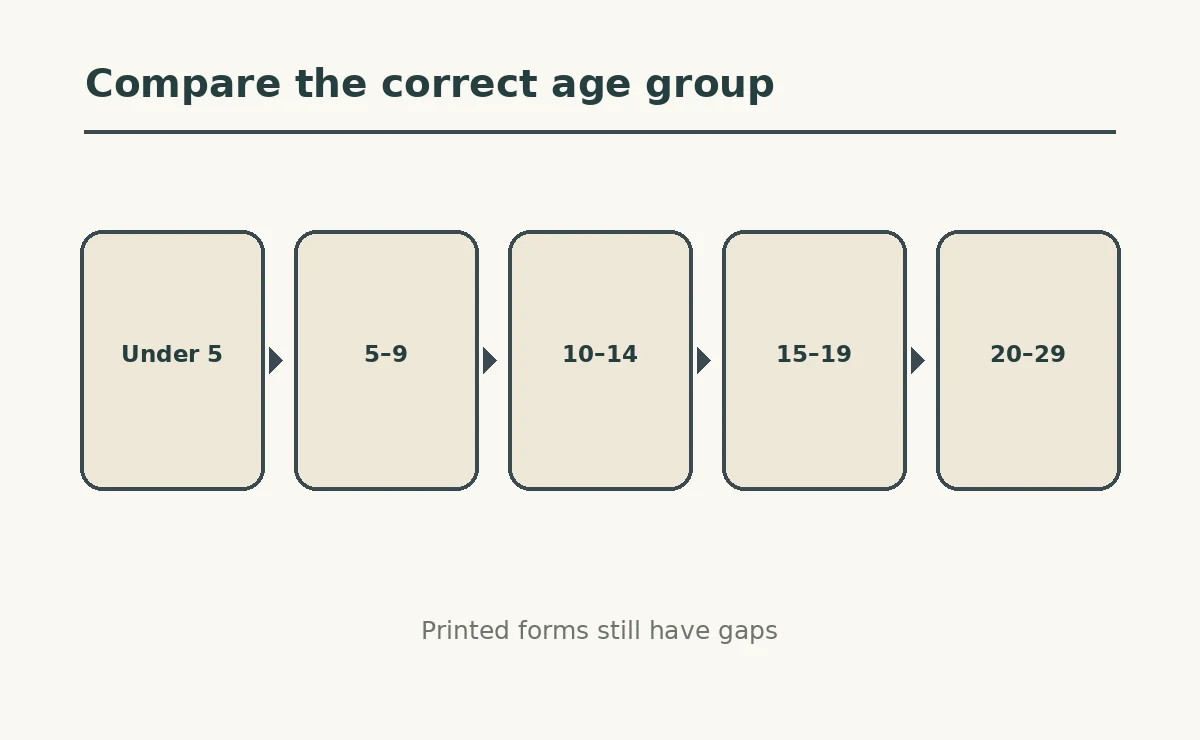
Among the free white male and female questions, the 1830 schedule distinguishes children younger than five, those five to nine, ten to fourteen, and fifteen to nineteen. Adults appear in wider stages such as twenty-to-twenty-nine, thirty-to-thirty-nine, continuing to older age groups. Suppose a suspected daughter was born about 1824. A female tick in the five-to-nine group in 1830 is consistent with that estimate. But it could refer to any other resident of that age and category.
Write intervals beside candidate names, not categorical identifications. Birth dates from gravestones, later death records or family stories should be treated as estimates until their own evidence is examined. When comparing to the 1820 census, remember that the old columns grouped people differently. It is more accurate to write that a household pattern is compatible with a proposed family than to match a particular mark across two separate pages. Our guide “1840 U.S. Census” adds more detail on this.
Screen losses county by county before interpretation
National Archives guidance identifies lost 1830 schedules for Montgomery, Prince George’s, Saint Mary’s, Queen Anne’s and Somerset Counties in Maryland; Pike County, Mississippi; and Clarendon County, South Carolina. These are documented location-level gaps. A statewide search may conceal this fact behind a reassuring collection title. Before recording ‘not found,’ write the old county name and compare it with the NARA preservation list.
If a candidate lived in an affected county, seek other contemporary sources rather than scanning other vendors for a nonexistent original. County tax assessments, deeds, probate packets and church membership lists can give narrower residence evidence. If you have a plausible neighbor in a preserved adjoining county, boundary history or migration might justify searching there. But do not relocate the ancestor just because a search engine returns a match.
Test adjacent households without inventing relationships
Names near each other on a printed 1830 page may be useful clues to neighborhood and community. However, the ordering can follow an enumerator’s route or other local practice and should not be read as a street address. Use a property description from a deed, a tax roll or a court witness list to assess whether two same-named households belonged to the same area. Neighbors may be more distinctive than common surnames when two men are both called Thomas Brown. Our guide “1820 U.S. Census” covers how to avoid double counts and read occupation clues.
A person recorded as the head in 1830 may be absent in 1840 because of death, relocation, remarriage or a split household. Those possibilities have different expected records. Write a decision tree: if estate papers appear, investigate death; if a deed transfers a farm, check migration; if a younger household emerges nearby, consider an adult child without assuming it. Selecting evidence by competing explanation is better than selecting the first internet tree that matches.
Treat marginalized residents as unnamed individuals
The schedule reports enslaved persons and free people classified as colored in age and sex bands. Like earlier head-count censuses, it does not name most of those persons. Even a distinctive mix of ages cannot link a person to a modern family line without independent records. Historical claims about freedom, enslavement or household roles require more than a tick mark. Seek sources that name people and describe transactions or events, while evaluating the coercive circumstances in which those documents were created. Our guide “1800 U.S. Census” adds more detail on this.
Census categories also excluded or misclassified some Indigenous people. Absence from the counted columns should not be interpreted as absence from a geographic area, and the federal system’s labels do not define tribal membership. Keep the form’s administrative purpose separate from a family’s identity and traditions. If a possible connection concerns a named Native nation, sources maintained by that nation and the relevant historical jurisdiction matter more than a generic census category.
Prepare an auditable 1830 census conclusion
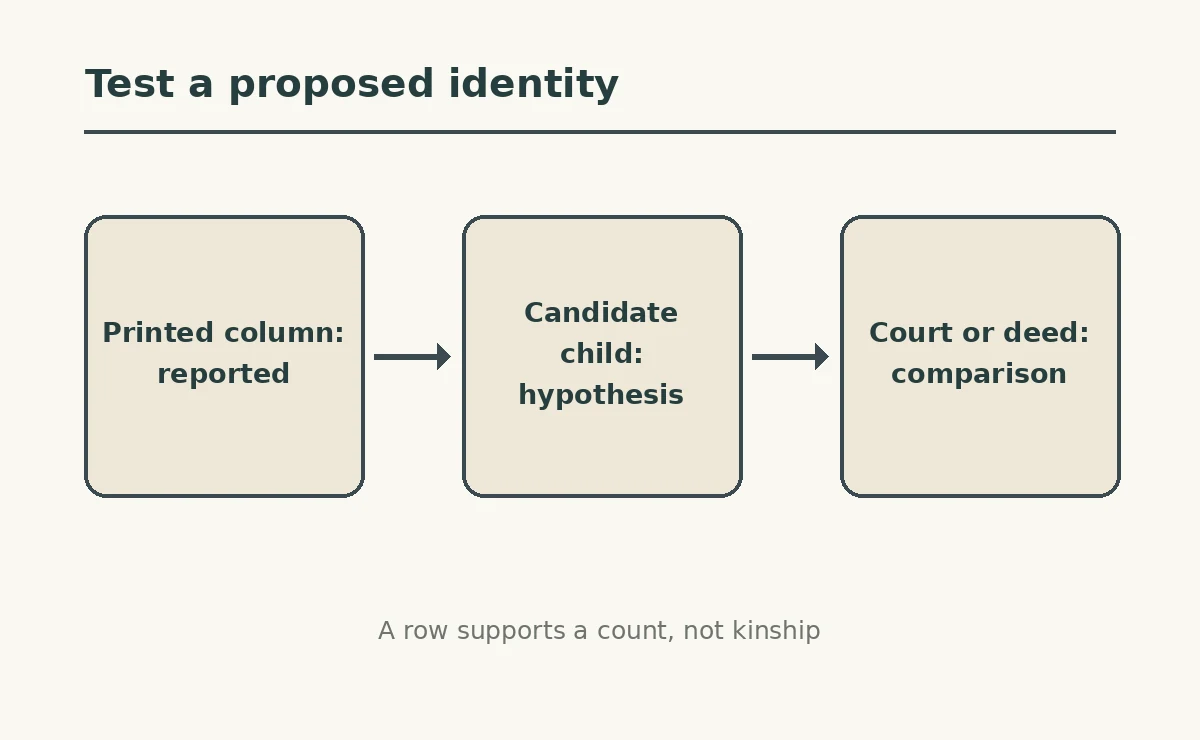
Build a three-part note for a hypothetical Mary Ellis household: what the printed page explicitly reports; why the location and age profile may fit the person sought; and what alternative person could also fit. Include the exact county, township if present, page image and date of the census reference, June 1, 1830. A birth estimate in one column should be phrased as conditional on the recording being accurate.
Attach a supporting document that is not copied from the census—perhaps a land conveyance with the same adult witness names or a congregation record naming children. If no such document exists, keep the census placement tentative. The usefulness of a genealogy note lies in making uncertainty visible: subsequent researchers should be able to see where your interpretation comes from and decide which archive to inspect next.
Apply a final 1830 research cross-check
Printed forms did not suddenly make the records equivalent to twentieth-century questionnaires. There were no relationship-to-head labels for most unnamed residents, and the age categories were enumerator reports rather than independently verified vital facts. When a website displays ‘household members,’ check whether those names come from an attached public tree instead of the original population schedule. Separate records-derived data from researcher-added connections. To go further, our guide “1810 U.S. Census” shows how to find households despite territorial record gaps.
For a same-name problem, rank the candidates based on documented locality first, then chronological fit and community associations. If both survive that screen, retain two labeled hypotheses. A conclusion that admits unresolved identity is preferable to linking the wrong ancestor across decades. Mistaken 1830 links can contaminate a family tree with inferred spouses and children not identified on the federal return.
How We Research the 1830 Evidence
The claims about federal printed blanks and five-year youth groups come from the National Archives 1830 census FAQ. Its enumerated missing counties provide the basis for our location-first screen. We compared the change in physical form with the Census Bureau’s historical questionnaire timeline, rather than assuming that printed columns supply personal names. Mary Ellis is a hypothetical problem used to illustrate evidence limits.
More Records and Archives Guides
Sources, limitations, and disclosure
For a missing 1830 return, the NARA guide makes a county-level claim, not a blanket statement that every name in Maryland or Mississippi is gone. The early census catalog supplies historical perspective on head-only identification. The related microfilm publication is M19. These sources support descriptions of records and their survival; they cannot validate a specific ancestor until that person’s line has been examined.
No merchandise or partner service is being endorsed in this printed-form tutorial. Readers can consult GenHis’s general disclosure page. The invented worksheet concepts must be paired with independent deeds, vital or church material for an actual family, because a reported age bracket and a shared surname are insufficient evidence of kinship.
It was the first U.S. census with federally supplied blank printed schedules.
No. They imply approximate age intervals; they do not name individual children.
NARA identifies Montgomery, Prince George’s, Saint Mary’s, Queen Anne’s and Somerset among the missing counties.
No. Geographic proximity can suggest a lead, but the census does not establish kinship.
No. Federal census classifications do not establish identity or membership in a Native nation.