
FO 655 is not a complete archive of everyone who held a British passport. It is a very small collection of preserved passports dated 1802–1961, kept to illustrate historical forms and procedures. The National Archives warns that there are fewer than a dozen passports for most years and that a researcher is extremely unlikely to find an ordinary ancestor’s original document. FO 655 is excellent for document history, but it is often the wrong first destination for a name search.
The National Archives passport research guide distinguishes these illustrative passports from registers in FO 610 and indexes in FO 611. It also warns that, before the First World War, passports were not universally required for overseas travel. Begin by defining whether your question is about the form of a historical passport, an application under a particular name or evidence that someone actually traveled.
Do not treat an illustrative sample as a lost application
The surviving FO 655 items were selected as examples of passport types, not as an equal-probability sample of the population. A person absent from the series may still have held several passports. Conversely, the presence of a named passport shows a document was issued or preserved, but the exact amount of travel it supported requires separate evidence. Document date, passport type and issuing authority are primary observations; destinations written in a document may be anticipated rather than actual trips.
A practical worksheet should start with three possible questions: What did passports look like in a given period? Did an individual apply for or receive a passport? Did that individual undertake a specific journey? Those questions point to different sources. Search by date and document type for FO 655, but prioritize FO 611 or FO 610 when a person’s name is the central inquiry.
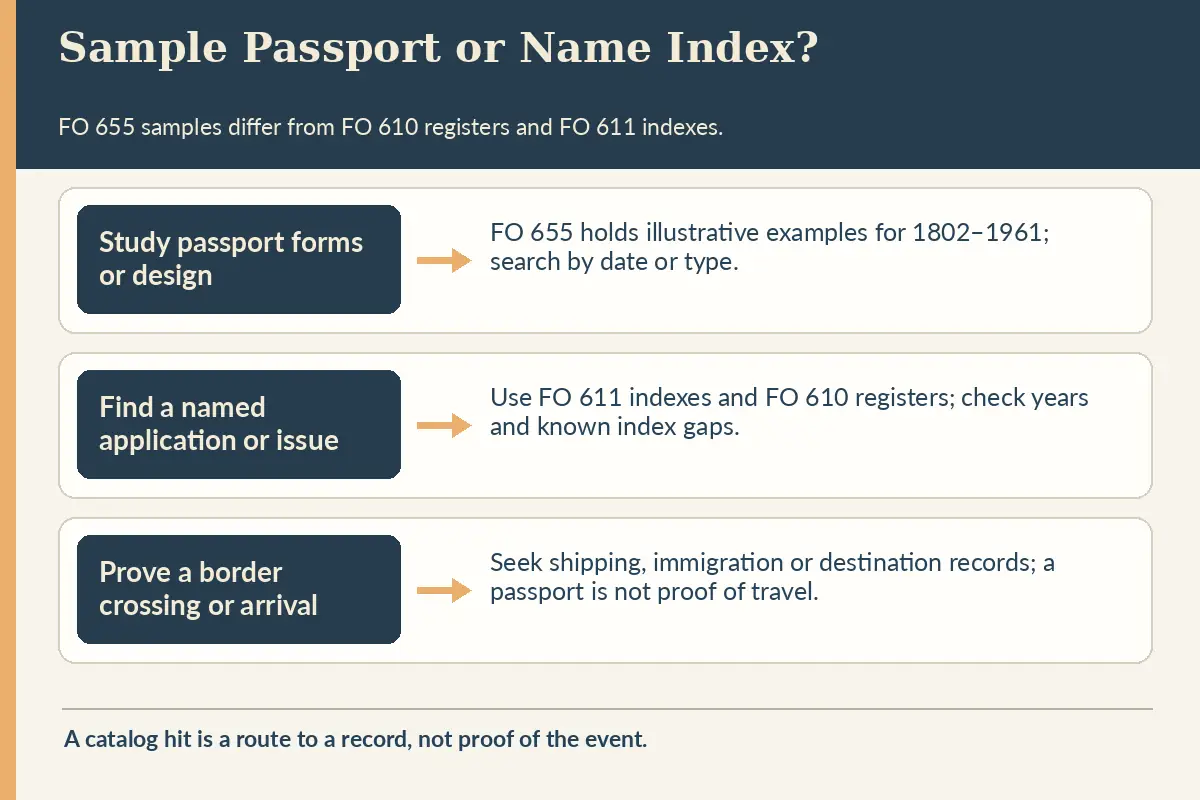
Follow the passport indexes and known missing years
The National Archives says FO 611 indexes cover applicants in 1851–1856, 1858–1862 and 1874–1903 through a commercial database, with further indexes for 1904–1916 in FO 611/20–25 at Kew. There is no index for 1857 or 1863–1873, and 1858 is missing surname initials A–G. These are substantive survival gaps: a negative search in those years cannot support a claim that nobody applied for a passport.
Indexes differ in detail. An earlier entry can supply name, passport number, issue date and occasionally an observation; a later one may supply just name and issue date. Always note the index’s coverage and whether the field was transcribed or read in an original volume. A person may appear under initials, alternative spelling or a married name. Check relevant variants without assigning each result to your relative automatically.
Use FO 610 registers to recover context
FO 610 registers cover British passport applications from 1795–1948 and are generally arranged by date and passport number. The National Archives cautions that these registers may contain little more information than the indexes, and sometimes less. They are therefore good for confirming a numbered entry but cannot be assumed to contain a birthplace, family relationships or a detailed itinerary. Never promise more personal information than the actual register reveals.
When an index gives a passport number, follow that reference into the proper register if feasible. Capture the exact FO 610 piece, date, number and any remarks, as well as the relationship between the original and the derivative index. If the register is unavailable online, preserve the Kew visit or copy-request route. An index search result is a lead to the underlying source, not itself a reproduction of all original evidence.

Separate photographs from verified identification
The National Archives notes that passports issued after 1 January 1915 normally include photographs; the photographs guide describes hundreds of examples in FO 655, but that does not mean every original survives or that portraits are individually searchable. A photograph in an illustrative passport can document appearance on that occasion, yet a caption, date and name must be verified from the actual record before assigning identity.
If a family portrait resembles a passport image, visual similarity alone does not prove the two are the same person. Cross-check full name, issue date, official markings and independent life records. Another series, FO 737, holds a representative selection of Passport Office case papers from 1916–1983; it too is not a national collection of every application. Maintain a clear boundary between sample, index, register and case file.
Verify a journey from movement evidence
A passport may be issued and never used, or used for journeys not specified in the surviving file. If the research question is departure, arrival or residence abroad, turn to independent port lists, passenger records, registration requirements at the destination, consular correspondence and local civil documents appropriate to the period. Compare dates rather than assuming a passport’s issue date equals the date of travel. The pre-1914 absence of passport requirements makes a negative passport search particularly weak as proof of non-travel.
A careful final claim might say that a named person appears in an FO 611 application index on a specified date, while a separate shipping record documents a journey. If the two records cannot be linked confidently, preserve that uncertainty. Cite each archival reference and explain what it actually proves. That is more useful than presenting a passport entry as a passport photograph, passenger manifest and proof of residence all at once.

More Records and Archives Guides
How We Research and Verify the Archival Claims
Our research starts with the National Archives collection guidance and its actual statement of series purpose, date range and limitations. We compare that guidance with Discovery search practice, retaining repository, series, piece and page. A series description is a finding aid rather than proof of every fact in an individual record. Each claim in this guide distinguishes contemporary document wording from our interpretation and identifies the independent record that could confirm an added inference.
Our visual charts are original research aids, not scans of original registers, passport forms, inspection reports or photographs. Descriptions of sample holdings and approximate series dates are not guarantees of complete survival. Before using any paid copying service, read our affiliate disclosure; no commercial relationship is claimed by this guide.
No. It is a small illustrative sample of types issued from 1802–1961, not a comprehensive name index.
Use FO 611 for surviving applicant indexes and FO 610 for application registers where appropriate.
The National Archives identifies 1857 and 1863–1873 as gaps, plus A–G surname entries for 1858.
No. Verify the journey with independent departure, arrival or destination records.
Passports issued after 1 January 1915 normally do, but only a very small fraction of old passports survives in FO 655.