
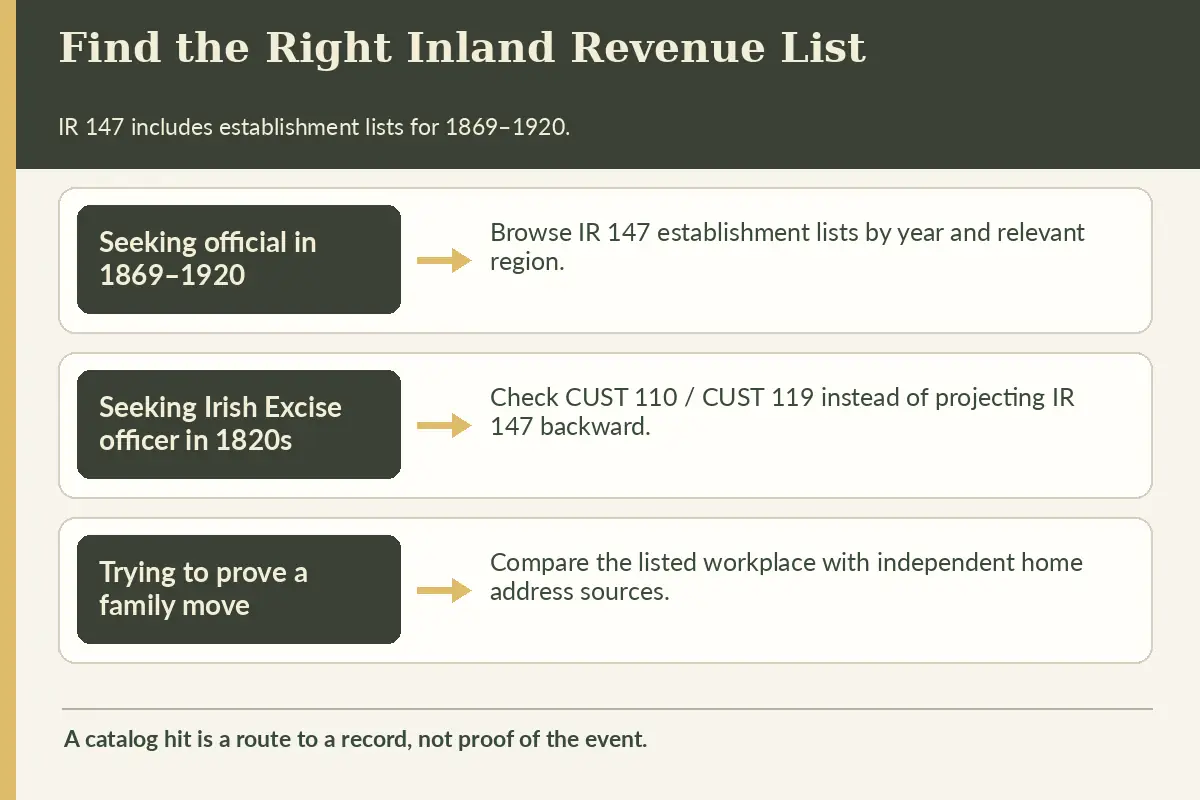
IR 147 contains Inland Revenue establishment lists covering 1869–1920, according to The National Archives. They are a promising route for identifying officials whose work appears in family records as tax inspector, collector, clerk or other revenue office employment. The archive explains that entries may include appointment and promotion dates, salaries, workplace and, in some cases, a date of birth. Each is valuable evidence, but a workplace is not necessarily a home address, and one listing does not prove continuous employment through every year afterward.
Use the National Archives Excise and Inland Revenue research guide to keep IR 147 distinct from earlier Excise Board and Irish Revenue Police records. The safest search is anchored by an approximate year, locality and job title, with the person’s name checked against independent household records.
Work from the right period, department and geography
IR 147 covers staff in England, Wales, Scotland and Ireland, but the coverage dates do not mean all years or occupations are represented uniformly in every individual volume. Browse the specific series entry to understand arrangement. An ancestor described as an Excise officer before the Inland Revenue merger in 1849 may be better sought in CUST or Treasury sources. An Irish Revenue Police officer in the 1830s belongs to a different administrative search route.
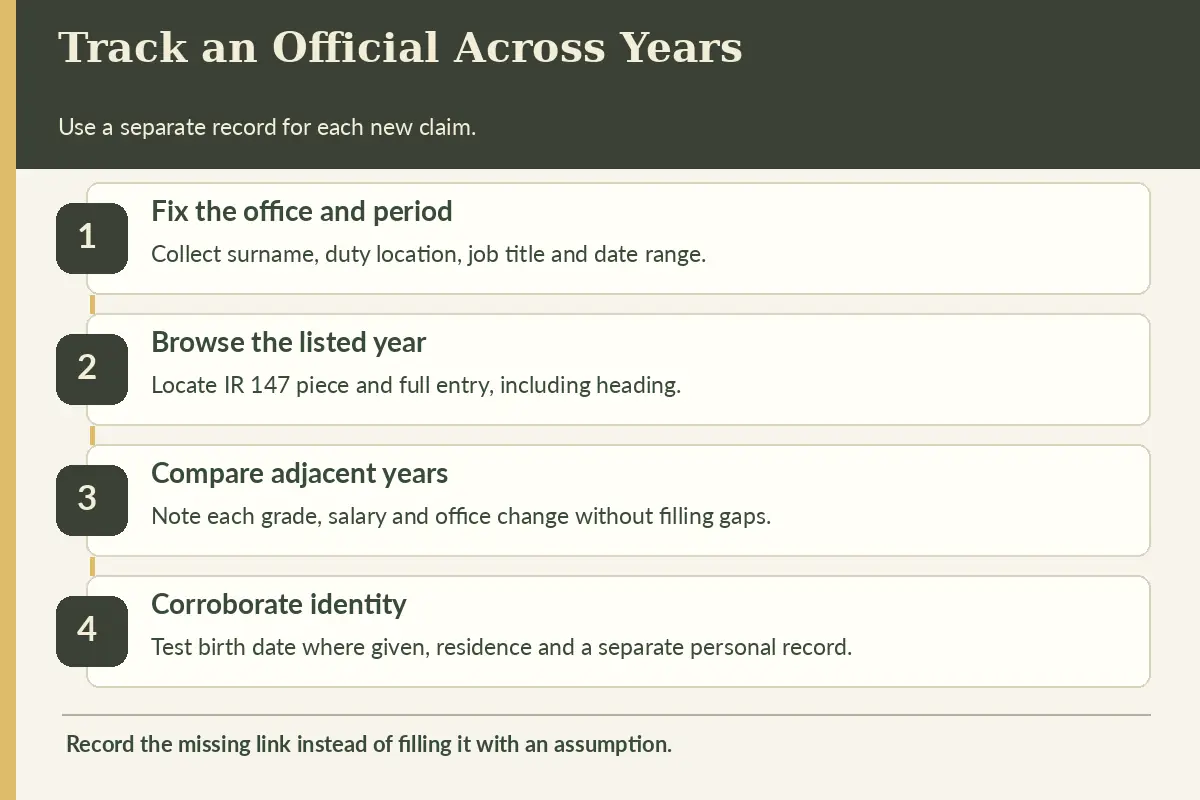
Write the earliest and latest independently established dates before opening a list. If a supposed civil servant was born after the date of a candidate entry, that result is plainly not the target. If a surname appears in several regions, treat each as a separate possible person until dates, roles, names and family details distinguish them.
Read grades and salary columns in context
An establishment list is an administrative representation of offices and personnel. Locate column headings before transcribing numbers. Record whether the amount is salary, allowance or another item, and do not automatically convert it to take-home pay or family wealth. Promotion dates and grades should be stated exactly as printed; a promotion reported in an annual list may refer to an earlier appointment. A named office may represent a duty station or administrative posting.
Create a ledger with the source year, as-printed name, department, grade, date, location, monetary field and any notes. If only an initial appears, preserve it rather than inventing a middle name. A salary difference between two list years might indicate a change in grade, annual scale or the identity of the official; it is not self-evident proof of a personal raise.
Build a cautious cross-year staff timeline
Locate adjacent years where the series permits, but remember that organizational reorganizations, list formats and record survival can create gaps. The absence of a name in one volume could mean promotion, transfer, retirement, death, variant spelling or a list outside the target grade. Do not describe a missing entry as dismissal without a record showing dismissal. If a later listing names a different office, record the difference without assigning an exact move date unless one is stated.
For a fictional “A. Morgan” who appears in Cardiff and a later “Arthur Morgan” in Bristol, a common surname and plausible transition are not sufficient. Compare years, grade, any birth-date field, middle initials and independent civil documents. A sound report may list both candidates with a specific unresolved link rather than manufacture a seamless career.
Keep workplace and family residence separate
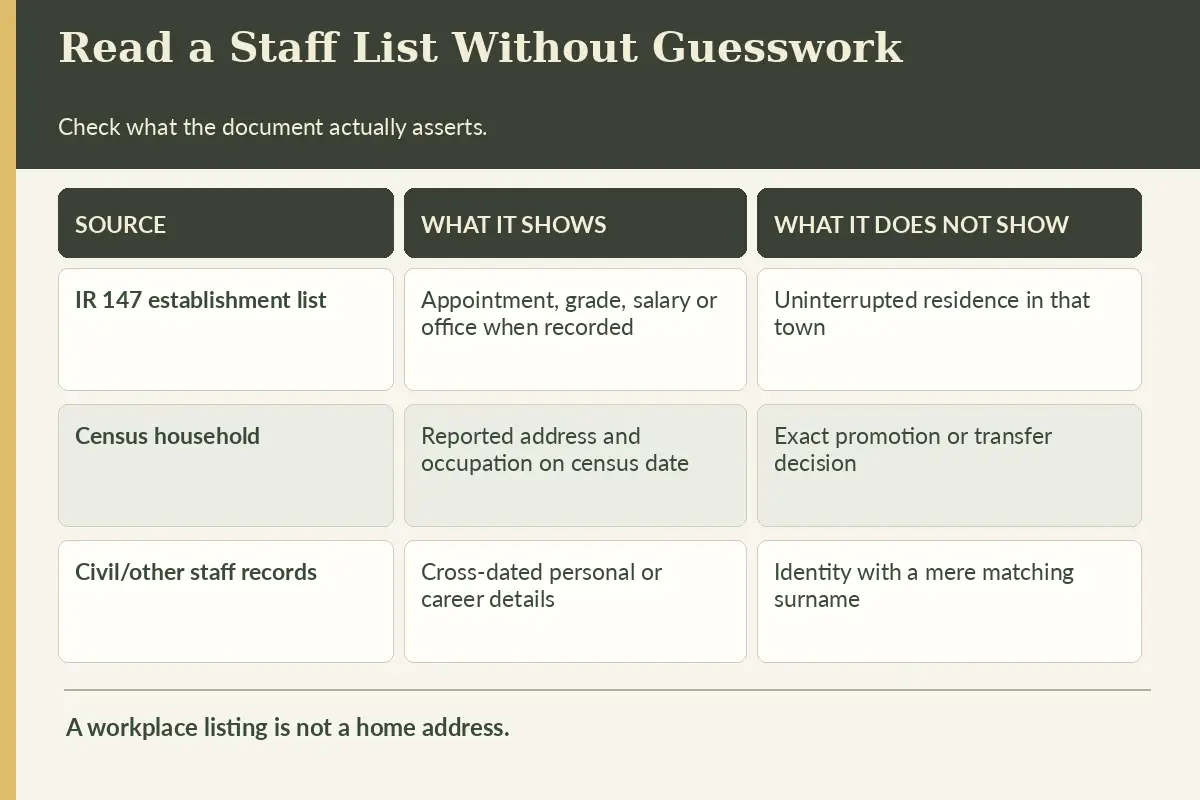
Civil and census evidence can locate a household, while IR 147 can describe official employment. They answer different questions. An official whose workplace was recorded in Birmingham may have had a family home in another locality. Likewise a census occupation of “Inland Revenue clerk” does not prove an entry under a particular initial in a central establishment list. One may need a marriage certificate, obituary or local trade directory with fuller identifying details.
If an annual list shows a transfer, corroborate the family’s move through civil registration, electoral information, school records or the next census. Do not treat the pay office as a mailing address, and do not assume all members of the household accompanied the officer. This separation matters when tracing children born in different towns during a long civil-service career.
Produce evidence that survives future source changes
Save each IR 147 full reference and the year, page or entry position. Identify whether you read a catalog description, original list or a transcribed extraction. Where the catalog gives only series-level text, browse to the relevant piece before citing it as a personal source. The exact source should support each event separately: appointment, promotion, salary and office. Note contradictory spellings and any uncertainty in handwriting or printed abbreviations.
A practical conclusion might establish that a particular official held a named post in a stated year while leaving residence and exact transfer date open. It can also explain why a candidate remains unconfirmed. This is genealogically useful: it tells the next researcher precisely which personal record would connect the official on the civil-service list to the documented family.
More Records and Archives Guides
How We Research and Verify These Records
We first review the National Archives research guidance for the collection’s official purpose, record ranges and known omissions. We then review Discovery search methods, which distinguish an indexed name from a piece description and an item actually examined. For a difficult claim we ask what an original document could establish directly and which different source would be needed to prove residence, identity, a decision or subsequent action.
Our diagrams are original editorial explanations, not reproductions of historical manuscripts. Dates are kept as stated by the archival custodian; uncertainty, gaps, and alternative searches are visible rather than hidden. Our affiliate disclosure explains the site policy. None of these archival routes depends on a paid endorsement.
The National Archives lists Inland Revenue establishment material for 1869–1920.
Appointment or promotion dates, salary, workplace and sometimes date of birth.
No. Duty location and home address must be checked separately.
No. Gaps or administrative changes may explain absence; seek an independent record.
Correlate year, grade, office and birth detail where present with independent family records.