
Separate Government Correspondence From an Event It Reports
The State Papers Domestic series SP 36 covers the reign of George II, 1727–1760. It preserves correspondence and working papers used by the secretaries of state, including petitions, intelligence, memoranda and other state business. These are invaluable historical sources, but they were not written to provide complete biographies of people mentioned in them. A letter can record what someone asked or reported without demonstrating that the government agreed, that a proposed action was implemented or that an accusation was true.
Begin by defining the kind of claim. A petition makes a request; a report describes an event from its author’s viewpoint; an order or warrant is an administrative action; a court or parish record may independently document what happened. They are not interchangeable. For genealogy, identify the exact individual named, why that name appears, which office created or received the document and what the text actually says before claiming family relationships or an official outcome.
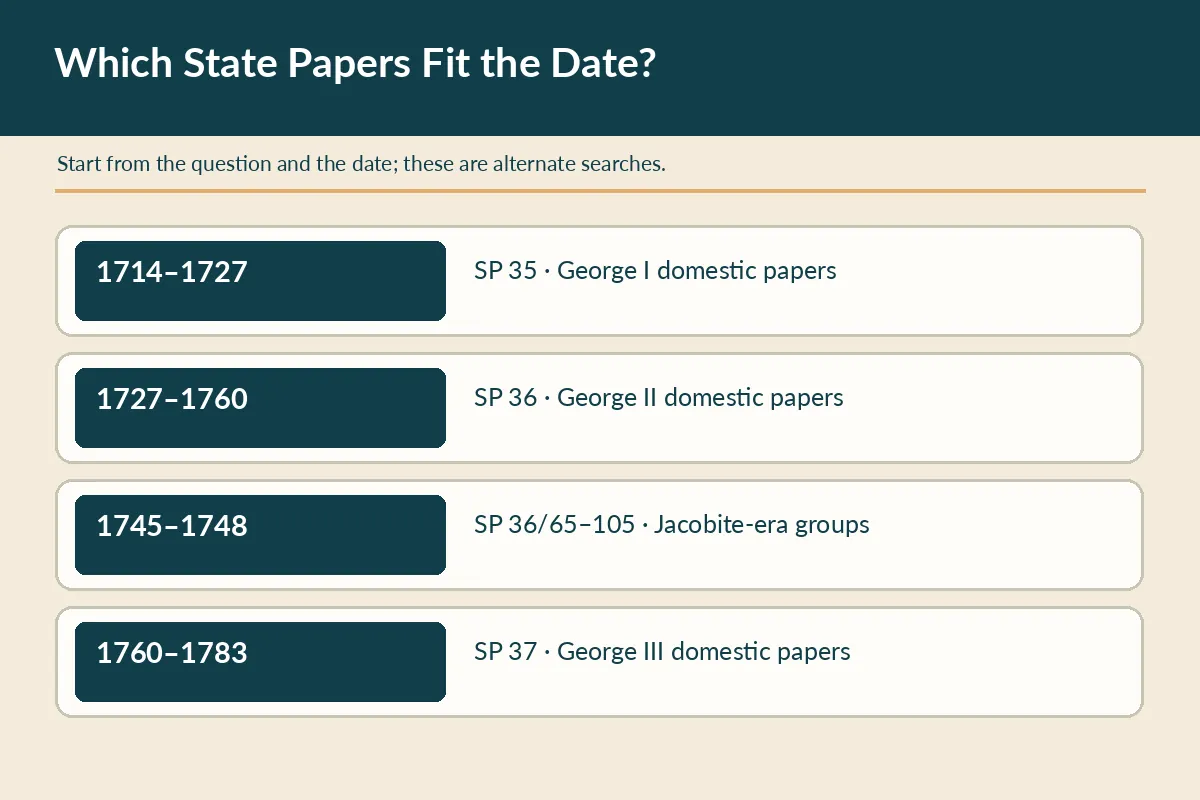
The National Archives’ guidance places SP 36 between the George I State Papers in SP 35 (1714–1727) and the George III papers in SP 37 (1760–1783). These are reign-based collections, not one continuous set of documents about a single family. Verify the document date and reign when a story spans a succession; do not assume that a paper from 1761 must still be in SP 36 just because an event began in the preceding decade.
Choose SP 36 by Date, Place and Kind of Paper
An initial search in Discovery can combine a personal name, historical locality, date and a subject keyword, restricted to SP 36. The National Archives notes that State Papers Online provides searchable descriptions and images through institutional access, with on-site access at Kew, while other finding aids include manuscript lists. Some catalog summaries are detailed and others are terse. A low-yield surname search therefore does not prove that a person is absent from the surviving volumes.
For research into the 1745 Jacobite Rising, the archive guide identifies SP 36/65–104 covering 1745–1747, SP 36/105 covering 1747–1748 and SP 36/162–163 for later activity. These ranges point to periods or groups of government papers, not a roster of all participants or proof that a named suspect was convicted. Start with a place, date and type of report, then inspect the individual paper instead of treating a whole volume as one account.
The Jacobite research guide explains that SP 36 contains 163 volumes and that a four-volume manuscript list of the series is available in The National Archives reading rooms. Use the catalog and list together when search descriptions are uneven. Keep the precise piece and item or folio reference; “SP 36, Jacobites” is too broad to retrieve a specific source. Record the original words for place names, ranks and roles, which may differ from modern indexing terms.
Read the 1730 Legal Petition at Its Actual Evidence Level
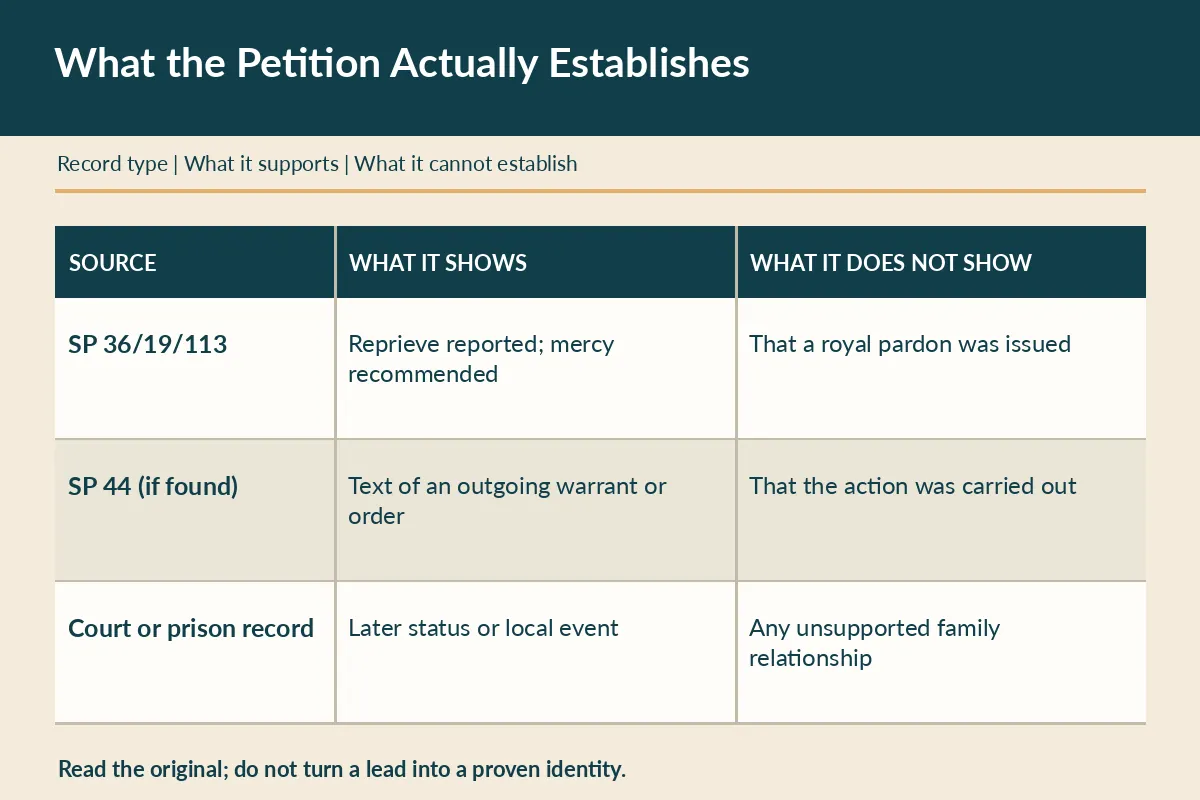
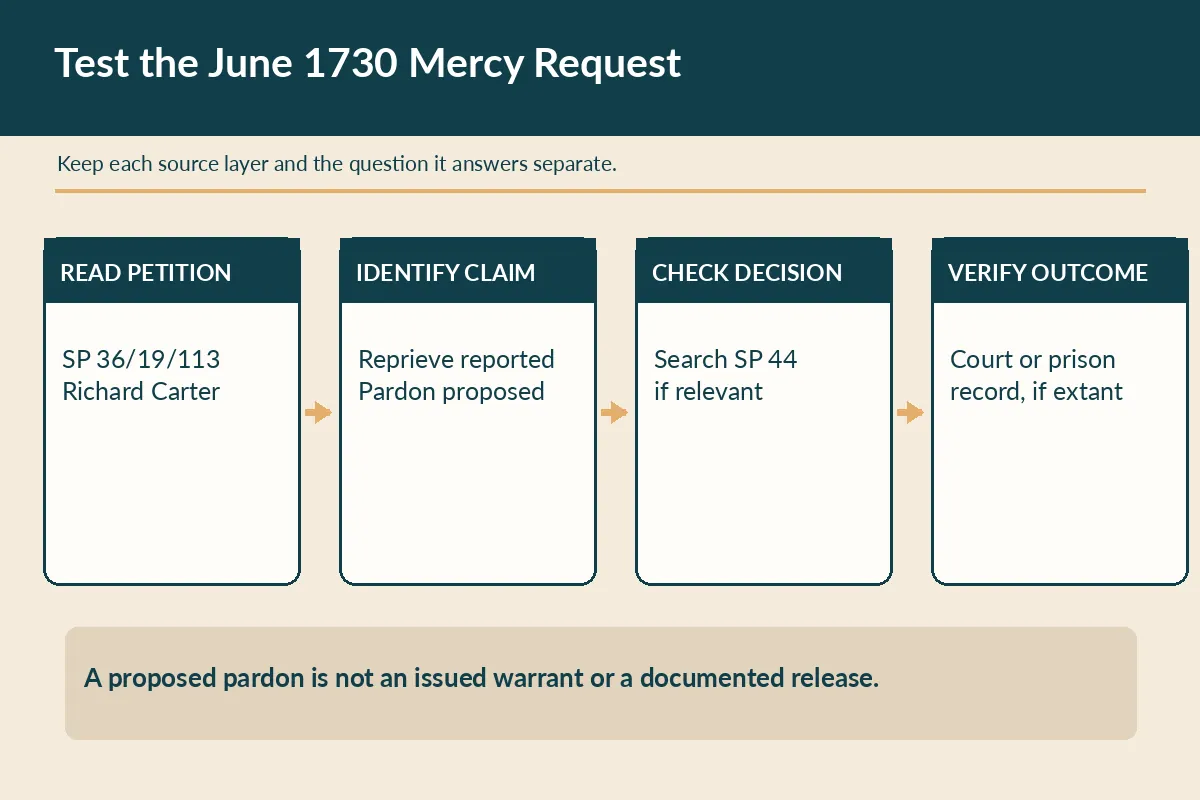
The National Archives publishes a June 1730 legal petition with the reference SP 36/19/113. In the document, Richard Carter, a justice of the Grand Sessions in South Wales, discusses Gwladis Llewelin of Neath and Morgan Lewis of Gelligaer. He reports their convictions, says he had reprieved them and recommends them for royal mercy. This is a valuable example of a named contemporaneous document. It is not by itself a final order granting a pardon to either person.
The wording matters. A judicial recommendation for inclusion in a future general pardon is a prospective request, even when it follows a conviction and reprieve. Distinguish the reported sentence, the reported reprieve, the recommendation and a subsequent official decision. In a research note, do not paraphrase these as “both were pardoned.” Find a later order or warrant if it survives, and consult criminal or transportation records where a claimed result would have been recorded.
The petition names people in several roles: the justice writing, the convicted people, and people named as owners of allegedly stolen property. Presence in the document establishes an attributed role within the account, not a family connection between them. Compare a person’s place, status, occupation and chronology with independent legal and local sources before making an identity match. A surname similarity between two individuals in the same case cannot supply a missing parent-child link.
Follow a Recommendation to a Separate Decision Source
The National Archives identifies SP 44 as a separate collection of entry books that include copies of outgoing letters, royal and secretarial warrants, reports and licenses. It is a potential follow-up when a SP 36 paper asks for a formal government action. However, SP 44 is not an automatic next volume of SP 36 and not every petition led to a warrant or a surviving entry. A search for a later response is conditional on what the original petition actually requests.
If the paper mentions reprieve, transportation or sentence, distinguish the judicial event from a secretarial recommendation and from implementation in the relevant court or custodial system. A later warrant may prove an administrative order was issued; it does not necessarily prove the person physically traveled, left prison on a particular date or lived in a named parish afterward. The source for those last events may be a prison register, transportation list, local court entry or parish record.
Construct a decision ledger with columns labelled request, who made it, evidence of approval and evidence of execution. For each row cite a real record or write “not located.” It is not legitimate to infer success simply because a petitioner was influential or the language is sympathetic. Likewise, a failure to find a response may indicate an unindexed, lost or different departmental record rather than proof of refusal.
Test Contemporary Reports Against Independent Local Records
Not every SP 36 document is a petition. A different archive example, SP 36/1/56, is a letter sent from Bristol on June 28, 1727 about protests over turnpike roads. The report describes disturbances from a government-facing perspective. Its existence proves that the account was communicated, but the interpretation and every detail of what happened require corroboration. Historical reports can use charged vocabulary or political assumptions that a modern family-history narrative should attribute rather than repeat as fact.
If a person is named in a government report, first establish whether the author personally witnessed the alleged occurrence or repeated someone else’s statement. Separate observation, hearsay, accusation and official action. For a claimed arrest, look for local judicial records or prison registers; for property damage, search accounts and local records. If people are identified only collectively, do not invent names merely because an ancestor lived nearby.
Write the final finding in claim-sized language. “A June 1730 petition recommends two named prisoners for mercy” is supportable from SP 36/19/113. “Both prisoners were released under a royal pardon” is not established by that petition alone. Preserve the exact document reference, its creator, its date and the question that still needs answering. The same method works for 1745 intelligence papers, official reports or petitions from other years in the reign.
More Records and Archives Guides
How We Research and Cite These Records
This guide uses the National Archives research guidance for the principal series, date ranges and retrieval workflow. The second archival guide supplies comparative context and cautions about record type or personal interpretation. We distinguish a finding aid from an original record, a dated institutional statement from an individual event, and a plausible identity from a proved one. We have not examined any particular family’s archival file or claimed that an illustrative example identifies a real ancestor.
For a reusable citation, record the institution, full series and piece number, item or folio if available, original document date, creator, database or catalog consulted and access date. Quote uncertain names exactly and keep a separate transcription of the document from your conclusion. An online summary may be narrower than the original and a register can point to a document that requires reading-room consultation; verify access options with the repository before ordering copies.
Before following a commercial research recommendation, review our affiliate disclosure. No paid partner or purchase is necessary for the reasoning in this guide. The next practical action is to test one named question against the specific original source, preserve the result whether positive or negative, and identify the independent record needed to confirm the conclusion.
The main series covers 1727–1760; check the individual piece and document date.
No. A recommendation or request is separate from an issued warrant or implemented decision.
It is a June 1730 legal petition in which Richard Carter recommends mercy for Gwladis Llewelin and Morgan Lewis.
The National Archives identifies SP 36/65–104 for 1745–1747, SP 36/105 for 1747–1748 and SP 36/162–163 for later activity.
No. SP 44 contains entry books including outgoing letters and warrants; it may provide a separate follow-up source.