
Locate the Medieval Deed by Place and Repository
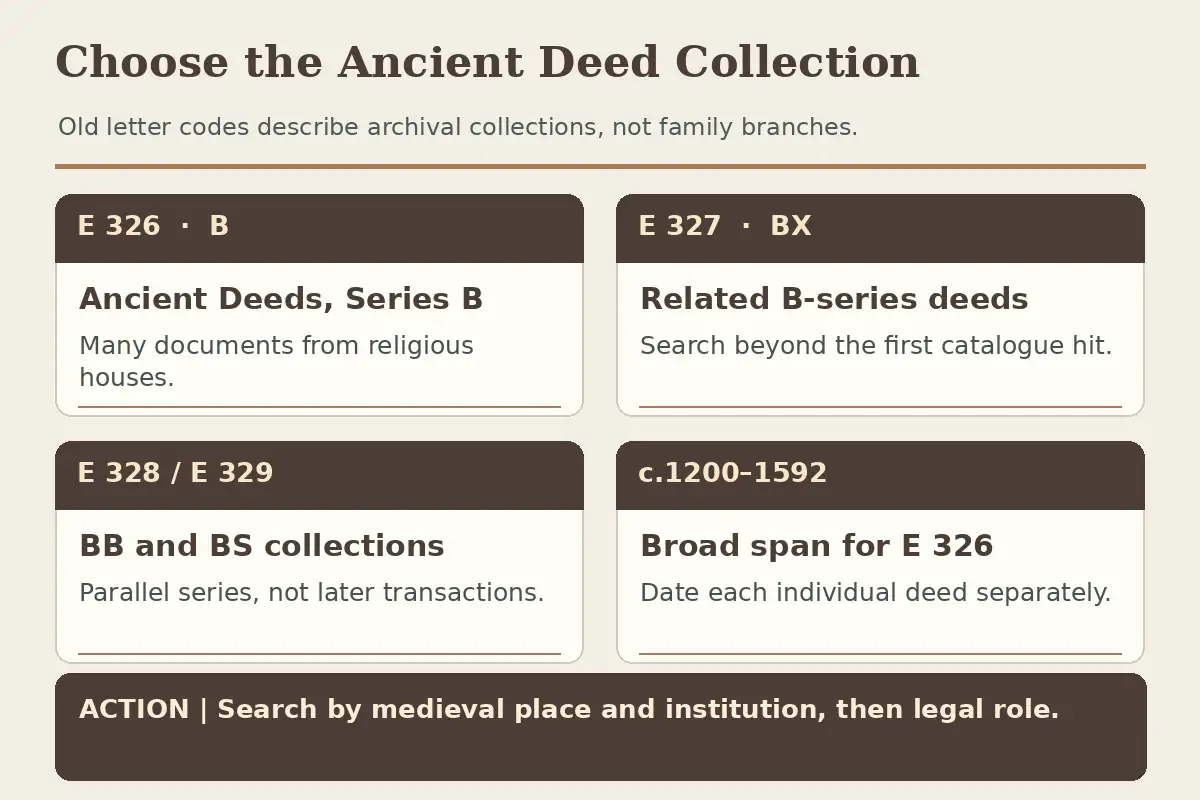
E 326 is the Ancient Deeds Series B at The National Archives, with material broadly dating from about 1200 to 1592. It is one of several artificial archival collections assembled from deeds formerly held in different government offices, rather than an original alphabetical register of families. Start with a historic place name, named religious institution, and a likely date or century. Do not mistake a searchable name for a documented ancestor until the original deed gives enough information to distinguish the person.
The official religious houses and lands guide maps the old letter code B to E 326 and distinguishes neighbouring BX, BB and BS collections in E 327–329. It notes that B-coded series contain many original deeds or other documents once held by religious houses that passed into Crown custody after the dissolution. This describes archival provenance, not a claim that every grantor was a monk, a tenant, or a donor.
Search variant medieval place names and institutional names, including Latin forms where relevant. A deed may concern land in one parish, a monastery elsewhere, and parties resident in yet another place. Write each location and role in a separate field. The series reference alone will not tell you which kind of place each name represents.
Identify Parties, Witnesses, and Legal Roles
Read the operative clause before extracting people into a family tree. Someone can be a grantor, grantee, lessor, lessee, witness, heir named in a formula, or a person from whose prior holding the land is described. Each role has a different evidential meaning. A witness’s surname matching the grantor is not evidence of parentage; even jointly named parties need not be related unless the deed says so explicitly.
Look for boundaries, neighbouring landholders and descriptive property phrases. A person named as the prior occupant of a messuage may help locate the parcel but need not be the owner on the date of the deed. Medieval deeds can use recurring formulae and repeated forenames, so surnames alone cannot bridge to a family living a century later. Keep the verb, any tenancy term and the document’s own relationships in a literal transcription.
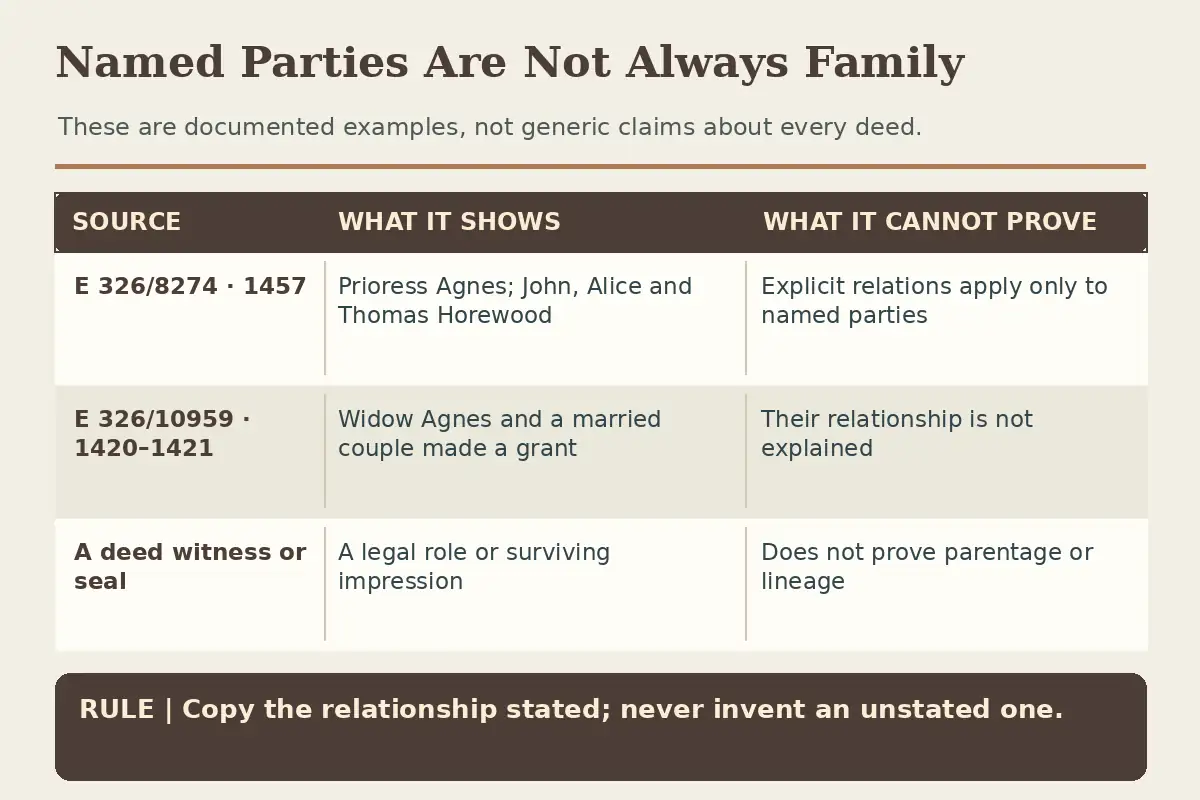
The National Archives medieval women teaching resource describes E 326/8274, a March 1457 indenture involving Prioress Agnes Allesley of Catesby and John Horewood, Alice his wife and Thomas their son, concerning a house and fields in Staverton. That example explicitly supplies relationships for the named Horewoods. It does not license the assumption that everyone appearing together in another deed is family.
Decode Seals and the Limits of Identity
Seals could be attached to deeds to authenticate the parties’ commitments, but a surviving motif does not operate like a modern identity photograph. Read the catalogue description and any legend visible on the seal; describe an illegible or damaged impression without guessing the letters. A fox, bird or geometric device may be interesting evidence of seal design but does not prove heraldic ancestry or a particular bloodline.
The record E 326/10959, highlighted by the National Archives in its collection exploration, concerns a 1420–1421 grant by three people including a widow and a married couple. The archive explicitly notes that their precise relationship and the reason for their joint land interest are not stated. This example is a useful safeguard: named women, multiple seals and shared action can be documented while kinship remains unknown.
If a document is an indenture, its cut or shaped edge can reflect the production of counterpart texts, but do not assert that an unattached second copy survives. Where a date is expressed by a feast day or regnal year, preserve the source wording before applying a conversion. A modern date supplied in a catalogue is a useful finding aid; verify the original when a precise timeline matters.
Follow the Tenancy, Not an Imagined Pedigree
Distinguish transfer of property from use of property. A lease for lives is not a perpetual freehold title, and a land description may name a prior holder without recording that holder’s full ownership history. E 326/8274’s described rent of fifteen shillings per year, payable in two installments, illustrates an agreement governing tenure. The amount is a term of that example, not a template to apply to every medieval holding.
The National Archives overview of land ownership and deeds explains that many ancient deeds were removed from their original archival contexts and regrouped. Related court or estate material may therefore be difficult to reconstruct. A catalogue search may show the first transfer you found, not the first transfer that occurred.
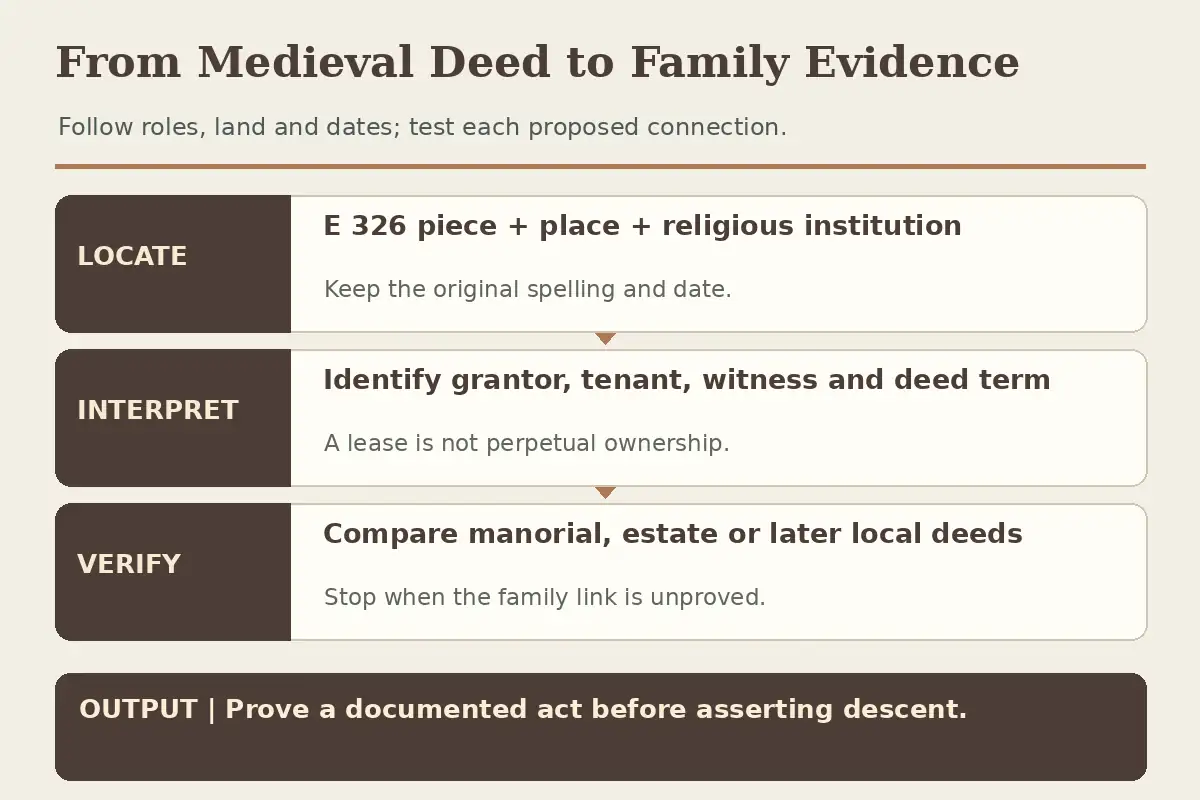
Make a crosswalk of DEED DATE, LEGAL PARTIES, LAND DESCRIPTION, TERM, ORIGINAL SERIES, and UNPROVEN LINKS. Search local manor court records, rentals, religious-house cartularies and later deeds by place rather than joining two centuries of surnames. Where there is no intervening evidence, stop the family connection at the last proven generation.
Record an Auditable Medieval Conclusion
Cite the exact E 326 piece and the original document, then record how you obtained the catalogue translation or transcription. Keep damaged words in brackets, and distinguish uncertain expansion from words plainly visible on the parchment. A different reader must be able to repeat your interpretation from the same source.
A strong finding might establish that a named woman granted, held, witnessed or leased a property on a documented occasion. It should not turn a joint seal, tenancy, or identical surname into a mother-child relationship without direct support. The value of E 326 lies in recording real medieval legal actions while showing exactly what remains to be researched.
More Records and Archives Guides
How We Research the Archival Evidence
Our method begins with the repository’s description of each series, its date limits and its known gaps. We compare record purpose with the question under investigation and distinguish direct statements in an original document from the cataloguer’s summary, a family tradition, and inference. The examples and record-class distinctions in this guide derive from the official sources listed below; they are guidance for finding and evaluating a document, not proof that any particular family member appears in it.
Official references checked on October 29, 2026: religious houses lands 1000 1530. land ownership records and deeds an overview. medieval women. We recommend recording retrieval dates and consulting the original image or physical document when possible. See our affiliate disclosure for site-wide relationship information; no paid relationship is implied by these archive links. The National Archives collection example of women in medieval deeds documents E 326/10959.
No. Match the person across independently dated records using place, role, age when available, associates and documented relationships. A name hit is only a research lead.
A catalogue or printed calendar can locate a record and supply context, but summaries may omit wording and qualifications. Inspect the original before making a strong personal claim.
No. A series may have coverage limits, losses, poor indexing or alternative filing. Record the years, references and spellings actually searched before describing a gap.
Keep the complete archival series and piece, item or folio where available, document date, repository, image or physical access route and the exact claim supported.
Write a precise hypothesis and find an independent record of the relevant person, place or event. Keep unverified relationships and movements clearly labeled as unproven.