
To research the nuclear-powered N.S. Savannah in archival images, check the two AEC photo groupings before trusting the picture. In NARA RG 326, NSA refers to 141 images of artist renderings and interior details from 1961; NS refers to 76 photographs of the ship from 1962. An elegant shipboard room in NSA may be a design view rather than evidence that passengers used that exact room during an actual voyage.
This difference matters to anyone researching the vessel’s construction, museum history, or a relative reportedly aboard it. The Maritime Administration places major reactor work in 1961 and the maiden voyage in 1962. The archival strategy is to identify a single image, verify its production context, and then use dated ship or personnel records for a specific claim. A rendering, a photograph, and a voyage record answer three different questions.
Choose the AEC Photograph Series Before Interpreting the Ship

The National Archives description of Record Group 326 distinguishes two very specific still-picture groupings. NSA contains 141 photographs of artists’ renderings and interior details dated 1961; NS contains 76 photographs of the nuclear-powered ship dated 1962. Those are not interchangeable inventories. Record the two-letter series designator alongside the record group, date, object in view, and any item number before making a historical statement.
Begin with the physical question. Is the image an artist’s perspective drawing, a photographed interior detail, an exterior view, or a photograph of machinery? A photograph of a painting is still a photograph as a medium, but its subject is a proposed appearance. A room visible in a rendering cannot, without other evidence, prove the same furnishing was installed, occupied, or still present during a voyage.
Use the 1959–1965 Milestones as a Dating Check
MARAD dates the launch to 1959 and the testing and reactor-fueling period to 1961. Its historical timeline places the maiden voyage in 1962 and experimental service in 1962–65. Therefore, the 1961 label on an NSA rendering belongs to the design-document sequence and is not a statement that a 1962 voyage occurred in 1961. A photograph taken during a fitting-out stage likewise need not show final operational conditions.
Compare deck configuration, gangways, signage, furniture, decorative panels, and visible equipment, but avoid asserting a definitive difference until both images have a stable archival identifier. Camera angle, reproduction cropping, and the artist’s license can all make similar rooms look different. A contradiction may be a design change, a photographic limitation, or two entirely different shipboard spaces.
When studying an image labeled “Savannah,” also check the archival institution, the full vessel name, and the series code. RG 326 belongs to the Atomic Energy Commission, not a generic maritime photo album. Do not confuse the ship with the Savannah River nuclear site, another subject that appears in the same record group’s textual arrangement.
Record What the Image Actually Establishes

Build an evidence ledger with four headings: repository and series; visual observation; original caption or catalog wording; and personal or operational inference still requiring a source. From an NSA rendering you may describe a proposed interior appearance and the existence of a visual-design artifact. From an NS photograph you may describe a visible portion of the vessel at the moment of exposure, if the caption and date are credible. Neither image automatically supplies crew names.
A visually plausible passenger lounge is not a certified passenger list. A control room may show equipment but not prove which operator handled it, whether the reactor was critical, or whether a particular voyage was underway. Look for a log, manifest, official program report, or a dated caption that states the claim explicitly. Where the images cannot be conclusively paired, state “possibly corresponding views” rather than inventing a before-and-after story.
NARA describes images at the series level, not necessarily every digitized scan. Search the catalog, request the item description if necessary, and preserve the exact credit line. A family scrapbook’s reproduction may have a different date from the underlying view. Treat a later publication or anniversary caption as evidence of circulation, not automatically of the exposure date.
Test a Specific Shipboard Claim Against MARAD Records
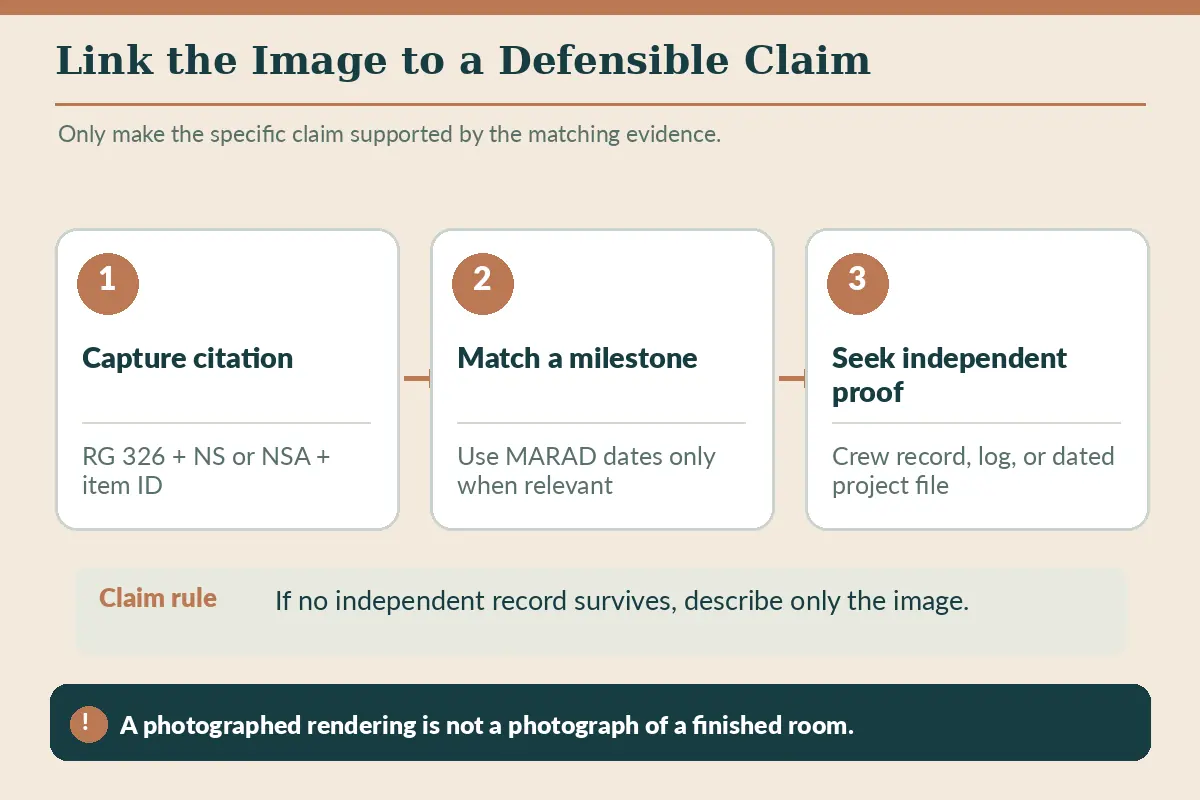
For a claimed 1962 sailing, start with an NS photograph whose caption identifies the port or event. Consult MARAD’s ship history for the known operational sequence and seek voyage-specific documentation rather than attaching that voyage to any generic exterior shot. For a claimed interior that existed during 1961 testing, compare an NSA image with separately dated shipboard documentation; a year-matched design illustration alone is not enough.
If the researcher is tracing a relative said to have worked aboard, collect the person’s name variants, role, approximate dates, employer, and independent service record. A posed publicity image of a reactor room or a group of visitors is not evidence of paid employment. The Atomic Energy Commission, shipbuilders, operating agents, and MARAD had different functions; an agency’s ownership of a photograph does not make everyone pictured its employee.
Write conclusions at the level the material permits: “The AEC preserved a 1961 rendering of a proposed interior”; “a 1962 NS photograph shows a completed exterior feature”; or “the identity of personnel in the image is unverified.” The most productive follow-up is the missing dated record, not a more confident caption.
More Records and Archives Guides
How We Research N.S. Savannah Images and Their Limits
Our starting point is the NARA RG 326 description, which supplies the separate NSA and NS series, dates, and approximate counts. We then compare those archival facts with the official Maritime Administration history. The years in those sources do different jobs: image grouping, ship-development milestone, and period of operation. We do not use them as substitutes for one another.
Before citing a particular scene, we would request its actual catalog identifier and original caption through NARA’s still-picture research guidance. No individual rendering here is asserted to match a particular voyage photograph. See our affiliate disclosure; these official research links are not presented as paid recommendations.
The physical item may be a photograph of an artist’s rendering. It documents the rendering, not necessarily the completed space.
They are distinct NARA series designators in RG 326: NS for 1962 ship photographs and NSA for 1961 renderings and interior-detail images.
No. MARAD places the maiden voyage in 1962. An image year is not a voyage history.
No. Confirm the individual from captioned imagery plus independently dated personnel or ship records.
The published series counts do not establish current online availability. Check the NARA catalog and contact the holding unit for a specific image.