
BT 347 can confirm a recorded Second World War merchant-ship casualty. It does not identify the entire crew. First find the vessel and loss in the BT 347/8 index and date-ordered register; only then investigate a particular seafarer.
Start With the Ship and the Incident
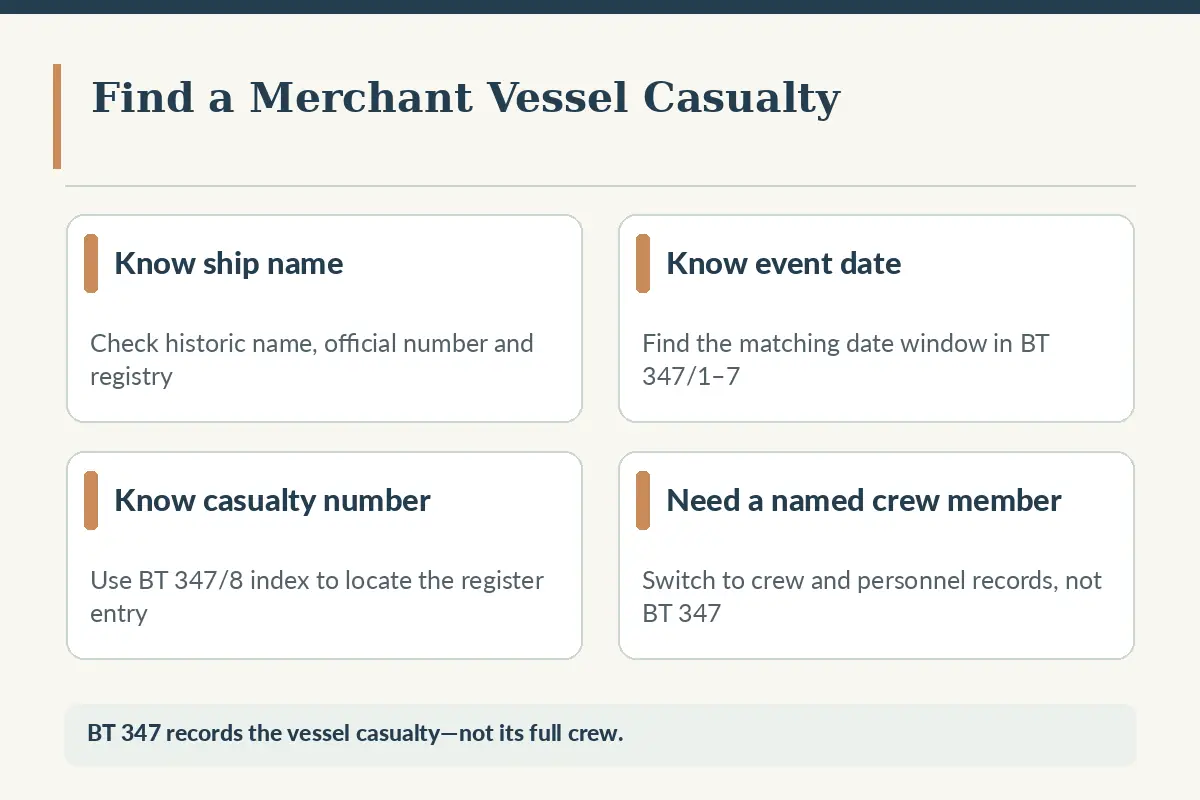
BT 347 documents losses of British merchant vessels in the Second World War. It is a ship-casualty source, not a register of the people who sailed on every voyage. The National Archives identifies casualty registers in BT 347/1–7 and a microfiche card index in BT 347/8. The registers are arranged by date, with a casualty number helping to find the incident. A family claim that a relative “went down with” a particular vessel must therefore be tested using other records after the vessel has been identified.
Begin by writing down the ship’s name exactly as reported, an approximate date, port, shipping company and the source of the family statement. Check whether the incident involved sinking, damage, disappearance or a vessel with a similar name. Ships can change names and owners; two ships may share a common name. The official number and registration history, where available, are stronger discriminators than a name alone.
Follow the Index Into the Date-Ordered Register
Use The National Archives merchant ship registration guide to locate BT 347/8, the microfiche casualty index held at Kew. Transcribe any casualty number, vessel name and indicated date without normalizing uncertain spellings. Use the exact number and time window to identify the relevant entry in BT 347/1–7. Catalogue availability and the index medium must be checked: it is not safe to assume that every part is remotely viewable.
A casualty register may record a single administrative incident involving a ship, but the case number itself is not an individual sailor’s identifier. Record any reported cause and dates with the vocabulary actually used by the original. Terms such as “lost,” “missing” or “damaged” should not be harmonized into “sunk with all hands.” If a loss is disputed, compare independent maritime records written nearer to the event.
Distinguish Sinking, Damage, and Closure of Registry
Official ship-registration transcripts and transactions in BT 107–110 can help establish a vessel’s identity and why its registry closed. Closure does not always mean destruction: sale to foreign owners or later re-registration may produce similar administrative traces. The Archives’ shipwreck guide specifically warns that BT 110 closure papers can reflect a loss or other reasons. A discrepancy between casualty date and registry closure date is therefore a question to investigate, not proof that one source is wrong.
Check a wartime vessel’s movements in BT 389 where surviving movement cards can provide a route or port chronology. A movement card documents a ship’s movements and not a full roster. Newspaper reporting, Lloyd’s war losses, or Board of Trade correspondence can add circumstances but may contain wartime errors and changing estimates. Cite each statement with its publication or creation date; an initial report of “presumed missing” is not a final finding.
Find the People Only After Establishing the Vessel
The explicit archival limitation is that BT 347 casualty registers concern ships, not crew members. To determine whether a specific person was on board, look for surviving crew agreements, personnel records, casualty rolls or official notifications under the relevant Merchant Navy guides. Match names using date of birth, rating, discharge number, next of kin and voyage period where those fields are actually present. A ship listed in an ancestor’s career record does not establish presence on its last voyage.
The ship may have changed its complement after the last surviving list; some lists are missing, and transfers can occur between recorded dates. Record a separate source for death, survival, rescue or repatriation. A memorial inscription may help identify a candidate but need not describe how death occurred. When discussing wartime casualties, distinguish recorded death, a presumed death and an unresolved disappearance; avoid declaring a person dead solely from a vessel’s loss.

Resolve Ships With Similar Names
An effective vessel identity ledger includes historical ship name, official number, port of registry, tonnage where known, owner or operator, and the event date. If two records disagree on spelling, keep each recorded version linked to its own original. A date-only search can fail if a newspaper reports the event days later; a name-only search can retrieve unrelated ships. Cross-check the administrative number, casualty details, and at least one independently dated source.
For incident geography, distinguish departure, final reported sighting, position of damage, sinking location and port reached by survivors. These may be different places. Likewise, an insurance claim about cargo need not establish the fate of the vessel’s crew. Construct a date-by-date timeline with the certainty of each entry; mark estimates as estimates rather than converting them into precise coordinates or dates.
When the Register or Index Is Incomplete
The absence of a name in BT 347/8 is not definitive proof that a ship was never lost. Test variant names, different year estimates, the possibility that the ship was foreign registered, and whether a record concerned damage rather than total loss. Check The National Archives shipwreck research guide for alternative loss reports, company files, published sources and registration papers.
A useful negative-search note identifies the exact BT 347 index consulted, time window, spellings, and catalogue or viewing limitations. It should also record whether the search concerned a ship or a person. This prevents a later reader from misinterpreting “no crew entry” as a negative result in a source that never attempted to identify crew in the first place.

More Records and Archives Guides
How We Research a Wartime Ship Loss
We begin with the vessel as an entity: name, official number if possible, date and port. We consult BT 347/8 before the date-ordered BT 347 registers, check BT 389 or registry records for vessel identity, and only then start a separate named-person search. This order prevents the common leap from “my relative sailed in this ship” to “my relative was present at this casualty.”
We note the author, time, claim and scope of each account. Where sources conflict, we show the competing dates or casualty descriptions and request the underlying image rather than preferring an unverified index snippet. For any linked commercial research tools, our affiliate disclosure explains the site’s policy; the evidence standard is the same regardless of access route.
No. The official guide states the registers relate to vessels and do not include crew.
Establish its official number and approximate incident date before consulting the BT 347/8 casualty index.
The casualty registers are in date order; the separate microfiche index helps researchers find the casualty number.
No. Closure can also reflect foreign sale or other changes to registration.
Find a dated personal service or crew source for the voyage and compare it with independent casualty or death evidence.