
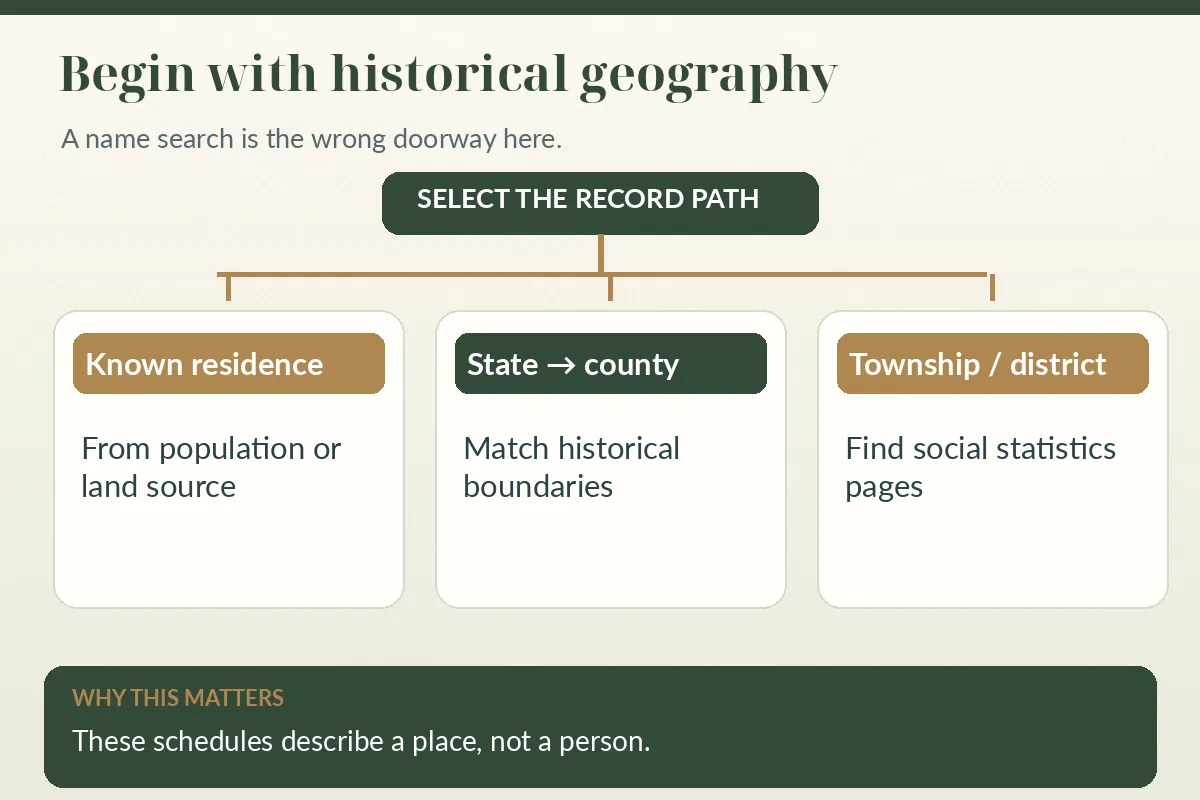
Use the U.S. federal social statistics schedules of 1850, 1860 and 1870 to learn about the community in which an ancestor lived—not to find that ancestor by name. These nonpopulation schedules describe subdivisions such as townships and city districts, recording schools, denominations, newspapers, wages and other civic statistics. The National Archives explicitly warns they are statistical, not person-level sources. Begin with NARA’s nonpopulation census guide and the ancestor’s independently documented town or enumeration area. Find the schedule by historical place, year and custodian; avoid implying an individual attended a listed school or church. See our affiliate disclosure.
Start With a Place, Not a Person Name
The main historical value lies in context. A town-wide newspaper list can direct a search for a family obituary; school counts can suggest what educational institutions existed; wage figures can provide background for a laborer’s possible economic setting. None of those columns generally names an ancestor. If a person-level 1860 census lists an occupation and residence, use those facts to choose a social statistics subdivision, then return to named sources for the individual’s own activities. That source sequence is different from a farm or manufacturing schedule, which may list an owner or operator by name.
Social statistics were collected with the 1850, 1860 and 1870 federal censuses. NARA groups nonpopulation schedules by state, county and political subdivision, but surviving holdings and access vary widely. The research starting point is not a nationwide name search. Verify the exact state and historic county for the event year, then open NARA’s state-by-state listing for the appropriate microfilm or linked custodian. A film description might bundle agriculture, mortality, industry and social statistics, so read the schedule heading and internal page reference before drawing a conclusion from the wrong section.
Find a Surviving State and Local Schedule
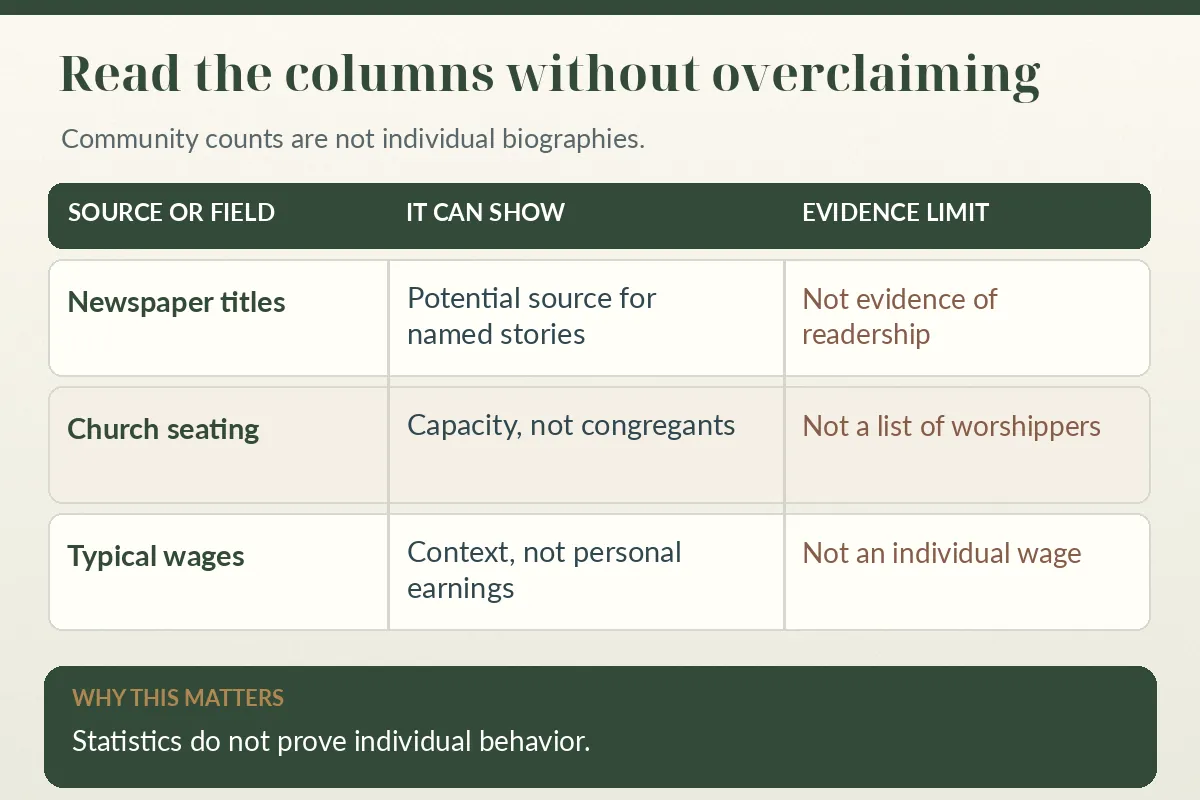
Several kinds of columns matter. NARA lists values of real estate, annual taxes, schools, teachers and pupils, libraries and volumes, newspapers and circulation, church denomination and seating, certain public relief and prison aggregate measures, and wages for particular kinds of labor. These are not interchangeable categories: church seating counts are capacities, not a census of parishioners, while newspapers listed may be published within the district rather than read by every household. Wages are contextual figures, not a pay slip for your ancestor. Describe the geography and the measurement before copying any figure.
Extract Schools, Churches, Newspapers, and Wages
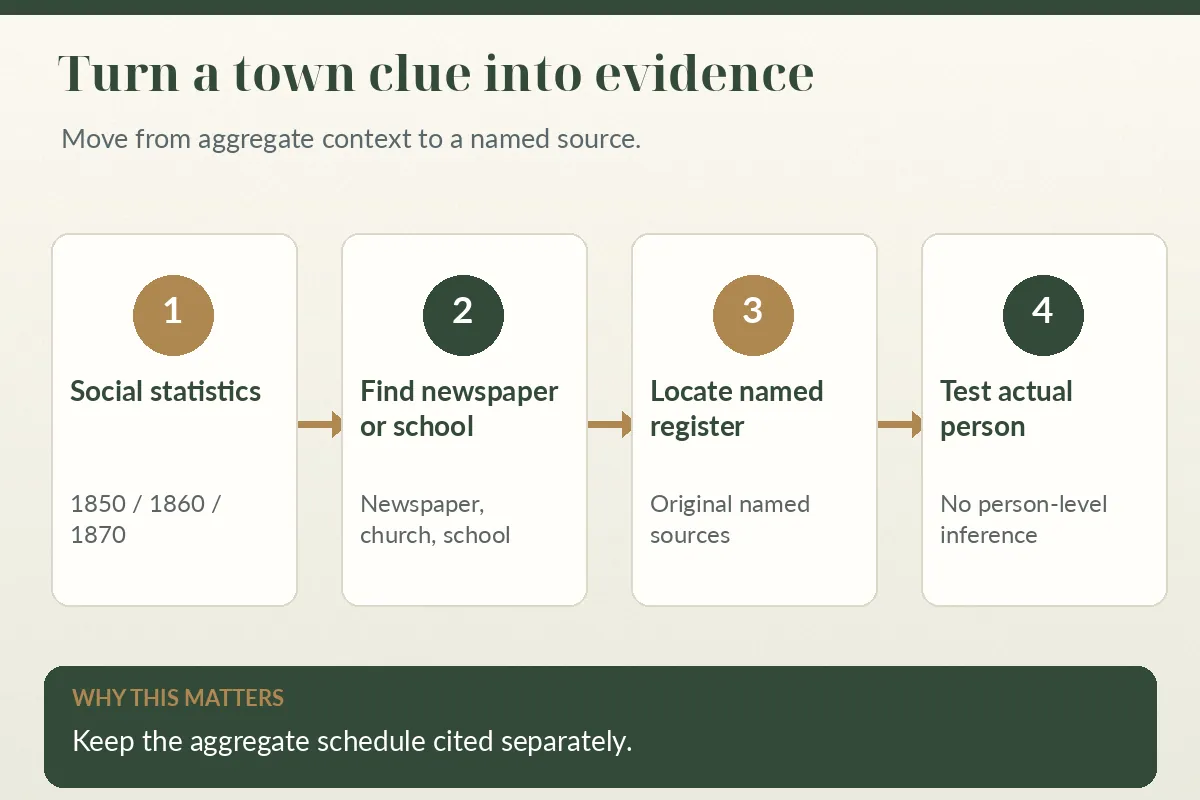
For example, finding two newspapers in a township can identify publications to investigate by title and date. NARA’s Social Statistics research example shows that newspapers can be named in this census material. Next search surviving issues through libraries and newspaper repositories, checking title changes and publication ranges. A publication listed in 1850 does not prove a particular household subscribed to it, read it or advertised in it. The schedule is a discovery tool for a new source, not the final evidence for an individual’s life.
A church entry is similarly limited. The social statistics schedule can give denomination, number of churches, seating capacity and church property values. These may guide a search for a parish, congregation or regional religious archive, but do not identify the residents who attended. A church’s existence in a district is not evidence that every person of that faith was baptized, married or buried there. The year of a family’s migration may also put an event outside the census reference period. Search actual congregational membership, sacramental or cemetery records for person-level claims, with the correct congregation and date.
Turn Community Clues Into Original Person Records
Schools and libraries are useful if the historical question concerns access to education or community conditions. A count of teachers and pupils does not reveal which named children attended, and a library inventory does not establish anyone’s literacy or membership. Trace school districts or institutional names in county education reports and local manuscript collections. If a later school register is found, evaluate whether it records enrollment, daily attendance or a different event. Do not transform a community total into the identity of an individual pupil. A statistical document’s value is often to identify where named registers might survive.
The schedules also contain historical classifications about crime, poverty and nativity. Treat these as period government definitions and aggregated counts, not objective descriptions of all residents or evidence about a particular family. A report of convicted persons in a district does not identify the defendant or prove that an ancestor with the same surname was imprisoned. Population, geography and definitions may change between censuses. Avoid per-person rate calculations without compatible denominators and documented methods. Privacy and responsible interpretation apply even to historical categories, particularly when they could stigmatize descendants or communities.
| RECORD / FIELD | CAN SHOW | DOES NOT PROVE |
|---|---|---|
| Newspaper titles | Potential source for named stories | Publication is not personal readership |
| Church seating | Capacity, not congregants | Capacity is not attendance |
| Typical wages | Context, not personal earnings | Typical wage is not personal pay |
Avoid Statistical Claims About One Household
A missing county can be a custody problem rather than an absence of schools or newspapers. NARA’s Record Group 29 guide lists varied nonpopulation holdings, and its state-by-state table sends researchers to other institutions in some jurisdictions. Verify whether originals, microfilm or digital images survive and which dates they cover. If the relevant 1870 social statistics schedule was never located, search local histories, contemporary gazetteers, town minutes and annual reports, while noting that these are substitute sources with different reporting standards.
Imagine a fictional 1860 mill worker, Martha Reed, recorded in a Pennsylvania population schedule. The social statistics material for her town names two newspapers, several churches and typical labor wages. A valid conclusion is that these institutions and reported conditions formed part of the town’s context. It would be wrong to assign Martha to a particular congregation, assume she earned the average wage, or say she read a specific newspaper. To answer those personal questions, seek payrolls, membership rolls, school documents and newspaper issues with explicit names. The statistical schedule should guide, not replace, that next search.
Test a Hypothetical Mill-Town Search
Capture the state, county, township or city subdivision, year, schedule type, page or image number, custodian and exact column. Build a two-level log: one row for what the town’s statistics actually report, another for the specific named record to pursue. Keep comparisons between 1850 and 1870 cautious because boundaries, question wording and surviving pages may differ. A blank cell can reflect a reporting omission, an unknown quantity or a category not used on that form. State exactly which. In a family-history article, cite both the aggregate source and any original named evidence it helped you find.
More Records and Archives Guides
How We Research Social Statistics Schedules
Our workflow starts with independently documented residence and dates, then follows the NARA geographic and state-custody route to the original social statistics sheet. We read its period-specific column headings and note the denominator or measurement, not just the number. We then use newspaper, school, church and wage clues to select external records that can name an individual. The boundary is explicit throughout: social statistics can describe a place but cannot establish a named person’s attendance, earnings, denomination or alleged misconduct. This makes the record valuable without claiming more than it can show.
Generally no. It is a community-level statistical schedule, not a person-by-person enumeration.
Federal social statistics schedules relevant here are 1850, 1860 and 1870.
No. It identifies a local publication to investigate for independently named evidence.
No. Seating is a capacity-related measure, not a named attendance list.
Use NARA’s state-by-state nonpopulation schedule list and check the responsible archive or microfilm.