
The National Archives’ World War II Army Enlistment Records are reconstructed electronic data on roughly nine million Army enlistments between 1938 and 1946, not complete individual service files. Search by serial number or name, verify enlistment date and residence, then assess coded fields and gaps. The data exclude officers and people serving only in other military branches; many records are missing or partly unreadable. NARA lists the series in its WWII electronic-records reference. The database helps identify a soldier for further research, but does not itself document the whole wartime career. See our affiliate disclosure.
Decide If the Enlistment Database Can Contain the Person
The first step is an eligibility check. The source encompasses enlisted personnel in the U.S. Army, including the Enlisted Reserve Corps and Women’s Army Auxiliary Corps, for 1938–1946. It does not provide a universal list of all who served in World War II, nor a reliable negative test for officer service, other branches or enlistment outside the covered period. An ancestor in the Navy or Marine Corps calls for branch-specific records; an Army officer normally requires separate personnel sources. Begin with known documents such as a discharge paper, obituary or unit history, but do not assume family stories use ranks and service terms consistently.
NARA identifies the electronic collection as the Army Enlistment Records series, National Archives Identifier 604357, and describes separate data tables. Its longer technical history and genealogy article explains how the original punch-card data were microfilmed, scanned and reconstructed. Old instructions for the Access to Archival Databases interface may not match every current catalog screen; use the archive’s current catalog links and record description first. Always capture the actual database title, search terms and record identifier in a research log rather than relying on a third-party transcription alone.
Search by Serial Number, Name, and Context
Search a known Army serial number without punctuation if the interface accepts it, then verify name, enlistment date, state and county of residence, and place of enlistment. If no serial number survives, search full name and variants, narrowing by approximate birth year or state where the interface permits. A name match is especially weak for common names, and adjacent serial numbers are not proof of family ties. Sometimes residence and place of enlistment differ because a person joined away from home. Compare these fields with an independent wartime letter, draft card or discharge record before accepting the hit.

Translate Punch-Card Fields Without Overreading Them
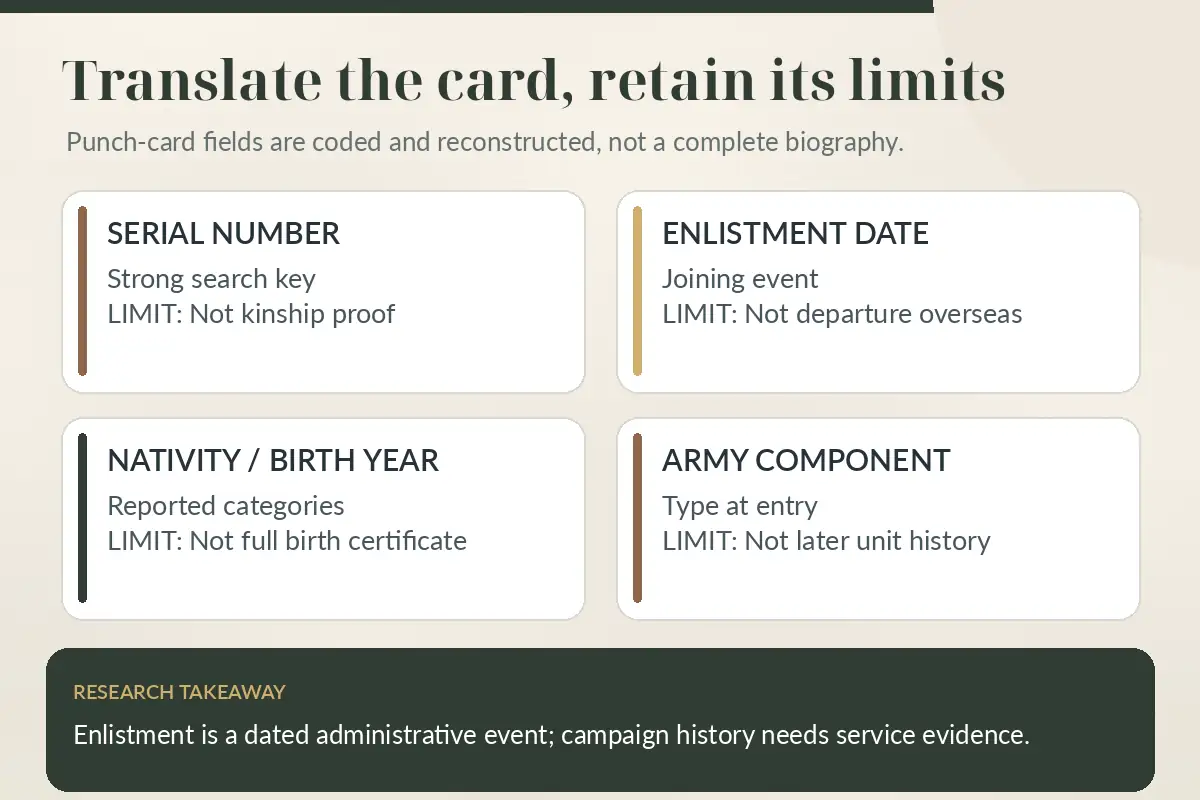
Common fields include an enlistee’s Army serial number, enlistment date and place, component, enlistment grade, branch, reported birthplace or nativity, year of birth, education, civilian occupation and marital status. Values often represent coded categories reconstructed from a card, not narrative testimony. Not all fields appear for all periods, and the meaning of a code can vary with format or be undefined. If the displayed value appears implausible, do not substitute a more attractive answer from a genealogy site. Check NARA’s documentation and preserve both the original code and the interface’s interpretation where possible.
A birth-year field is not a full birth certificate; nativity may be a broadly coded jurisdiction rather than a precise birthplace. A marital-status code does not identify a spouse, and a civilian occupation at enlistment is not necessarily the soldier’s postwar career. Treat ethnicity and race categories as classifications used by a historical government form, not objective conclusions about a person’s identity. An assigned branch or grade at enlistment should not be expanded into a complete sequence of wartime units, campaigns or promotions. Use service documents for those questions. Distinguish the reported or encoded fact from an inference you make about the person.
Investigate Unreadable Cards and Missing Enlistments
The coverage has known technical holes. NARA’s historical explanation notes the difficulty of converting microfilmed punch cards, multiple layouts, unreadable data and a reconstruction process that made imperfect merged records. The electronic-records guide is a useful gateway but cannot repair missing source cards. Some forms generated separate Reserve Corps information and some entries reflect a later reenlistment rather than every enlistment in the person’s life. Do not claim a veteran never joined simply because the searchable database has no match. Search also for typographical, transcription and code errors.
For a no-result search, use a four-way audit: was the person eligible for this series, were plausible names or serials searched, did the card survive and convert intelligibly, and does another federal or family source establish service? Document these as separate questions. Retain the date of the database search and fields used. A second candidate in a neighboring state is not automatically a match just because the birth year aligns. If the source does not show a middle name, use place and serial number cautiously to distinguish people. Negative searches are search-history facts, not proof of nonservice.
| EVIDENCE | CAN SUPPORT | DOES NOT PROVE |
|---|---|---|
| Army electronic entry | Enlistment and recorded identifiers | Entire duty and campaign history |
| Coded nativity/year | Reported category or birth year | Exact birthplace or full birth date |
| No search result | No match under tested conditions | No military service occurred |
Separate Enlistment From Full Military Service
Military service proof normally requires records beyond an enlistment punch card. Personnel records, separation documents, unit records, muster rolls, casualty records and official awards answer different aspects of service, though availability and access differ. The National Personnel Records Center’s record-request process may be relevant where enough identifying details are known. Do not promise that a full file will always exist, and do not imply an enlisted person’s record provides every personal or medical fact. A file may have been affected by preservation history or access restrictions. Describe exactly which wartime assertion a corroborating document does or does not establish.
If a tree says an individual belonged to a specific division, check service and unit materials before copying the claim. The database’s component field can help explain an Army entry category; it does not supply a day-by-day assignment history. Compare dates of enlistment with independently documented deployments or decorations and record any contradiction. If a birth-year discrepancy is only one year, consider age reporting or data conversion while withholding a final match until several identifiers agree. A printed list extracted from an old interface may not include all the source metadata needed for a proper citation.

Test a Fictional Namesake and Reenlistment
Take a fictional 1942 enlistee, James Carter, whose name appears twice across different web indexes. The first result reports a matching county and enlistment date but an unexpected birth year; the second gives the expected year but an incompatible residence. Neither should be automatically selected. Retrieve NARA’s actual electronic entry and compare serial number, component, enlistment place and outside evidence. If a later enlistment appears to replace an earlier card, describe it as a possible database behavior, not proof of an additional wartime tour. This example contains no real person’s identity claim.
A practical worksheet records personal identifiers, the source database, search terms, raw code, decoded label, whether the meaning is reliable, and independent cross-checks. Keep ‘service claimed’ and ‘service documented’ in separate cells. Note which individuals are excluded by the series definition before recording negative results. Where a sensitive field is irrelevant to the genealogical question, do not reproduce it merely because it appears in the public database. A successful search identifies an archival data point and a next useful source, not permission to infer every part of an ancestor’s wartime life.
More Records and Archives Guides
How We Research WWII Army Electronic Records
We read NARA’s electronic-records guide and the archive’s account of punch-card conversion together, since a search page without scope information can encourage false certainty. For each proposed match we check eligibility, identifiers, data codes, errors and surviving outside evidence. We maintain clear distinctions between a coded enlistment record, a verified service event and a still-unproven family story. If an entry is absent, we report the search parameters and plausible causes instead of falsely equating database completeness with all U.S. military service.
The reconstructed U.S. Army enlistment series covers 1938–1946, with imperfect digitization and gaps.
No. The series is chiefly enlisted Army personnel and does not comprehensively cover officers.
No. It is a coded enlistment field and needs an independent birth source for exact details.
No. Excluded branches or categories, unreadable cards, errors and other gaps can explain absence.
No. Consult personnel and unit records to document assignments, campaigns and later service.