
Find a Claimant in M87 Before Picking an Archive
The Southern Claims Commission investigated claims by Southern Unionists seeking compensation for supplies furnished to or taken by federal forces during the Civil War. Begin with the consolidated alphabetical index on roll 14 of National Archives Microfilm Publication M87. A proper search records the claimant surname, state, report number, office number and final status. These last fields determine where the case file may be held; they are not disposable catalog details.
The commission was created in March 1871 and reviewed thousands of claims through 1880. The National Archives describes claims submitted and investigated through sworn statements and witness examination. The file may preserve rare testimony about daily life, work and neighborhood relationships. Its statements were made to obtain a financial remedy and require careful source criticism, even when an agency accepted part of a claim.
Read Allowed, Disallowed and Barred as Different Outcomes
An allowed claim refers to a claim approved for some payment; it should not be interpreted as an award of every dollar requested. A disallowed claim was rejected or dismissed on the merits or under the commission’s process. A barred claim was not accepted for examination because it missed the filing deadline, March 3, 1873. These statuses have distinct meanings. A barred file cannot be summarized as proof a claimant was disloyal, and a rejected claim does not itself settle the truth of every witness statement.
Build an outcome row for the M87 notation, the amount claimed, any approved payment, and the actual file reference. If two entries have the same surname, report and office numbers distinguish their petitions. An index notation is the lead to a file, not a substitute for reading whether named goods, losses or witnesses are actually documented.
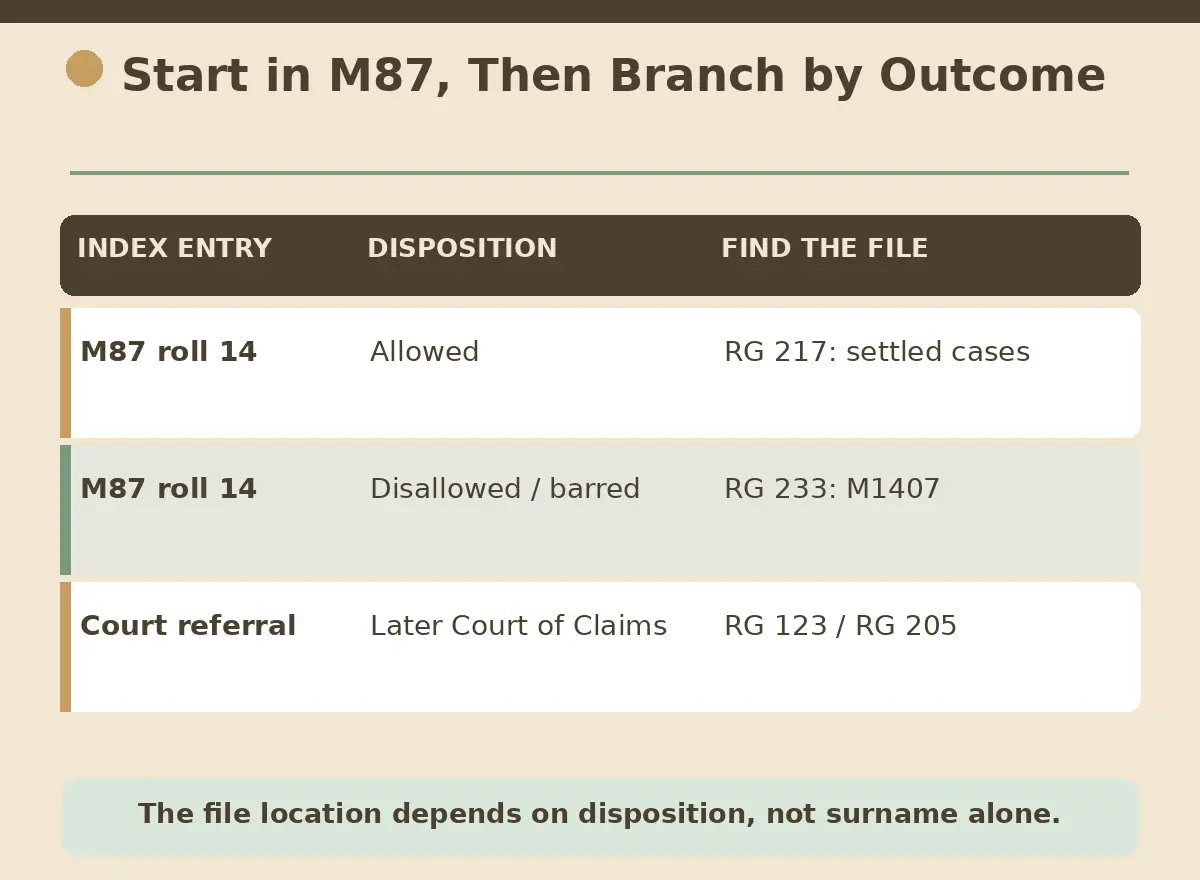
Route Each Outcome to Its Custodian and Record Group
The National Archives holds allowed settled claims in Record Group 217, the records of Treasury accounting officers. Barred and disallowed claims are in Record Group 233 among House of Representatives records, notably microfiche publication M1407. The Archives explains that disallowed entries are arranged by report and office number while barred entries are arranged by claimant surname. Use the proper arrangement instead of applying one locator to all outcomes.
Following later legislation, some disallowed or barred cases went to the U.S. Court of Claims. The relevant case materials may be in Record Group 123 or 205, with a Court of Claims docket route, rather than in the original claim packet. If you encounter a referral envelope, it may point to a later case. Track that procedural move as a separate archival trail, not a missing page of an apparently complete original packet.
Work Through the Witness Depositions as Claims
An individual case can contain the petition, statements of witnesses, special-agent reports, examinations of Confederate records, commissioners’ recommendation and possibly a payment receipt. Some files also preserve affidavits, letters or vital-record copies. Not every case includes all these categories. Record each speaker’s name, reported residence, stated relationship to the claimant, date of statement and the precise language used.
If testimony says a neighbor knew a family for twenty years, that documents a witness’s assertion, not twenty uninterrupted years established by independent sources. If a witness describes enslaved people, distinguish their statements, the claimants’ property claims and the individuals’ historical identities without treating an owner’s assertion as proof of kinship or legal standing. The commission’s loyalty requirement was a legal test within a historical claims program, not a genealogical identity certificate.

Test the Property Loss Separately from the Family Link
An itemized account of livestock, food, supplies or labor can illuminate the economy of a household, but the description alone need not establish title to land or ownership of every object named. Compare the alleged place and timeframe to tax rolls, land records, census schedules and local maps. A claim brought by a person using a common name requires an identity table just as a pension or probate file would.
Keep two evidence columns: what the claimant asserts happened to property, and what federal investigators or the final decision recorded about the requested compensation. The first may contain useful family clues regardless of approval; the second concerns adjudication under that commission’s rules. Neither can replace a marriage certificate or probate record for establishing a reported relationship.
Use a Negative Result Without Overstating It
No claimant in a browsed surname range does not prove a household was unsympathetic to the Union. Claims were limited by law, eligibility, dates, surviving documentation and a person’s willingness or ability to file. Try spelling variants, neighboring counties and other spellings that appear in postwar records. Note the exact index version, date range and search criteria for reproducibility.
If the M87 index points to a file not available on the particular website, look for the correct record group and repository. The Archives’ detailed guidance distinguishes allowed, barred and disallowed files and indicates that some Court of Claims series have gaps. A request should quote the M87 office and report numbers and final status, not just a surname.

More Records and Archives Guides
How We Research a Southern Claims Commission Case
We begin with M87, write down the reported final disposition, then use the National Archives routing guidance to find the corresponding case series and any later transfer. We compare each person-name assertion with independently dated records and never infer loyalty, land ownership or family relationship merely because the file includes a named claimant or witness. A ledger cites each deposition separately from the final report.
The National Archives case-file guide and its legislative finding guide identify which federal holdings to request. Readers can consult the site’s affiliate disclosure for commercial policies; no outside subscription service is claimed as a sponsor.
Start with the consolidated claimant index in M87, roll 14, and capture the report, office and disposition.
Approved settled claims generally belong to National Archives Record Group 217.
Barred claims missed the required filing deadline; disallowed claims were rejected or dismissed after consideration.
No. The decision concerns compensation under the commission’s rules and does not independently authenticate each personal claim.
Check references to Court of Claims proceedings and the related RG 123 or RG 205 docket path.