
To research a family in Balclutha or nearby South Otago, begin with the local Genealogical Society’s reference tools, then request the underlying record from its custodian. Clutha District Libraries explains that the Balclutha Genealogical Society works with researchers at the Balclutha Community Library. Its master index points to school, cemetery and family material, but an index pointer is not necessarily an original register or a proven family relationship. The most effective approach identifies the exact place, approximate year and record class before asking for the item.
Identify the Balclutha Place and Time Period
Write the historical place name as given in a certificate, family paper or newspaper. Balclutha is one locality within the wider South Otago and Clutha district; a family recorded in a nearby settlement may belong to a different school or cemetery series. Keep the place as it was at the event date rather than expanding it to the entire modern district. If a family lived along a rural route, list neighboring communities as controlled alternatives for a locality search.
Use a dated town map, school name or address to improve the location. Do not assign a relative to Balclutha because a modern descendant lives there. A family may move between borough, rural parish and district records, and different institutions maintained independent indexes. Note the approximate year and what the specific record should answer, such as schooling, residence, burial or a reported family memory.
Use the Local Master Index as a Finding Aid
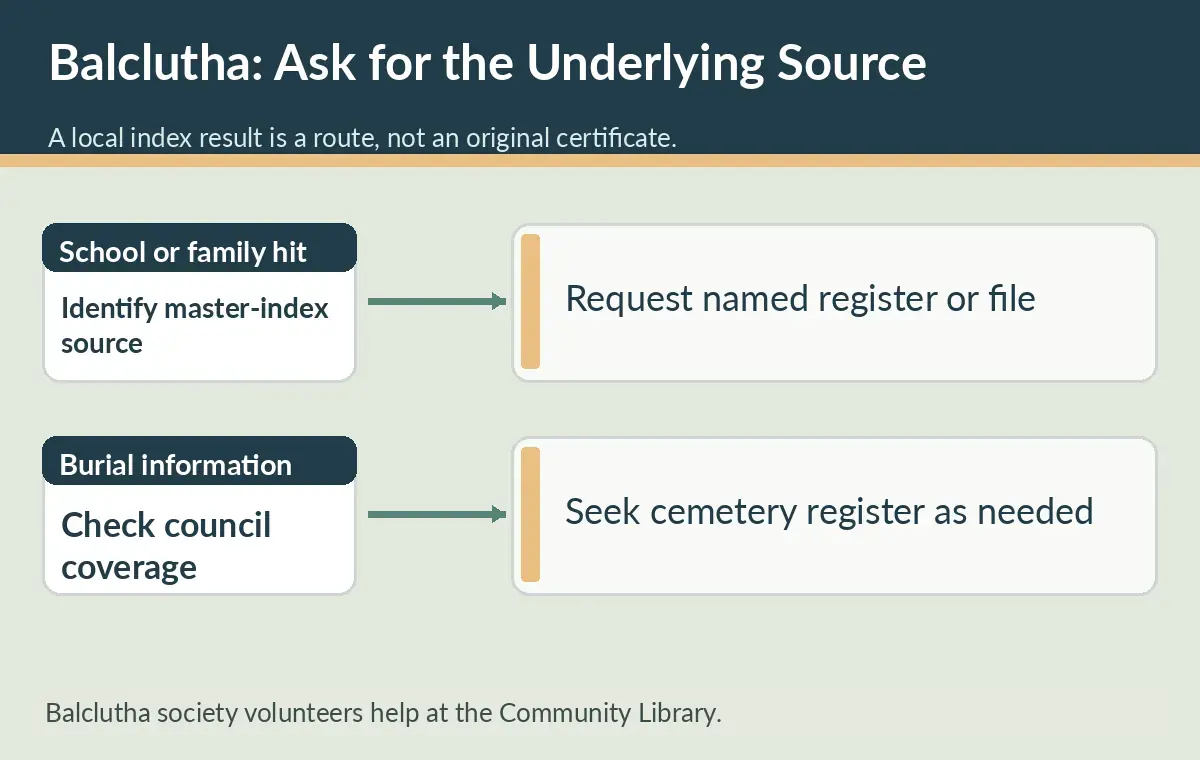
The Clutha District Libraries research guide identifies the Balclutha Genealogical Society’s master index as a route into school, cemetery and family records. Start with surname variants, then ask what collection and item each result refers to. An index may summarize local records gathered or abstracted by volunteers; its entry should be treated as a lead until you inspect the cited original or transcript and identify its creator.
When contacting the group, provide a surname, time span, exact locality and a single research question, not an entire unsourced family tree. Ask whether the indexed entry came from an original school register, a cemetery transcription, a published notice or a donor’s family note. Note any access condition, page reference and whether a copy can be supplied. Respect volunteers’ time by documenting previous searches and the spelling variants already tested.
Distinguish Schools, Family Compilations, and Civil Records
A school attendance entry can establish that a named pupil was recorded at an institution in a dated term, sometimes with additional information depending on the book. It does not necessarily prove birthplace or legal parentage. Family compilations can preserve valuable leads but may contain retrospective memories or secondhand research. Treat every claim separately and ask who supplied it, when it was written, and whether the compilation includes a source citation.
New Zealand official births, deaths and marriages form a different record system. Local society indexes should not be confused with government civil-registration certificates or printouts. Use the local clue to identify a date and person, then locate the appropriate official register record within its access and privacy rules. Where surnames recur across generations, correlate age, school location, other family members and original dates rather than assuming all same-name entries represent one individual.

Check Council Cemetery Coverage Before Concluding Absence
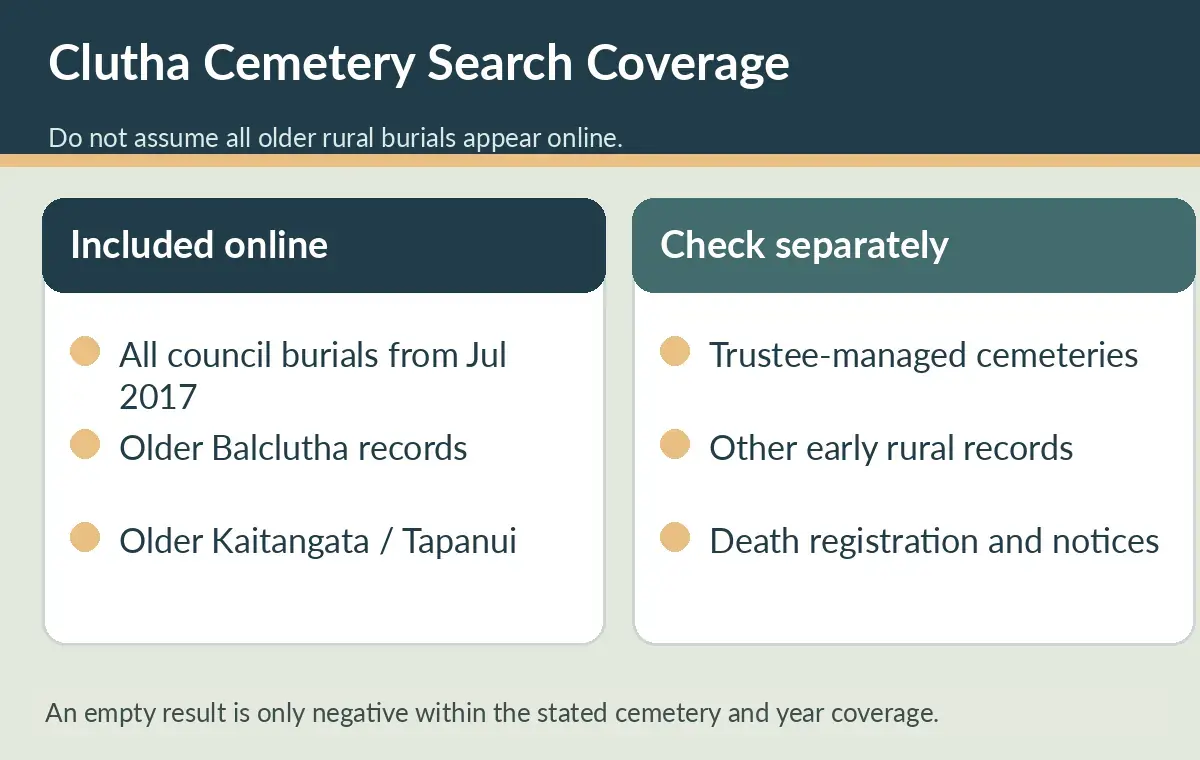
The Clutha District Council cemetery page says that its online search covers all burials from July 2017 and pre-July-2017 material for Balclutha, Kaitangata and Tapanui. Not every trustee-managed or historical rural cemetery necessarily appears under that same online coverage. Record the cemetery name and date range actually checked. If a relative was buried elsewhere, an empty Balclutha search does not invalidate a death notice or family account.
Separate three claims: a death occurred, a particular cemetery registered an interment, and a plot or monument marks a location. A cemetery search record may carry some but not all of these. A memorial inscription might list a person buried elsewhere; sharing a plot or surname does not prove the people are related. Request a burial register or plot record where available and compare the deceased with civil death details before entering the place in a family tree.
Follow the Local Heritage Hub without Treating It as a Registry
The Clutha Heritage hub presents district stories and local historical material that can provide names, photographs and neighborhood context. Search an exact street, institution or settlement where possible. A published photograph caption is a source with its own author and date, not a birth or burial register. Check image provenance, licensing and description, and avoid treating names supplied later by viewers as contemporary identification.
When a local history points toward military, immigration or land records, the relevant national institution may be the next custodian. Do not ask a district library to certify a document held by a national archive, and do not assume a digitized story has the same evidentiary weight as a contemporaneous administrative form. Keep a source ladder that records the local finding aid and the separate repository of the record it identifies.
Preserve a Reproducible Citation and Next Question
For each hit, save the exact master-index reference or search term, the organization that created the index, the alleged original collection, relevant dates and whether you saw a scan, transcript or physical page. If a staff member provides a copy, ask for its archival collection title and page or register number. Transcribe ambiguous handwriting literally, with a separate interpretation note. An unsupported date in a family card must stay provisional until verified.
A useful conclusion is deliberately narrow: ‘The local index points to a school record for this surname and place; the pupil’s identity remains to be checked.’ That keeps discovery separate from proof. If no record appears, log the collections and years actually searched, not a district-wide negative conclusion. Our affiliate disclosure is provided for transparency and does not imply endorsement from the library or society.
More Records and Archives Guides
How We Research This Collection
We used Clutha District Libraries and its research guide for the in-person Society and master-index route, and the Council cemetery page to restrict claims about online burial coverage. No real individual or indexed result was represented as personally verified.
Clutha District Libraries identifies the Balclutha Genealogical Society as meeting at the community library.
It is a finding aid pointing toward varied local records; verify the actual item and its creator.
No. The council states specific pre-July-2017 coverage for Balclutha, Kaitangata and Tapanui.
Only if the specific record actually provides and supports that information, preferably with corroboration.
Surname variants, dated locality, exact record type, index reference and the question to answer.