
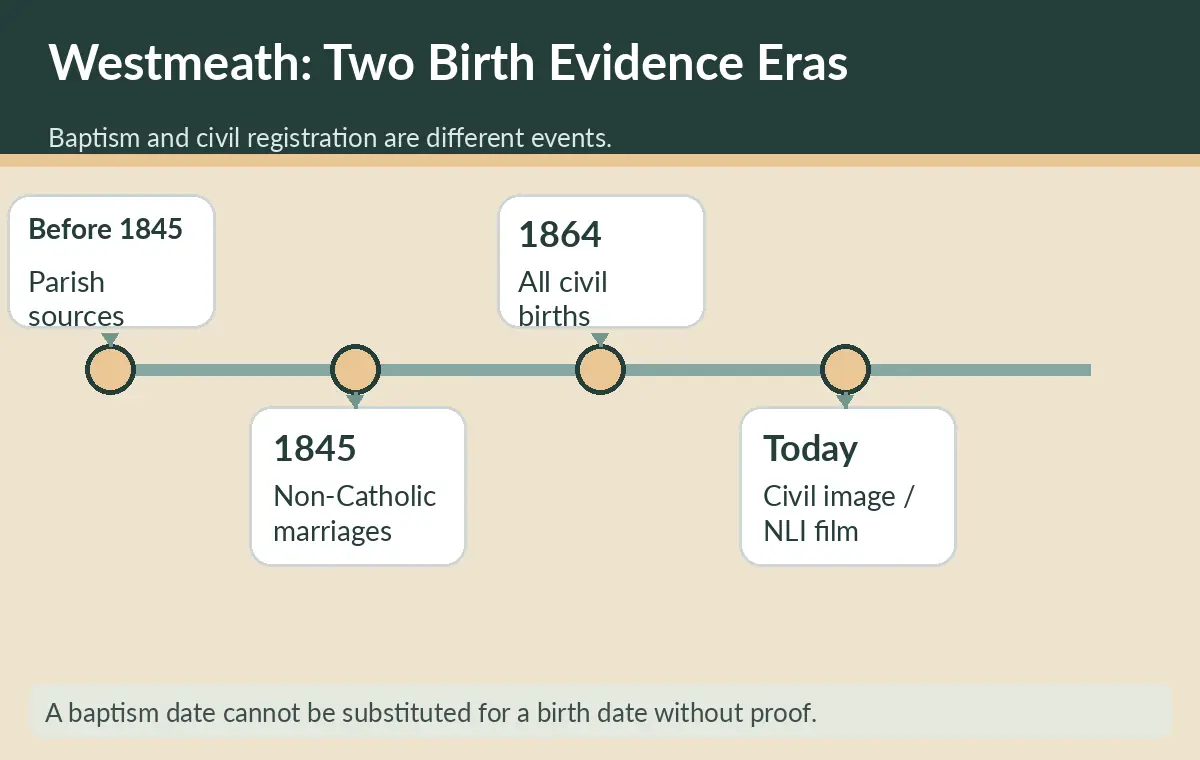
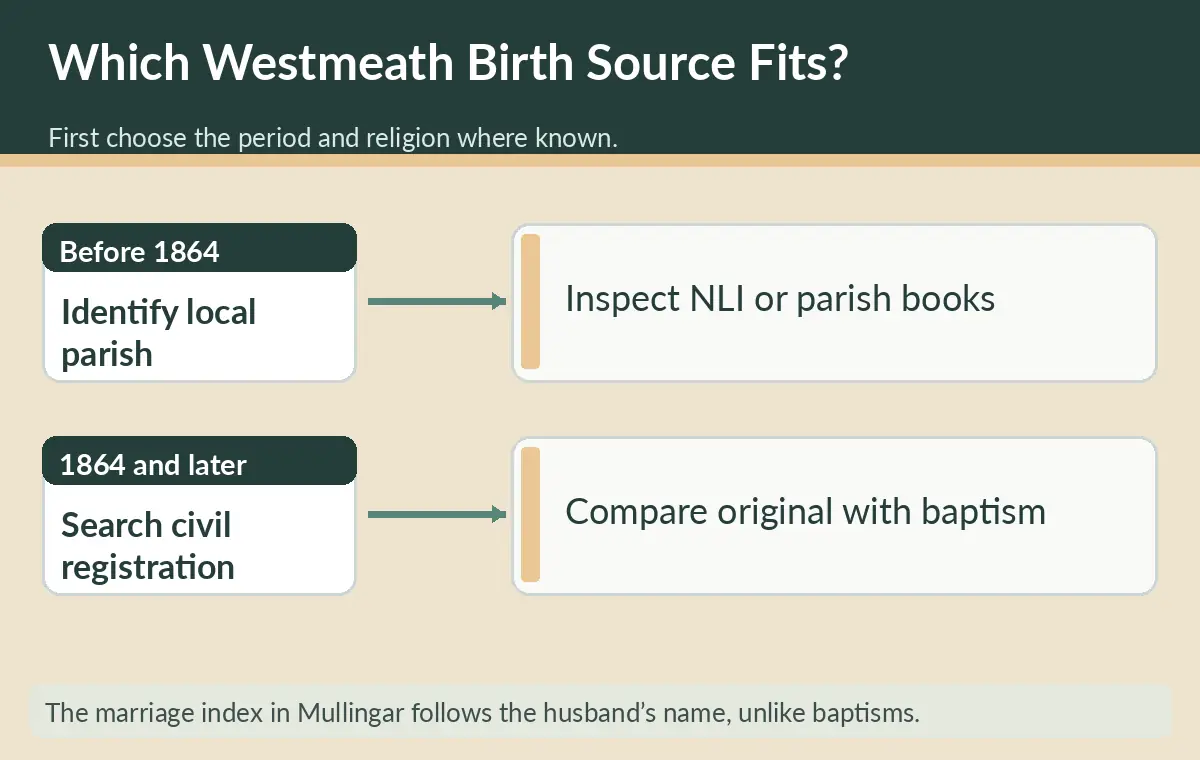
For a Westmeath birth from 1864 onward, start with Irish civil registration; for an earlier event, identify the actual parish baptism books. Westmeath County Council also describes a useful local exception: Mullingar Library holds alphabetical Catholic baptism indexes that are not the same thing as the original NLI parish pages. The county’s genealogy guide explains local custodians and the civil-record boundary. A recorded baptism does not by itself fix the precise day of birth, and a similar name in a Westmeath index should not be joined to a family tree without the original entry.
Start With the 1864 Civil Registration Boundary
Ireland registered non-Catholic marriages from 1845 and births, deaths and marriages of all denominations from 1864. For a child born in Westmeath in 1872, prioritize the civil birth entry, its registration district and recorded parental information. For a claimed 1842 birth, a civil birth certificate from that era does not exist; consult parish baptisms and other contemporary evidence. A child baptized in one town could have been born in a nearby townland, so do not reduce the civil parish or registration district to a modern mailing address. Preserve original spellings.
IrishGenealogy’s government FAQ distinguishes the existence of an index from the availability of a digitized image and notes that events may be registered in the following calendar year. If the initial Westmeath search fails, try a wider period and spelling variants before concluding an event was not recorded. Record the actual image reference and page details when visible. A modern copy of a civil record can report information given by a parent or other informant at the time, but it still needs comparison with independent records if competing same-name families lived in the district.
Use Mullingar’s Local Baptism Index Carefully
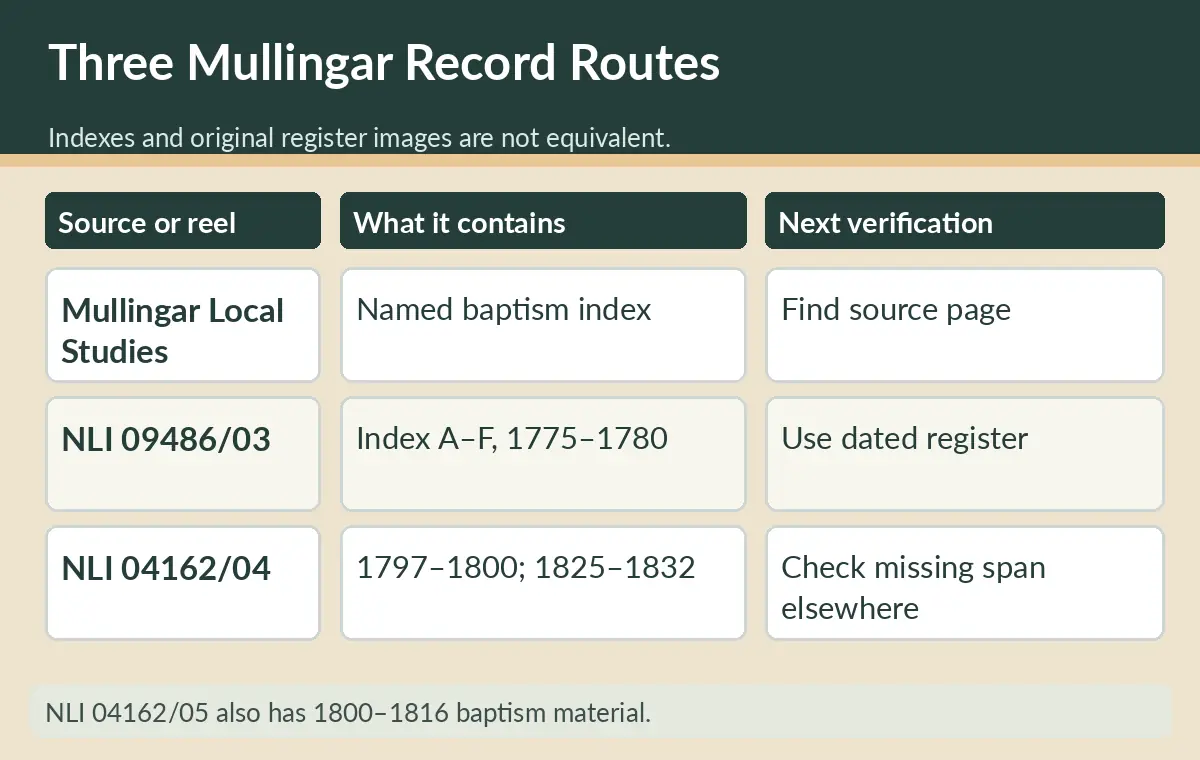
Westmeath Libraries specifically reports an alphabetical index to Catholic baptisms at the Local Studies Department in Mullingar Library. The child is indexed under their own name, with the father’s name and the mother’s maiden name, when transcribed. This is an unusually helpful finding aid for distinguishing same-name children. It remains an index and can contain transcription mistakes or represent only the parish’s indexed span. Request the underlying page with enough identifiers for a librarian to reproduce the search; do not describe the alphabetical index as a civil birth register.
Marriage indexes follow a different rule in the county guide: Mullingar marriages are indexed alphabetically under the husband’s name, and the marriage is recorded in the bride’s parish. That detail matters when looking for parents of a baptism candidate. A mother’s supposed maiden name in a baptism index should be tested against a marriage entry, not mechanically copied as proven. If a parent has an uncommon nickname, compare the original Latin or English register wording, sponsors and townland before reconciling forms. A missing local-index entry may reflect coverage rather than a missing baptism.
Separate NLI Index Microfilms From Chronological Register Pages
The National Library of Ireland’s Mullingar parish inventory distinguishes chronological baptism and marriage registers from separately filmed alphabetical baptism indexes. For example, NLI 09486/03 is described as an index for surnames A–F during 1775–1780, while other 09486 and 09487 components are likewise index material. These are not individual baptism certificates. Note the parish’s variant names—Mullingar, Walshestown and Gaynstown—when searching the portal. A townland may appear under a different historical parish label from the modern place name.
An especially instructive example is microfilm 04162/04: NLI labels baptism entries for 1797–1800 and separately for 1825–1832 within the same reel. The gap in the displayed span should not be treated as proof no baptisms happened in those intervening years; inspect the other listed reels. The parish inventory also has film 04162/05 for baptisms 1800–1816. Plan searches by event type and dated coverage, then open the correct chronological images. Save film, item, image sequence and readable page date rather than citing only the broad parish landing page.
Test Parish, Denomination and Townland Before Accepting a Match
Not all Westmeath families appear in one Catholic parish. Church of Ireland registers may be held in a surviving parish collection or the Representative Church Body Library, and Catholic books depend on local parish custody or NLI film coverage. Determine the family’s denomination only where sources support it. The Westmeath guide also directs researchers to the Dun na Si Heritage Centre for some Catholic research and notes that professional searches may incur a fee. A general database hit may combine material from different custodians and should be traced to the originating register.
A fictional pair of children named Patrick Murray, baptized a year apart in nearby locations, illustrates the danger. Compare the mother’s maiden surname, father’s occupation where recorded, witnesses or sponsors, parents’ known marriage place and subsequent residences. A godparent with the same surname can suggest a social network but does not independently prove a specific relationship. Keep both candidates visible and record conflicts in dates or districts. If one baptism is later than the claimed birth, distinguish the two dates rather than correcting the entry to fit a descendant’s recollection.
Make a Registration-to-Parish Evidence Table
Use columns for event claimed, civil registration year and district, NLI parish, reel, visible page date, named parents, sponsor or informant, and source type. Write ‘index only’ where no image has been examined. For a birth after 1864 with both a civil image and baptism, compare parents, address and event date while retaining their separate citations. For an earlier birth, a later death record may provide an approximate age but not a contemporary birth date. The event date can be inferred as a range only when the source supports that method.
Consult local studies material for newspaper notices, townland gazetteers or Griffith’s Valuation when a surname appears in multiple parishes. These can help choose a locality but cannot prove that the occupier of a holding was a child’s father. If the requested NLI volume has no image or a blank page, verify actual series coverage and ask the holding parish or archive before reporting an exhaustive negative search. The purpose is a defensible chain between a named Westmeath child and verified parents, rather than a simple collection of similar baptism entries.
Cite Both Finding Aid and Original, Then Note the Gap
For the local Mullingar index, cite the index title, holding department and exact entry or supplied reference. For NLI, cite parish, sacrament, actual register year, microfilm item and image/page number. The separate civil registration needs its own source description and registration reference. If the same index exists online through another website, credit the underlying source and the access platform separately. Do not repeat a digitized surname index as though it were two independent witnesses to the historical event.
The GenHis affiliate disclosure explains site relationships; the article does not assume a paid genealogy service is necessary. An unresolved family link should be written explicitly. A useful next step might be checking Mullingar’s 04162/05 original baptisms for one parent’s address or locating the matching registered marriage for the candidate mother. Keep date windows, record classes and alternative name forms in your research log. This makes an archive request possible even when the first index search found only initials or conflicting years.
More Records and Archives Guides
How We Research This Collection
We cross-checked Westmeath County Council’s Local Studies inventory with the NLI Mullingar parish inventory and the specific 04162/04 film description, plus the government IrishGenealogy FAQ for registration-versus-image coverage. We distinguish the separately owned local index, NLI surname-index reels, chronological sacramental registers, and post-1864 civil records rather than merging them into one database.
The all-Ireland system began in 1864; earlier births require church or other non-civil evidence.
Yes. Westmeath County Council describes an alphabetical Catholic baptism index in Mullingar Local Studies.
NLI describes it as an alphabetical index to baptisms for surnames A–F for 1775–1780.
Its NLI description lists 1797–1800 and 1825–1832 baptism sections; check other reels for intervening years.
Only if the original entry explicitly gives it; the sacramental date is not automatically the birth date.