
The USCIS Genealogy Program is a fee-based route to specified historical immigration and naturalization records, not a universal database of everyone who immigrated. Its historical series include Certificate Files, alien registration forms, visa and registry files, and some older Alien Files. The first practical question is whether the relevant file is held by USCIS, is eligible for genealogical release and can be identified by a file number. An index search and a records request perform different jobs; ordering the wrong service can waste money and still leave your question unanswered.
Identify the historical series rather than ordering by surname alone
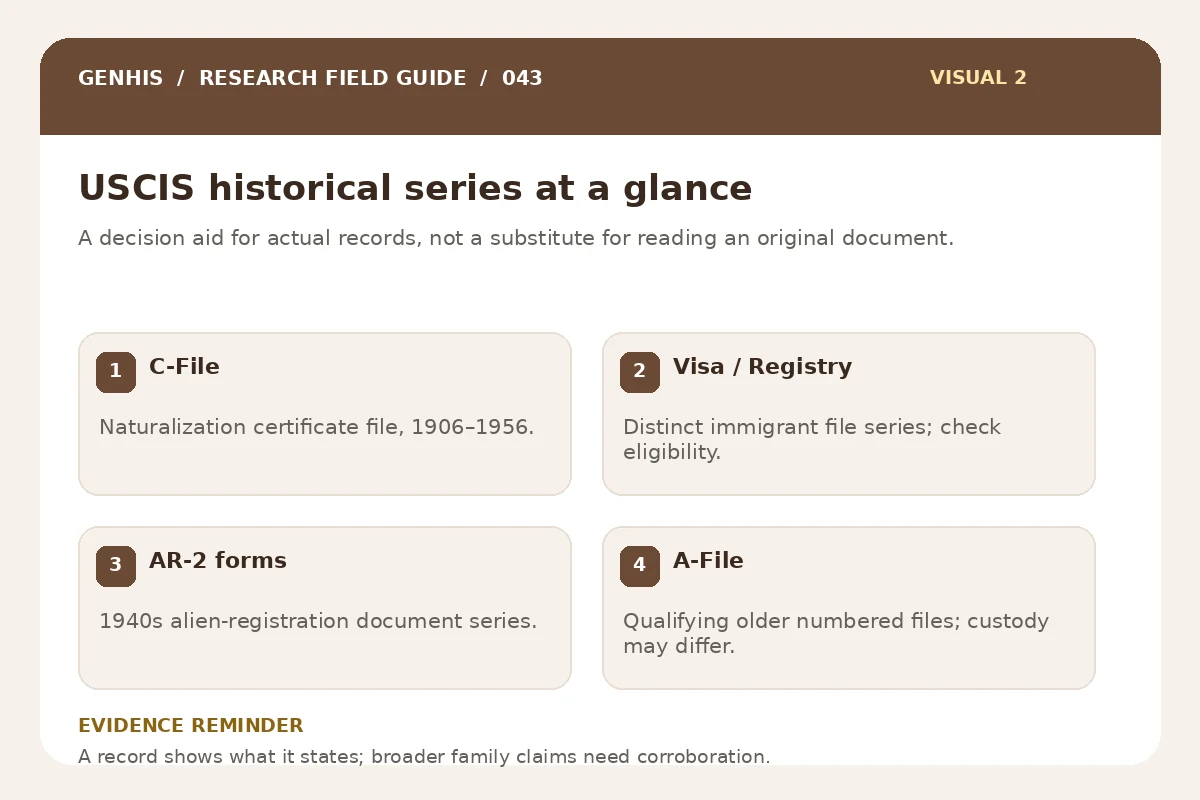
Start by determining which type of document could answer your question. A Certificate File is associated with naturalization certificates during a defined 1906–1956 era; a visa file concerns a different immigrant process; registry papers document another administrative route. Alien registration forms and qualifying Alien Files have their own record arrangements. One immigrant may appear in more than one series, and a person’s name in a census does not prove that any particular USCIS file exists. Record your tentative file type with a source for its covered years.
The federal regulations describe file identifiers: a C-File requires the correct naturalization certificate number; other series use an A-Number, Visa File Number or Registry File Number. An online search result displaying a name alone is not the same as a valid file number. If your research question is about a pre-1906 court naturalization, another custodian may be the first stop. Read the current USCIS series definitions rather than extrapolating from a relative’s modern immigration paperwork.
Decide between an index search and a specific records request
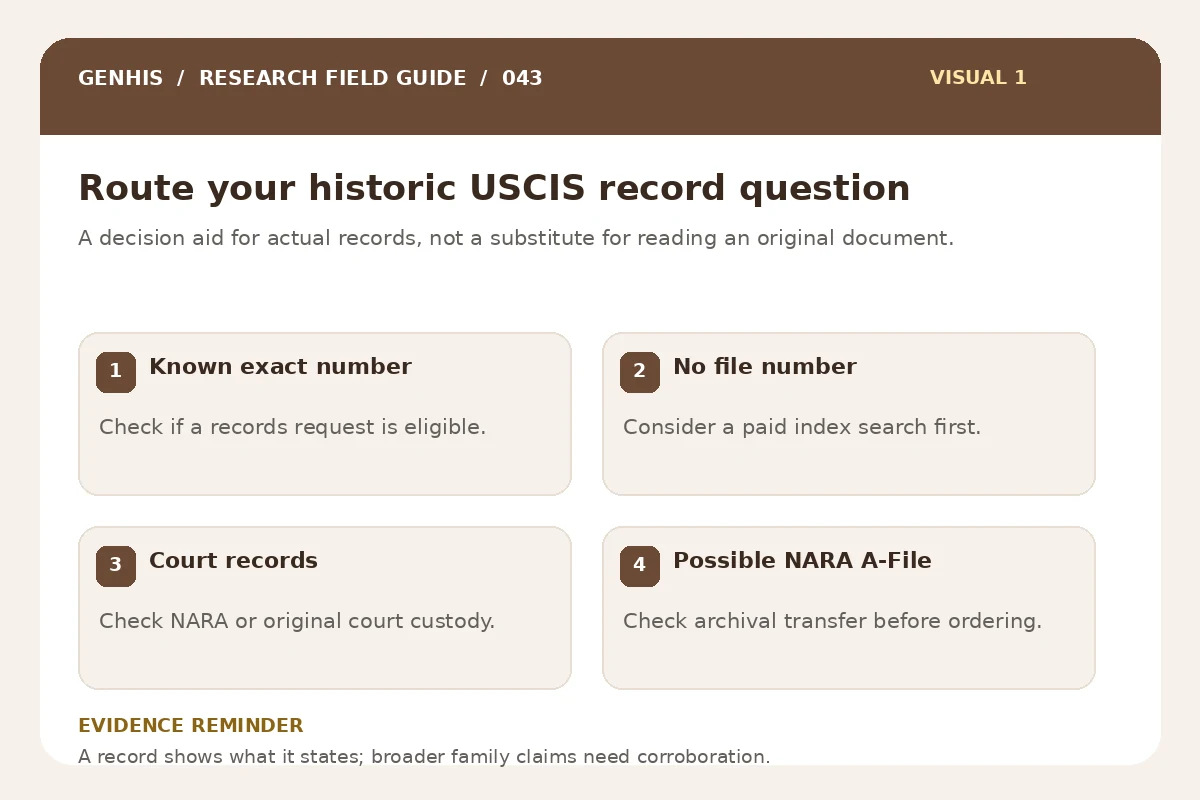
If you cannot identify a historical file confidently, the agency’s index-search service is designed to determine whether responsive historical records exist and to provide file information. Current regulations also describe delivery of certain digitally stored records with index results; paper files may be routed through a later records request. If you already possess an exact valid number, a separate record request may be possible. The official request screen and current instructions control eligibility, costs and acceptable proof; old blog fee tables are not reliable.
Before submitting, assemble surname variants, known birth date and country of origin, likely U.S. residences, and any prior arrival or naturalization dates. Keep your own evidence sheet stating which items come from records and which are estimates. Do not send unsupported invented dates merely to populate a form. A “no record found” notice describes the search conducted within the program; it does not establish that the person never immigrated, applied for citizenship or had documents in another agency. If you want the full process, read how to find U.S. naturalization records in the right court or archive.
Check whether NARA or a court holds the record instead
The historical legal record and the later agency file are different objects. NARA describes court naturalization papers, regional jurisdiction and the role of USCIS in maintaining agency copies after standardization in 1906. Some old naturalizations occurred in state or local courts not routinely represented in NARA federal holdings. Therefore, searching USCIS first for every person is inefficient. Start with the court, date and file type suggested by independent evidence, then consult the appropriate keeper’s finding aid.
Some historical A-Files have been transferred to the National Archives, while others remain with USCIS. Do not treat a series description as proof of custody for one person. Search the NARA catalog where appropriate, retaining the exact A-Number and archival identifier if one is shown. When NARA already has the relevant public file, learn its ordering rules before purchasing another search. A useful decision log has columns for proposed custodian, record series, reference number and unresolved eligibility conditions.
Follow historical privacy rules and document uncertainty
Historical records can contain information about people other than the main file subject. Federal rules generally presume subjects born more than one hundred years before a request to be deceased for the program; other cases require satisfactory proof of death. Additional access or redaction conditions may apply. These rules do not turn an entire file into public information about living relatives. Keep copies private, do not use a genealogy request to investigate a living person and never publish an A-Number or other sensitive identifier unnecessarily.
Imagine a fictional ancestor, Elena Ortiz, believed to have naturalized in 1937. A newspaper clipping is not enough to prove that USCIS retains a C-File. First locate court evidence or a certificate number, check NARA court papers, and then decide whether an index search is necessary. If a file is located, read each document in chronological context. The example is a workflow demonstration, not a claimed USCIS discovery, and it should not be interpreted as legal guidance about citizenship rights.
| Record class | Typical purpose | Next question |
|---|---|---|
| Certificate File (C-File) | Naturalization certificate-era agency papers | Do you have the certificate/file number? |
| Alien Registration Form (AR-2) | Historical alien registration data | Is the person in the covered 1940s window? |
| Visa or Registry File | Visa application or registry determination | Can the correct file number be identified? |
| Qualifying A-File | Alien case file with variable contents | Is this specific file at USCIS or NARA? |
Keep an actionable request ledger and verify current fees
For each attempt, write down the purpose, subject variants, probable series, custodian, file number if verified, source of that number, eligibility evidence, request reference and outcome. A response can include multiple records, an index reference or no match; record the agency’s exact language. When a file arrives, cite its cover, individual page or form, file number and custodian rather than replacing those details with the agency name alone. A reliable paper trail prevents a second paid request for the wrong series.
Official costs and procedures can change. As of this guide’s review, federal rulemaking concerning archival transfers was underway, so do not treat a proposed rule as an enacted transfer or promised reduction in charges. Check the current USCIS instruction page and filing portal immediately before submitting anything; do not use a fixed fee or processing estimate from this article. If your question concerns proof of citizenship rather than historical research, consult official agency pathways and qualified advice.

How We Research: jurisdiction, source provenance, and uncertainty
We compared current USCIS program and request instructions with the federal regulation describing identifiers, indexing and proof-of-death requirements, then checked NARA guidance on naturalization custody. The editorial task was to keep five different record series and two different USCIS services separate. We deliberately omit a fixed fee or processing promise because government rules and active filing screens change; proposed federal rulemaking is not treated as effective law. The Elena Ortiz illustration is fictitious, and no actual case file was requested or inspected for this guide.
Authoritative record sources and repository limitations
www.uscis.gov — source guide. USCIS describes the Genealogy Program and the historical file request service. This source defines programs or legal requirements and does not confirm the existence or release eligibility of any particular person’s file.
www.uscis.gov — source guide. USCIS explains the online Genealogy request workflow and index-search route. This source defines programs or legal requirements and does not confirm the existence or release eligibility of any particular person’s file.
www.ecfr.gov — source guide. Current federal regulation details file-number requirements, index searches and proof-of-death rules. This source defines programs or legal requirements and does not confirm the existence or release eligibility of any particular person’s file.
www.archives.gov — source guide. NARA explains which naturalization records are kept by federal courts, USCIS and other custodians. This source defines programs or legal requirements and does not confirm the existence or release eligibility of any particular person’s file.
genealogy.uscis.dhs.gov — source guide. USCIS public Genealogy request portal describes index and records request entry points. This source defines programs or legal requirements and does not confirm the existence or release eligibility of any particular person’s file.
More Records and Archives Guides
Privacy, disclosure, and the limits of this guide
This is educational historical-records guidance, not immigration, citizenship, privacy or legal advice. USCIS services can require payments and personal information; check current official eligibility, transfer rules, costs and terms before filing. The linked government resources are not represented as sponsors or affiliate partners. Read the GenHis affiliate disclosure. Do not reveal living persons’ A-Numbers, addresses, file contents or nonpublic records.
Not necessarily. The index search identifies responsive records and may deliver digital material under current rules, while paper files may require a separate records request.
A records request normally requires the correct certificate number. If it is unknown, follow the agency’s index-search instructions first.
It is not a general passenger-list search. For ship arrivals, begin with NARA port-series guides and manifest collections; USCIS agency files are a different record system.
Determine custody using USCIS and NARA archival descriptions before paying. Some eligible historical A-Files have been transferred; availability depends on the file.
Special privacy and release rules apply. Do not presume the historical program authorizes disclosure; follow USCIS requirements and provide permitted proof of death where required.