
Historical U.S. passport applications can preserve birth dates, birthplace details, descriptions, signatures and—in later cases—photographs unavailable in ordinary census returns. The National Archives holds applications from October 1795 through March 1925; later applications are under the Department of State. To find one, choose the correct date range and index, locate the application in NARA microfilm M1372 or M1490, and inspect the original image. Never treat an application as automatic proof that a passport was issued or that the traveler reached the destination listed on a form.
Choose NARA records only for the correct date range
The National Archives explains that its federal passport application holdings run from October 1795 through March 1925. The Department of State retains applications from April 1925 onward, subject to separate access procedures. Before 1856 passports were not issued exclusively by the federal State Department, so a federal no-result search may have narrower meaning for early travelers. Start by estimating the likely application date from a letter, travel advertisement, naturalization date or reported overseas trip.
Regular, emergency, special and insular passports can appear in different sets of records. Do not assume that the regular-application series captures every person who traveled abroad. A traveler could also have moved without a passport under some historical conditions. Record the exact record class and year before searching by surname, and avoid converting a modern database title into a false claim that the coverage is complete for every decade.
Use index publications M1371 and M1848 precisely
NARA identifies M1371 as registers and indexes covering several early periods through 1906, and M1848 as indexes covering selected spans, including 1906–1923. These are finding aids, not the application files themselves. The index you need depends on the date and type of application, and some early runs are intermittent or incomplete. Write down the exact application number, application date, full name, index heading and source publication for every plausible candidate.
If a common surname generates many index hits, compare initials and dates with independent family evidence before opening a microfilm roll. If the person’s name changed after marriage or naturalization, search both forms. A missing name in a particular index does not demonstrate that no passport application existed: check another index span or the chronological arrangement where appropriate. Keep a clear log of which index volumes and variants you actually searched.

Route applications to M1372 or M1490
NARA’s main regular-application microfilm is split at 1906: M1372 covers the early regular passport applications through the end of 1905, while M1490 covers applications from January 1906 through 31 March 1925. The early M1372 period is not a neat continuous year-by-year run from 1795; NARA lists gaps and distinct surviving periods. Use the official publication description rather than assuming that a missing 1819 entry was lost by a search engine.
After finding an index match, open the actual application and record the reel or image identifier, application number, date and repository. Do not cite only the index if the original is accessible. Keep pages together where the form spans more than one image or includes supporting correspondence. When pages are separated in an online viewer, compare document numbers and dates so that another person’s photograph or statement is not mistakenly appended to your ancestor’s application.
| NARA publication | Purpose | Research warning |
|---|---|---|
| M1371 | Selected early indexes | Not applications |
| M1848 | Indexes including 1906–23 | Some periods incomplete |
| M1372 | Regular applications to 1905 | Early date gaps |
| M1490 | 1906–March 1925 files | Not proof a trip occurred |
Extract reported birthplace and naturalization clues
The information on applications varies by period. NARA notes that earlier documents may state only an approximate age or broad place of birth, whereas later printed forms often contain more detailed responses. For a foreign-born applicant, the declaration can contain a reported birthplace and a statement of citizenship or naturalization. These are clues to verify, not civil certificates or a substitute for the original naturalization case in the appropriate court.
In a fictional example, a naturalized applicant gives a birthplace in a European town that differs from the country named in a census. This is not necessarily a contradiction: historical boundaries, language and name forms changed. Transcribe the exact town and country wording, then compare it with a passenger list, naturalization petition and a place gazetteer. If a naturalization certificate number appears, research the issuing court and date before asserting that the applicant’s story is confirmed. Our walkthrough on how to find U.S. naturalization records in the right court or archive sets out each step.
Recognize when photographs are expected
NARA states that photographs were required with passport applications beginning 21 December 1914. An earlier application may include a physical description without a photograph, and individual image preservation or database presentation can vary. Check every image belonging to an application before reporting that a photograph is absent. A photograph can add identity evidence, but it is not a scientific age assessment or proof of a relationship to someone with similar appearance.
Compare a passport portrait cautiously with independently labeled family photographs, paying attention to known dates, identifying marks and the documented identity of the person. Do not attach a portrait to a family tree based solely on visual resemblance. Similarly, a signature may support a match across documents but should be evaluated alongside names, dates and place information. Note whether a printed description was supplied by an applicant or entered by an official.
Separate application, passport and journey claims
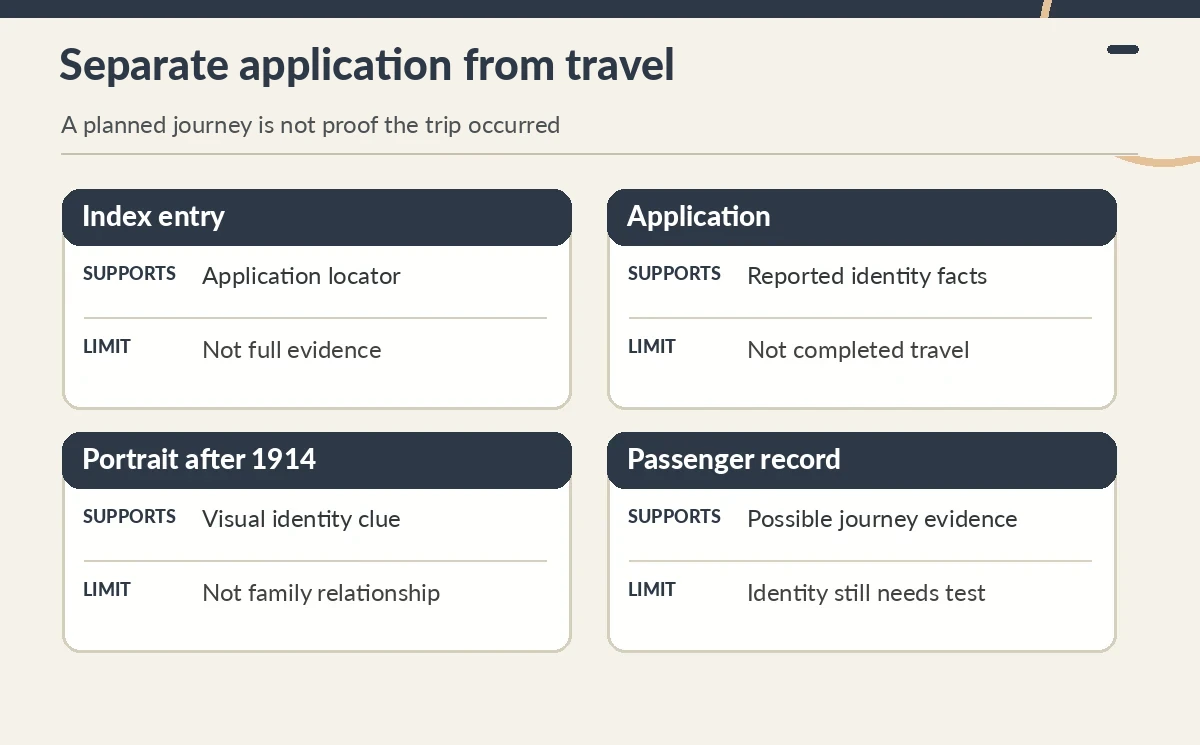
An application records a request and accompanying statements. It is not the same as a surviving issued passport, a ship manifest, a border crossing or proof that an intended itinerary was completed. Keep separate evidence columns for application date, passport issuance when independently documented, stated planned destination and a verified trip. A destination listed on an application might represent a hoped-for journey, not a permanent emigration or even a completed visit.
If a relative supposedly returned to a homeland, start with the exact reported passport application and then search passenger arrival or departure lists, foreign residency documents, contemporary letters and dated newspapers for the journey itself. Cite M1372 or M1490 with the appropriate application locator, the original image and the date of access. End your conclusion at the strongest documented stage, explicitly noting which journey and citizenship questions remain unanswered.

How We Research U.S. Passport Applications and Indexes
GenHis starts with the official archival description and distinguishes an index, the original record and any inferred family claim. For this guide we examined the repository instructions, stated date coverage, available search fields, documentary limits and relevant historical terminology. The sample identity checks are hypothetical and not records of identified ancestors. This is historical research guidance, not a guarantee that every record survives, is indexed or is free to obtain.
More Records and Archives Guides
Official archives and collection guides for U.S. Passport Files
NARA coverage, record types, photograph start date and information fields (archives.gov).
Official M1371, M1848, M1372 and M1490 microfilm descriptions (archives.gov).
NARA guidance for independently verifying U.S. naturalization claims (archives.gov).
Editorial disclosure: This guide includes no paid recommendation or verified affiliate partnership. See the GenHis affiliate disclosure. Record holdings, image availability, access restrictions and prices can change. Verify them with the cited repository before ordering documents; protect information about living people and present uncertain family conclusions as hypotheses.
NARA holds applications from October 1795 through March 1925; later files are under State Department custody.
Use the relevant index, then search regular applications in M1490.
No. NARA states that photographs became required in December 1914.
It can offer a lead, but the court or naturalization file is the stronger independent source.
No. Verify travel separately using manifests or other contemporary evidence.