
Start With the Archival Series and a Specific Question
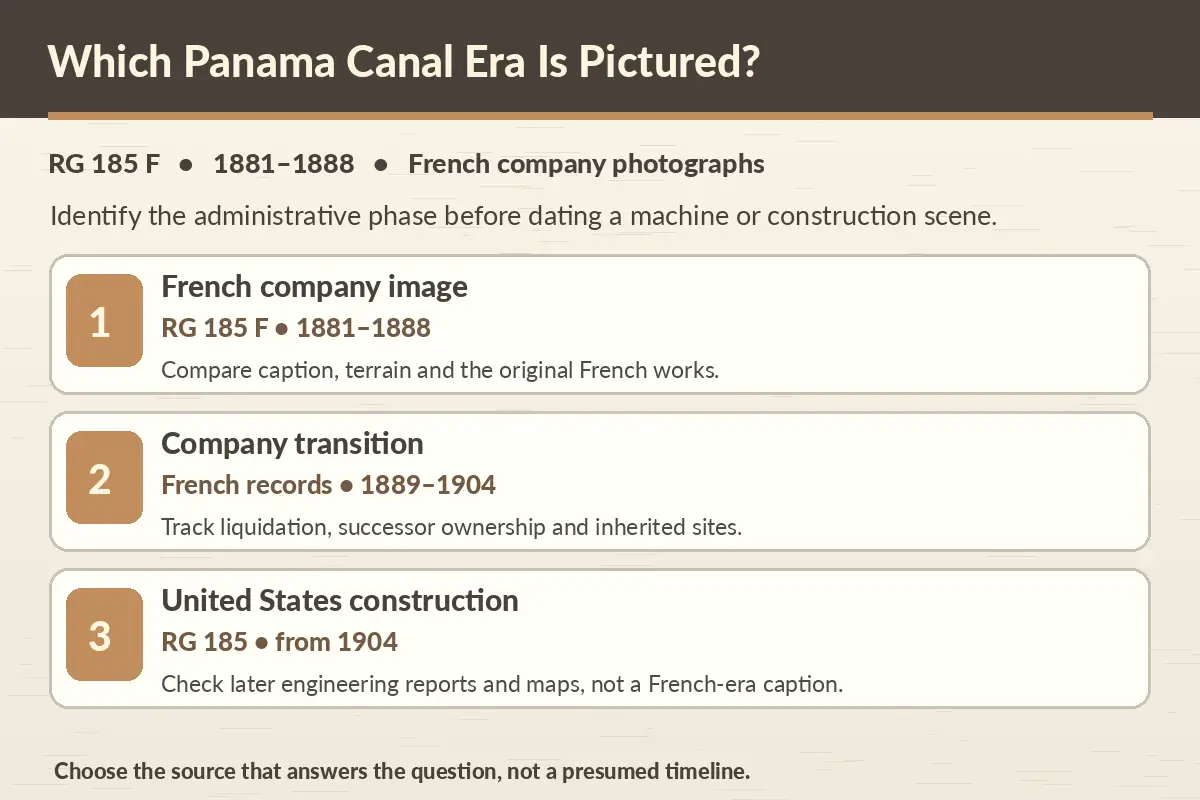
The Still Picture Branch guide describes RG 185 F as photographs relating to French work on a canal in Panama from 1881 through 1888. This is not a generic visual history of the completed Panama Canal. The series points to an earlier enterprise, the Compagnie Universelle du Canal Interoceanique, whose engineering, finances, and surviving structures predate the American-led construction period. A later image of the same channel can represent different machinery, management, and workforces.
Begin by recording three independent dates: when the pictured work occurred, when a photograph was exposed or printed, and when the image entered an archive. Compare the French phase with the federal records guide’s account of the 1889 bankruptcy, successor company of 1894, and U.S. acquisition in 1904. Do not assume those transitions are illustrated by every photograph. NARA’s broad record-group name reflects later custody, not proof that the United States created a French photograph.
Identify the Company Before Identifying the Work
NARA distinguishes Compagnie Universelle du Canal Interoceanique, organized in 1881, from the Compagnie Nouvelle du Canal de Panama formed in 1894 and the American acquisition of the French company assets in 1904. These names are not interchangeable. When a family account says an ancestor worked on the Panama Canal, establish which employer and decade are plausible. A person who left the isthmus before 1890 should not automatically be placed within an American construction photograph made after 1904.
Archive catalogs can group documents by the government that later held them. That custody convention must be separated from an image’s original creator, publisher, and subject. A French enterprise’s photograph can appear in a U.S. federal record group without becoming a U.S. construction image. Record any printed caption, mount inscription, or prior album order. If only a modern catalog title survives, quote it as catalog text rather than presenting it as a verified statement written in the 1880s.
Locate the Cut Using Terrain and Historical Plans
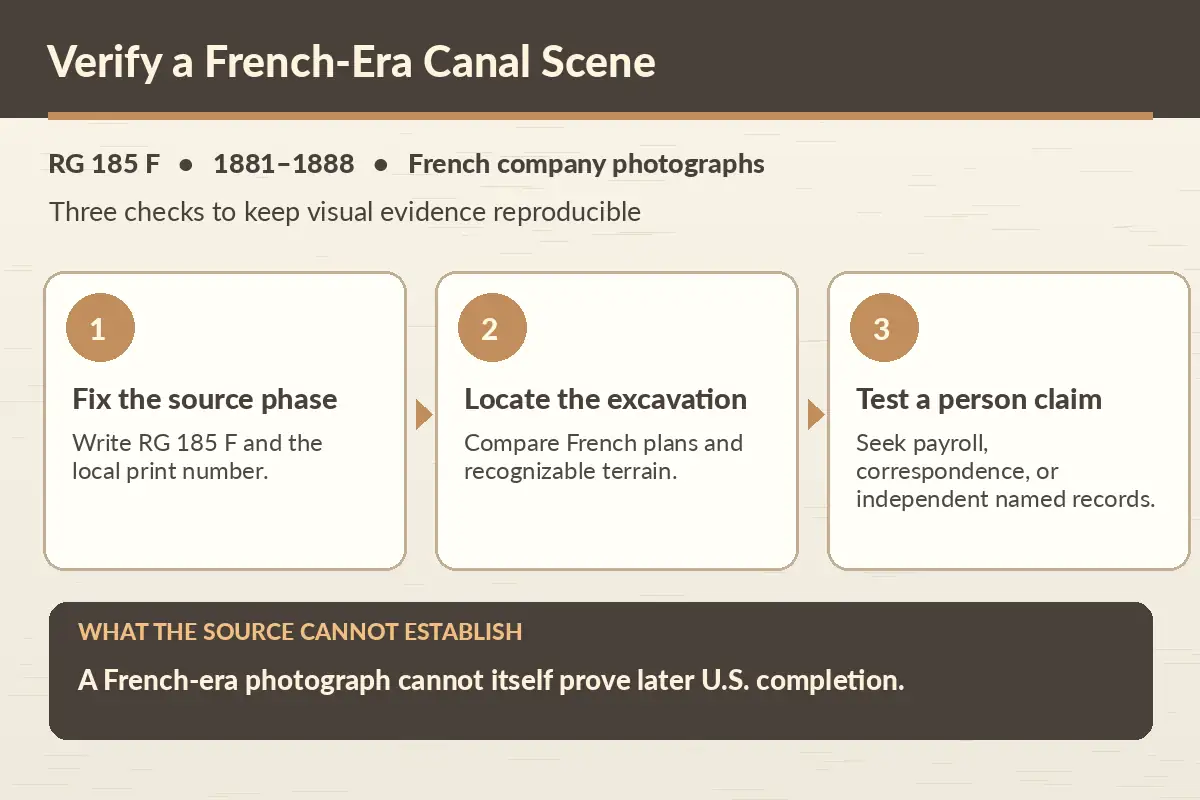
Use identifiable bends, elevations, machinery tracks, spoil deposits, bridges, and adjacent buildings to locate a French-era excavation. Contemporary maps and engineering cross sections are more reliable for site identification than an undated tourist caption. The later canal alignment may have altered an earlier cut; a modern geographic match should therefore be treated as a hypothesis until checked against dated plans. Avoid using current place names as though they were the terminology of 1881.
Measure no distance from a single perspective image unless the scale and camera position are known. A trench that appears deep in a photograph may be distorted by the lens or viewed from a temporary embankment. If two negatives depict nearby sections, establish whether they are the same worksite or different locations with similar equipment. Record each candidate location separately; clear geographical uncertainty is more useful than a polished but unsupported pinpoint.
Read Excavation Machinery Without Assuming Completion
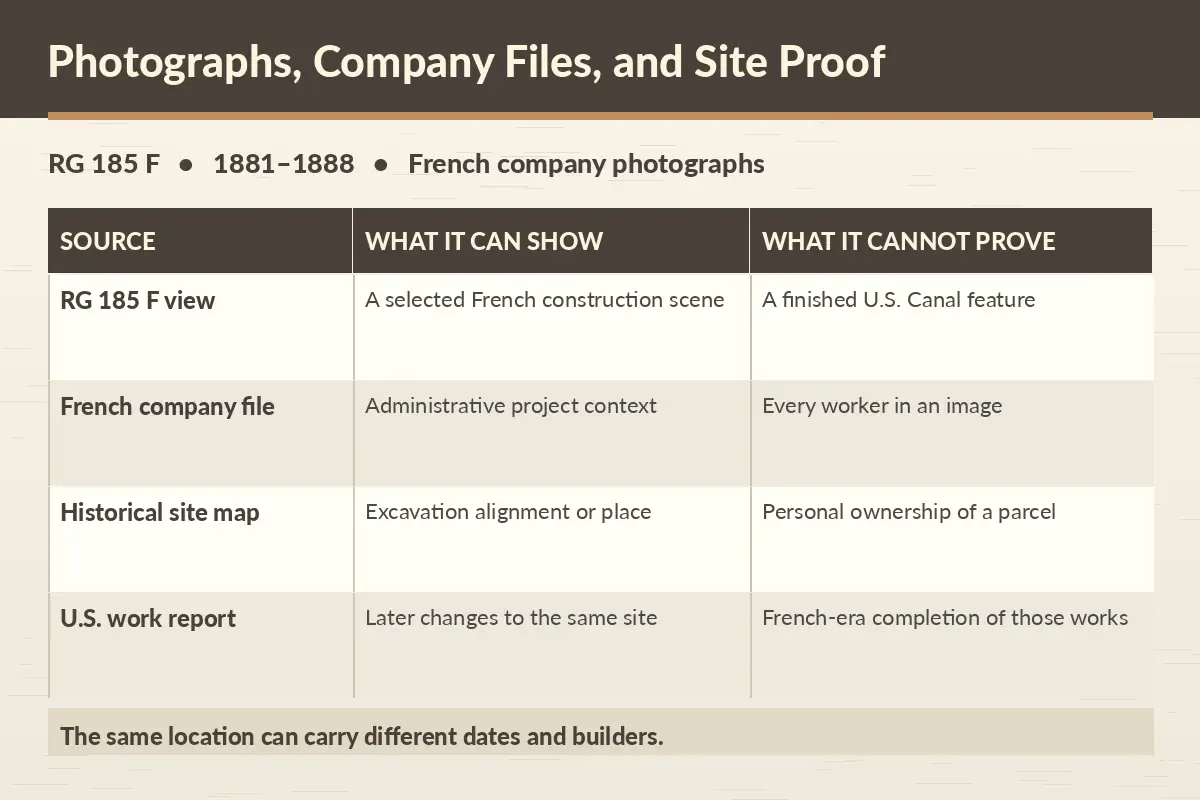
A steam excavator, rail wagon, dredger, or labor gang can document a technique or work activity at the instant depicted. It cannot show the total quantity excavated, the eventual engineering viability of a cut, or whether the location became part of the completed waterway. Search project plans, annual reports, and contract records for measurements and project decisions. Keep an image-based observation apart from later numerical estimates, especially when reports refer to different sections.
Engineering tools might be transferred between job sites, and a visible locomotive does not identify its crew. If the claim concerns a machine manufacturer, compare legible markings with a dated inventory or patent record. If it concerns progress, seek a report from the same month and location. Do not create a fictitious sequence in which every surviving French photo leads toward successful completion. The original project did not reach the same endpoint as the later American canal.
Research Workers Through Names and Jurisdictions
A crowd of laborers in the distance is not a personnel register. The French undertaking employed people from many places, and identifying a worker requires a named payroll entry, correspondence, contract, legal record, or personal letter. Search with name variants and historical place spellings, while separating workers, contractors, officials, photographers, and observers. A photo of a barracks is likewise insufficient to establish who lived in it, even if the employer and site are correctly identified.
Be precise about labor history and risk. The exposure of different groups to disease, hazardous conditions, and pay practices is a serious subject that cannot be measured from a single staged or selected scene. Where a source establishes a worker’s role, quote the role faithfully instead of supplying a modern job title. Missing records may reflect losses and administrative boundaries rather than absence. State plainly when the photographic series cannot resolve a person’s identity.
Compare French Work With the American Phase Correctly
A compelling before-and-after comparison needs a French photograph with a defensible location and an independently dated American engineering view. First identify the French state of the works, then verify what changed after 1904 through plans, photographs, and operating reports. The same terrain may have been excavated repeatedly, widened, stabilized, or rerouted. Refrain from labeling two views as a continuous timeline unless the site correspondence and order are demonstrated.
The NARA RG 185 federal records guide also describes much later U.S. construction photographs, canal operations, and other projects. Those series should be cited separately rather than folded into F. Keep a ledger for company name, photo series, local identifier, date claim, site, and source of confirmation. When a caption describes a worksite as Panama Canal, add the period qualifier so readers do not project the familiar twentieth-century canal backward onto the French enterprise.
Build an Image Citation and a Limited Historical Claim
An adequate citation identifies National Archives, RG 185, series F, item number, original description, and any available box or album context. Note whether the date comes from the print, an archive catalog, or an independent company document. Photographs may survive as later prints; do not assume a scan reproduces the original exposure or that its caption is contemporary. Seek the exact item through NARA still-picture access procedures when a catalog gives only a broad series.
Write the conclusion at the level the evidence permits. The photograph may show a French-era excavation near a proposed route; the corporate history confirms the enterprise’s operating period; a separate payroll might place a named relative in that area. Unless the picture names the person, it cannot prove their presence in the scene. This distinction protects both the family narrative and the engineering chronology from a familiar but misleading completed-canal story.
More House and Local History Guides
How We Research This Collection and Its Limits
The series description, dates, and record designation were checked against the official National Archives research guide on November 16, 2026. Independent context was compared with a second official research source, while NARA still-picture citation guidance establishes the information needed to locate an exact image. The site topic list and earlier production titles were compared for duplication. A series description does not identify every subject, date, or object in every frame, and access to a fully digitized item cannot be assumed. The figures in this guide are newly drawn explanatory editorial illustrations, not historical negatives or genuine reproductions. We make no unverified claims of commercial endorsements. See the affiliate disclosure for site policy.
Photographs of French Panama canal construction dated 1881–1888 in NARA’s Still Picture Branch guide.
No. The subject is the French enterprise; later federal custody is distinct from original creation.
No. Completion is a separate later engineering and historical claim.
Find a name in original caption or independent labor and personal records, not the image alone.
The United States acquired the assets of the French successor company; later construction has its own records.