
Start With the Archival Series and a Specific Question
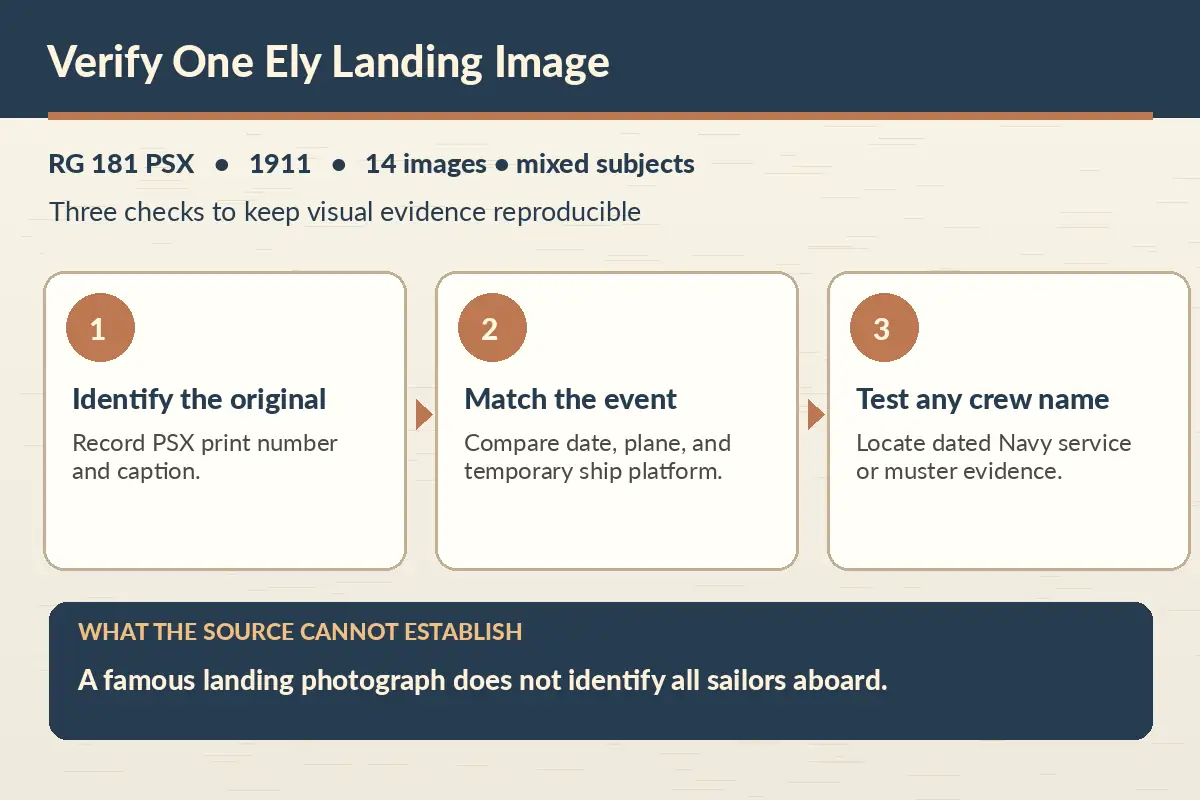
On January 18, 1911, aviator Eugene Ely landed a Curtiss biplane on a temporary platform aboard the armored cruiser USS Pennsylvania in San Francisco Bay and later took off again. NARA describes RG 181 PSX as a small set of 14 photographic prints that includes pictures of Ely’s landing alongside views of Navy gunnery practice. The collection is therefore narrower and more mixed than the familiar story of the event. Do not describe all fourteen items as photographs of Ely.
A researcher can make three precise claims: the event occurred on a particular date, a particular image depicts a moment, and a named person may have been there. These require different sources. The Smithsonian National Air and Space Museum provides the event chronology; Navy historical records can identify the armored cruiser; a NARA print establishes its own visual content. Identifying an ordinary sailor aboard the ship still requires separate named evidence.
Distinguish the Landing From the Earlier Ship Takeoff
Ely first demonstrated a takeoff from USS Birmingham in November 1910, an event distinct from his January 1911 landing on USS Pennsylvania. Narrative accounts often place the two feats together as the beginning of naval aviation, but a photograph of Birmingham should not be mislabeled as Pennsylvania. Check platform position, ship profile, date, and original caption. The Smithsonian describes the 1911 landing and the subsequent departure, giving an event framework that helps identify the stage a particular image may portray.
The fact that a scene was photographed on January 18 does not prove the exact minute depicted unless an original source supplies it. Arrival, landing, luncheon, and departure are separate moments. A graphic showing a plane near the platform may capture an approach rather than contact. If a caption says first landing, do not automatically infer which frame recorded touchdown. Preserve uncertainty when the camera angle or copy is too distant for a more precise observation.

Identify the Correct USS Pennsylvania
The landing platform was built on the armored cruiser USS Pennsylvania, identified in Navy history as Armored Cruiser No. 4. This is not the later battleship USS Pennsylvania, whose name is far more familiar to some researchers. The cruiser was renamed USS Pittsburgh in 1912 to free the Pennsylvania name. Therefore, a post-1912 source describing Pittsburgh may still concern the same hull, but only if dates and hull identification agree. Write the ship type with the name to prevent an inadvertent substitution.
A ship photograph should be matched using stern configuration, funnels, superstructure, and temporary platform as well as any written identifier. The landing deck was a short-lived modification, not an aviation carrier deck in the later sense. Modern captions can attach retrospective ratings or hull designations. Explain those designations instead of using them as evidence of what the crew called the vessel in January 1911.
Read PSX as a Mixed Small Photographic Series
NARA’s federal records guide lists PSX under naval districts and shore establishments, with fourteen images combining Ely’s landing and gun-practice views. A series-wide count gives no count for the landing subset. Begin with the particular print, its original local number, and any verso or mounted caption if access permits. Do not claim an exact number of Ely negatives without separate evidence. An online reproduction may omit a stamp, photographer’s credit, or marginal note present on the archived item.
Because the image is preserved in RG 181, one might be tempted to treat it as an official Navy photograph taken by a uniformed photographer. That does not follow from the record group. Record group custody, original camera operator, later copy maker, and collector can all differ. Compare the NARA object with Smithsonian or Naval History photographic versions only after checking whether they share the same exposure or are different viewpoints of the event.

Compare Smithsonian and Navy Captions Without Merging Them
The Smithsonian narrative supplies detailed context about Ely’s preparations, the improvised arresting ropes and sandbags, and the flight from Tanforan toward the cruiser. The Navy historical pages separately identify the ship and reproduce event photographs with their own numbers. These materials are excellent checks on date, equipment, and vessel identity, but an image on one website should not inherit another institution’s identifier. Treat each collection’s credit line and copyright information as independent metadata.
Write a parallel-source table: institution, accession number, image title, stated original date, visible equipment, and caption provenance. A Smithsonian print and a Navy print may show the same aircraft and platform but not be identical frames. If their descriptive words differ, quote each with attribution and investigate rather than silently combining the captions. The resulting comparison is stronger than a single authoritative-sounding composite citation.
Avoid Inventing Shipboard Witnesses From a Crowd
A visible line of sailors along a deck can support the observation that people witnessed the landing. It does not reveal their identities, service numbers, or exact duties. Find a named relative in muster rolls, personnel papers, ships’ logs, or dated letters, then determine whether the service dates include January 18, 1911. Even a sailor confirmed to have served on Pennsylvania in 1911 is not necessarily visible in one particular image. A ship assignment and a photographic identification are independent claims.
If a family legend says an ancestor helped prepare the landing platform, look for contemporaneous testimony or ship documentation of the work. Repeated later anecdotes may depend on one unverified recollection. The historian can record a plausible connection as tentative, but should not elevate it to a witnessed act. Likewise a souvenir image purchased later may prove family interest in the event, not a direct relationship to the person or vessel photographed.
Create a Citation That Survives Image Reuse
Cite the exact RG 181 PSX print identifier, not only the phrase Ely landing. Keep the institution that owns the specific print, the caption as supplied, the date source, and any publication or reproduction notes. For background, cite the Smithsonian’s January 18 account separately and ship identity through Naval History sources. A search result presenting only a thumbnail does not establish that an original negative survives or that the copy is unrestricted for publication.
A defensible final caption might say that an image depicts an early aircraft approaching a temporary platform on armored cruiser Pennsylvania during the January 18 demonstration, if those details can be verified in the print. A following sentence can explain the broader milestone. If a relative’s service can be independently documented, add that in a separate sourced statement rather than inserting an unsupported name into the photograph. Precision makes the aviation history stronger, not less dramatic.
More Research Method Guides
How We Research This Collection and Its Limits
The series description, dates, and record designation were checked against the official National Archives research guide on November 16, 2026. Independent context was compared with a second official research source, while NARA still-picture citation guidance establishes the information needed to locate an exact image. The site topic list and earlier production titles were compared for duplication. A series description does not identify every subject, date, or object in every frame, and access to a fully digitized item cannot be assumed. The figures in this guide are newly drawn explanatory editorial illustrations, not historical negatives or genuine reproductions. We make no unverified claims of commercial endorsements. See the affiliate disclosure for site policy.
Eugene Ely landed and subsequently took off from a platform on the armored cruiser USS Pennsylvania.
No. NARA includes naval gunnery subjects in the same 14-image series.
The armored cruiser No. 4, later renamed USS Pittsburgh, not the later battleship.
No. Use dated named Navy service and muster records for crew research.
Give the specific owning repository and item identifier; cite event histories separately.