
Start With the Archival Series and a Specific Question
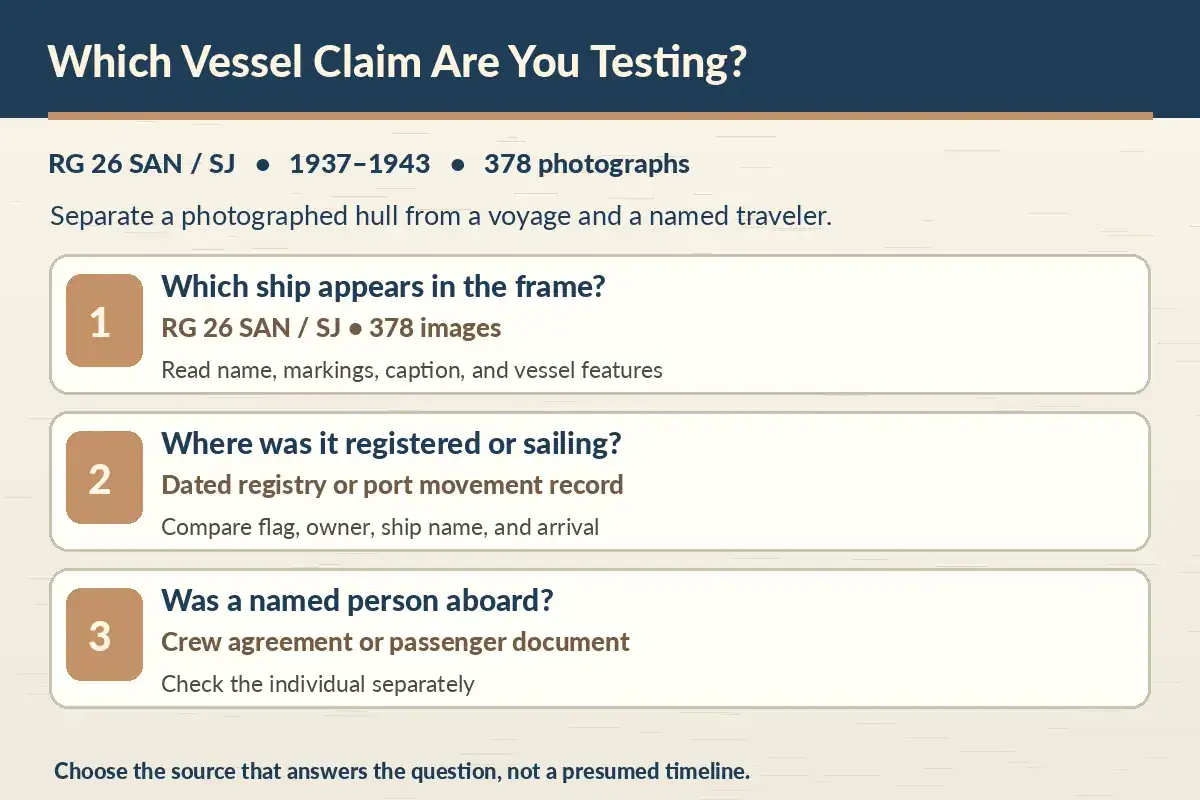
The National Archives describes 378 Coast Guard photographs in series SAN and SJ showing Japanese, allied, and neutral merchant vessels entering San Francisco Bay between 1937 and 1943. The series offers a place-specific glimpse of maritime traffic during a period when flags, ship ownership, and international relationships could change. A photo of a recognizable hull is not a shipping manifest, and an archive caption is not a complete register of who traveled aboard.
Use the pictures to ask narrow questions: Which hull is shown? What name or markings can be read? What arrival date, if any, is directly documented? What separate source identifies a particular crew member, immigrant, or passenger? Those questions require different record classes. Treat the guide’s date range as the collection boundary, not an exposure date for every frame.
Keep SAN and SJ Identifiers Attached to the Print
Begin with RG 26 and the two NARA series designators, SAN and SJ. The federal records guide groups them under Coast Guard public-affairs photographs and gives a combined count of 378 images. It describes Japanese, allied, and neutral merchant ships entering San Francisco Bay, not all vessels that ever entered the harbor. NARA’s broader wartime reference guide also names SAN and SJ among relevant still pictures. Neither overview assigns a precise vessel or date to an individual print.
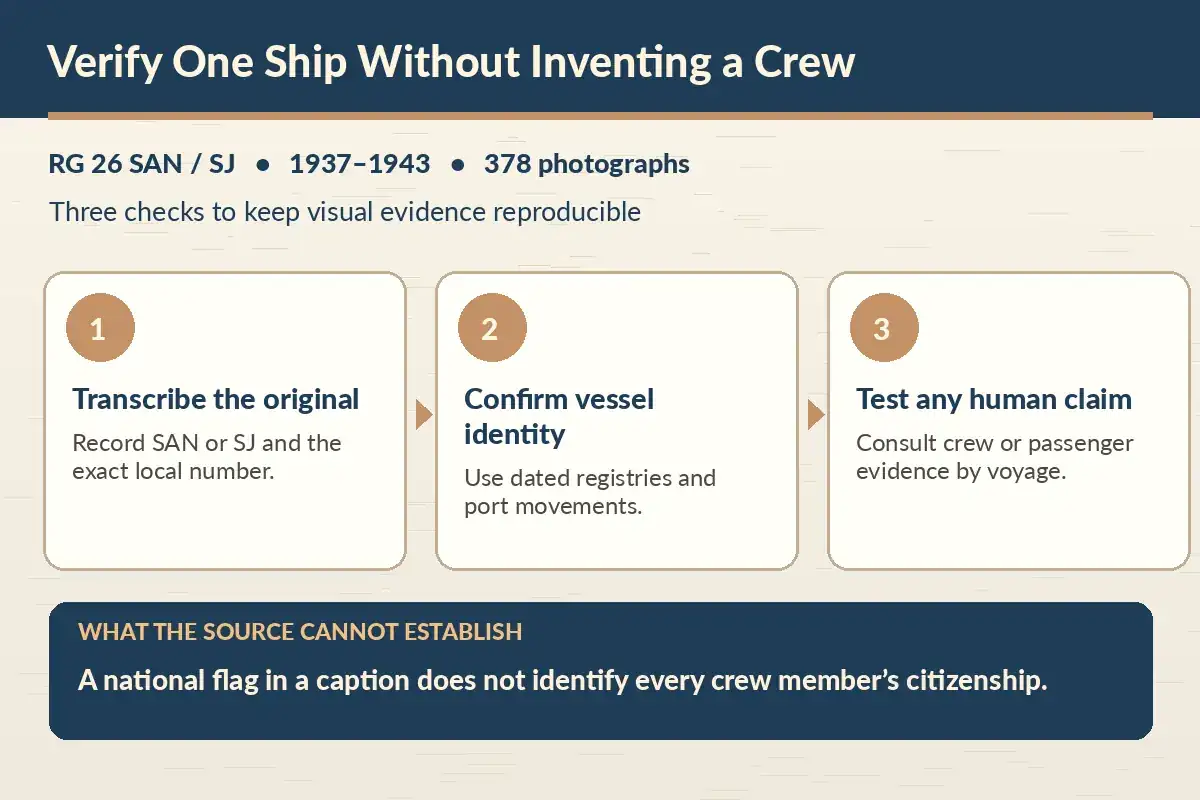
For each candidate photograph, preserve its original description, local item number, any negative number, and the spelling of the ship name as written. A caption may have been prepared or revised after the ship was photographed. If an image has a later descriptive title, record both titles rather than choosing one as necessarily contemporary. Modern web copies can crop ship markings, so use the highest quality authorized original available before deciding that a name cannot be read.
Identify a Vessel With More Than Its Painted Name
Merchant vessels could change owners, names, flags, and wartime functions. A shared ship name is therefore a weak identifier without a date and physical features. Compare hull length, funnel number, mast arrangement, bridge shape, paint, deck cargo gear, and any registration number with a vessel register from the relevant year. Do not transfer a postwar photograph’s specifications backward without checking whether the vessel was refitted.
If the original caption provides a nationality, distinguish the flag flown on the occasion, the registry recorded by authorities, the owner’s legal address, and the citizenship of people aboard. These are different attributes. The term neutral in the series description belongs to the historical and administrative context of the period; it is not a permanent characteristic of a hull. Document precisely which country and which date underlie a statement about neutrality.
Treat the Bay Entrance as a Place, Not a Manifest
A recognizable shore silhouette, island, bridge, or harbor feature may help position a vessel photograph. Compare the view with period nautical charts and dated harbor photographs, accounting for the photographer’s direction and lens compression. A vessel that appears near the Golden Gate may have been inbound, outbound, or maneuvering; direction cannot always be inferred from its bow alone. The catalog’s general description of ships entering the Bay should not override contrary evidence in a specific frame.
When reconstructing a voyage, search dated arrival and clearance notices or official port files for the vessel, then check previous and subsequent ports individually. A ship’s documented arrival does not show that it docked at every nearby pier or carried a particular cargo. Similarly, the presence of other ships in the background cannot establish that they traveled together. Build a timeline from separately dated records and flag photographic inference as provisional.

Keep Wartime Context From Overwriting Individual Dates
The 1937–1943 period spans several distinct stages of the Pacific conflict and U.S. policy. Do not describe a 1937 merchant-ship arrival as a wartime convoy unless a specific dated source proves that status. Caption language may have been shaped by later wartime filing and should be compared with contemporaneous port papers. When vessel registration changed, treat every date and documentary statement as a separate entry rather than making a smooth story from a single image.
Crew and passenger composition also changed between voyages. A family story that an ancestor worked aboard a ship may be true for one season but not another. Seek crew agreements, maritime employment records, embarkation papers, or passenger entries appropriate to the particular voyage. Ship ownership information cannot verify a named person’s presence. Even an image clearly showing sailors on deck does not supply their identities without reliable direct annotation and independent corroboration.
Check What the Coast Guard Was Documenting
As a Coast Guard photographic series, SAN and SJ preserve selected images collected for administrative or public information purposes. The collection does not claim exhaustive surveillance of San Francisco maritime traffic. The photographs may emphasize particular vessel categories, recognizable ships, or unusual arrivals. Missing hulls are therefore not evidence of nonarrival. Research the completeness of a specific port series before making statistical claims about the number of Japanese or allied ships.
Distinguish visual fact from explanatory interpretation. A clearly visible ensign can support a description of what flag appears in the photograph, but not an unverified claim about the political allegiance of the entire crew. A caption calling a ship Japanese may refer to registry rather than ethnic identity. Use terms precisely and avoid ascribing political beliefs or citizenship to unidentified workers on the basis of their workplace or the historical category of a vessel.
Create a Ship-to-Voyage Evidence Ledger
Build a table with RG 26 SAN or SJ identifier, the item caption, observed vessel features, candidate ship register entry, documented movement date, and a separate column for named persons. For each link, write what the record actually states and what remains inferred. If two similarly named ships exist, keep competing hypotheses until physical and date evidence resolve them. Do not delete an inconvenient discrepancy simply to force a match.
In a final citation use National Archives, RG 26, exact series designation, local negative or print number, and any box or folder identifier. Cite the historical registry and port papers separately; they are not part of a photograph merely because they describe the same vessel. A careful result might identify a likely ship while declining to name its crew. That limited claim is preferable to an attractive but untestable maritime family legend.
More Place and Jurisdiction Guides
How We Research This Collection and Its Limits
The series-specific count, dates, and record designation were checked against the National Archives federal records guide on November 16, 2026. Independent context was compared with a second official research source, while NARA still-picture citation guidance establishes the information needed to locate an exact image. The site topic list and earlier production titles were compared for duplication. A series description does not identify every subject, date, or object in every frame, and access to a fully digitized item cannot be assumed. The figures in this guide are newly drawn explanatory editorial illustrations, not historical negatives or genuine reproductions. We make no unverified claims of commercial endorsements. See the affiliate disclosure for site policy.
NARA lists 378 images across the two series.
The guide dates this series to 1937–1943; check each item for its actual exposure date.
Not without voyage-specific passenger or other named records.
No. Flag, registry, ownership, and crew citizenship are distinct.
RG 26, SAN or SJ, local image identifier, original caption, and the independently cited voyage record.