
The Post Office Department’s PB photographic prints offer a focused way to locate an old town post office, but a building photograph is not a list of the people who worked there. The National Archives identifies 3,800 PB prints from post offices in more than 2,000 U.S. communities, dated 1900–1940, under Record Group 28. Those counts describe the archived photographic grouping, not an image for every office in existence or a guarantee of complete online coverage.
Begin with the historical town and state, then locate the precise PB item and record its original caption. Treat a pictured facade, sign, entrance, or street as evidence of what the image shows. If you want the postmaster’s name, the date an office moved, or the owner of the building, research those as independent questions using the records appropriate to the claim.
Find the PB Photograph by Community and Original Caption
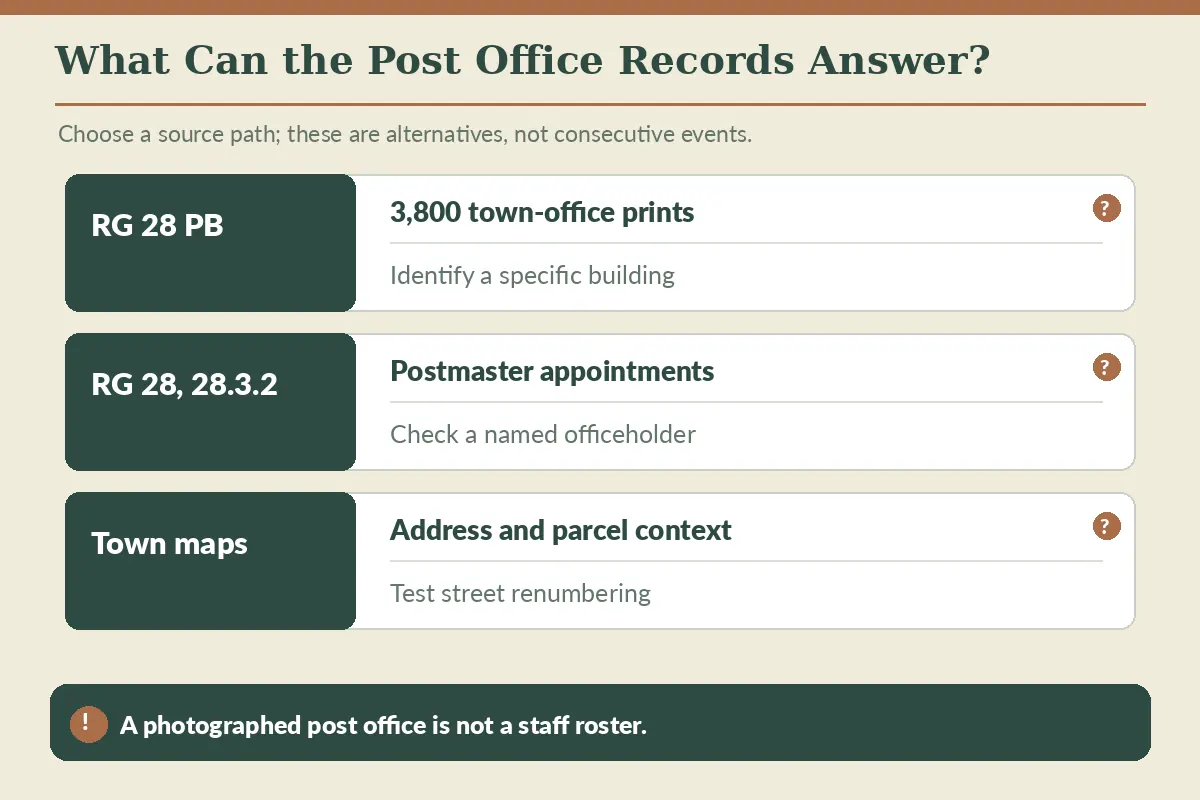
Start with RG 28 section 28.15, which distinguishes PB from the F grouping covering Washington, DC post office construction in 1931–1932 and later work-area images from 1956–1959. A scanned print of a 1930 small-town building should not be filed as F merely because it is an exterior view. Similarly, other RG 28 photographs depict postal equipment or people at work rather than the specific PB town-office collection.
Search by the town name as it was used during the probable photography period, not only the present spelling. A community may have had a renamed post office, an extinct office, or several branches over time. Record the precise caption, image number, building identifiers, date qualification, and any handwritten notes on the photographic mount. A label stating a town is not necessarily a street address, and a date range for the whole PB collection cannot fix an item’s exposure year.
Check whether an online image is a print scan, a copy made from a print, or a later reproduction. If the catalog record is only series-level, follow the Archives reference instructions for a more precise finding aid. Avoid constructing a false building history from search thumbnails alone. Keep the archival citation independent of any address or family identification added through later research.
Match the Facade to a Period Street Without Assuming Continuity
Historic post offices often occupied a rented storefront before a purpose-built federal structure opened. A familiar architectural style does not prove the building remained at the same address or served the same function every year between 1900 and 1940. Compare the photograph with dated Sanborn fire insurance maps where available, city directories, local tax maps, and contemporary street scenes. Watch for changed street numbers, annexed districts, and buildings moved or expanded after the picture was made.
Use landmarks in a fixed order: readable signage or street number first, the intersection or adjoining structures next, then architectural details such as window spacing or roofline. When two town buildings share a brick cornice and arched entrance, the resemblance alone is not a match. A map’s publication year matters; a 1950 map can be used to find a persistent lot but cannot automatically establish conditions on that lot in 1912.
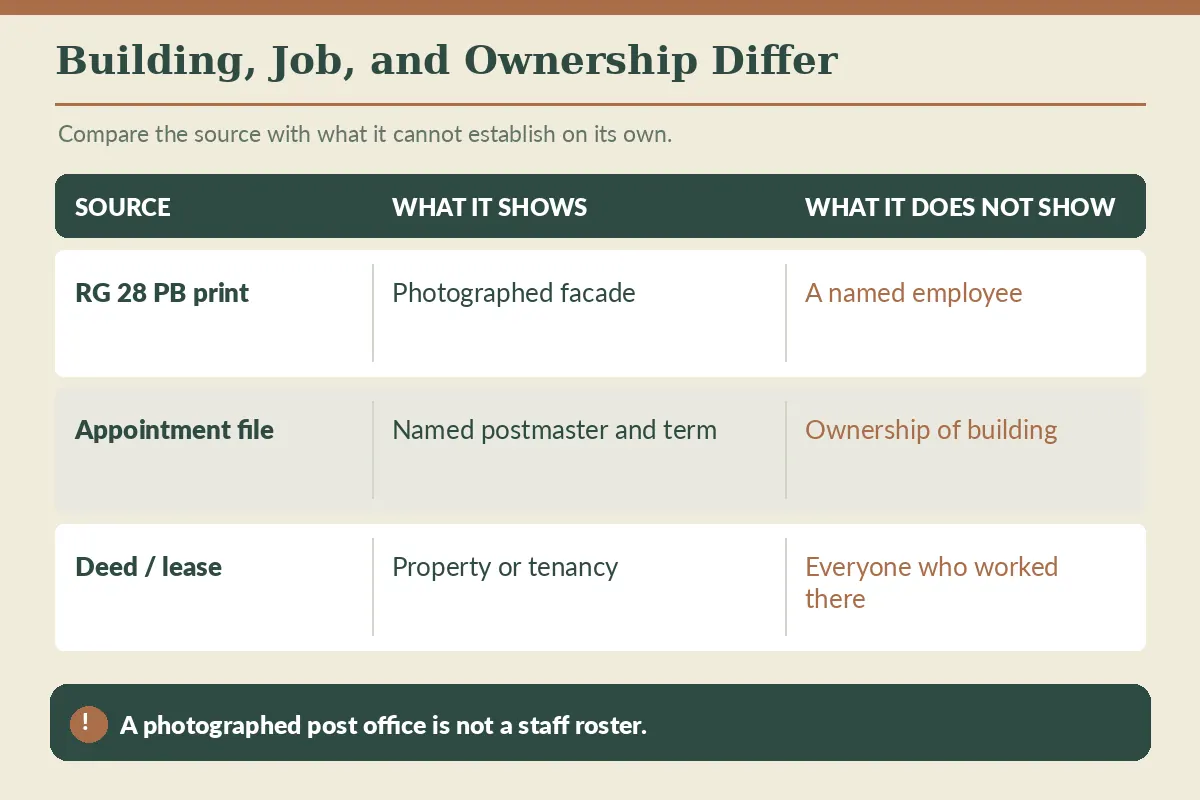
Write separate evidence statements for “this is the building photographed,” “the post office was operating at this address,” and “this parcel was owned by this person.” A PB caption may establish the first statement if it names the building; postal records and directories may establish operations; a deed or lease is required for a property claim. Those statements should not collapse into one because they share a street name.
Find Postmasters and Office Changes in Different RG 28 Files
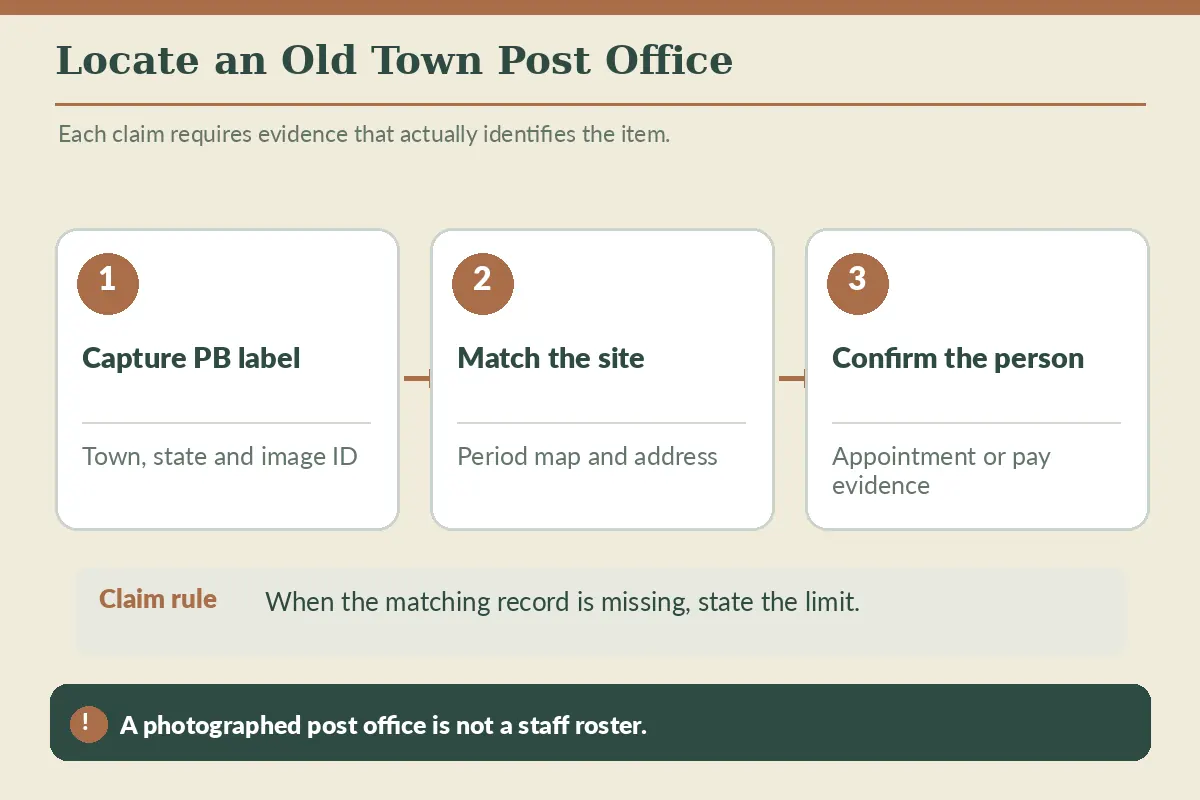
NARA describes records of the Division of Postmasters in RG 28 section 28.3.2, including records relating to appointments of postmasters from 1815–1971 and office openings, closings, redesignations, and relocations from 1899–1914. Their existence makes a more responsible inquiry possible, but they are not embedded inside PB prints and they do not necessarily cover every fact about every photographed office. Search the applicable date and jurisdiction before assuming that a particular name is available.
If the question concerns a named postmaster, connect the appointment or service period to an independently dated PB image. A person holding the office sometime in the decade was not necessarily present when the photograph was taken. A formal appointment proves a position; it does not automatically prove ownership of the postal premises. For a clerk or letter carrier, seek relevant employment or local evidence instead of assigning the postmaster’s identity to a figure in a doorway.
A relocation record can explain why a community has two visually different post office photographs close in time. Conversely, a new facade does not by itself prove an official relocation; renovations and replacement photographic prints are also possible. Keep office establishment, building address, employee identity, and building ownership as four testable claims with their own supporting documents.
Build a Town-Level Photo and Postal Record Crosswalk
Make a research ledger with the postal office name, state or territory, PB identifier, original caption, any confirmed photo date, historical address, address source, and distinct personnel-source citation. Add a field for current address only after checking contemporary boundaries and numbering changes. For towns whose names recur in multiple states, never search or cite the community name without the state and an appropriate period qualifier.
Preserve the original photograph uncropped when documenting building evidence; window arrangement, neighboring buildings, and marginal notes can be more useful than an enlarged postal sign. If you crop the image for a family website, retain a link to the full original and explain the edit. The NARA guide’s count of 3,800 is a holdings statement, not a promise of high-resolution images for every town or unrestricted reuse of every underlying photograph.
A robust page caption might say: “Post office building as labeled in the RG 28 PB print, original caption and identifier as cited; precise address and staff not established.” Add the address or employee names only after separate proof, and cite each additional source in the page’s notes. A photo can restore a lost town landmark to local memory without inventing an ancestor at its counter.
More House and Local History Guides
How We Research These Archival Sources and Claims
We take the PB grouping’s scope, community count, and date range from the NARA RG 28 guide, sections 28.15 and 28.3.2. The Still Picture Branch holdings guide and official still-image research page support the catalog and copy-check workflow. We have not inspected a specific PB print or confirmed any local postmaster or building address. The affiliate disclosure is provided for transparency, not as a statement of archival sponsorship.
PB identifies the archival photographic prints of post offices in over 2,000 U.S. communities between 1900 and 1940.
No. The NARA description lists 3,800 prints, not a comprehensive photograph of every town or postal location.
No. Look for a separate named appointment or service record under the applicable RG 28 postmaster files.
Compare the original print with contemporary maps, directories and, where necessary, postal relocation records.
No. F covers different material, including Washington, DC construction in 1931–32 and 1956–59 work-area photographs.