
The International Genealogical Index (IGI) is not one uniformly documented register. FamilySearch explicitly distinguishes the community indexed IGI, derived from historical documents, from the community contributed IGI, assembled from family-submitted information that may have no cited original. Search these branches separately. A promising birth or marriage is a candidate until you check the source behind it, the relevant jurisdiction and any same-name alternatives.
Identify which IGI branch produced the result
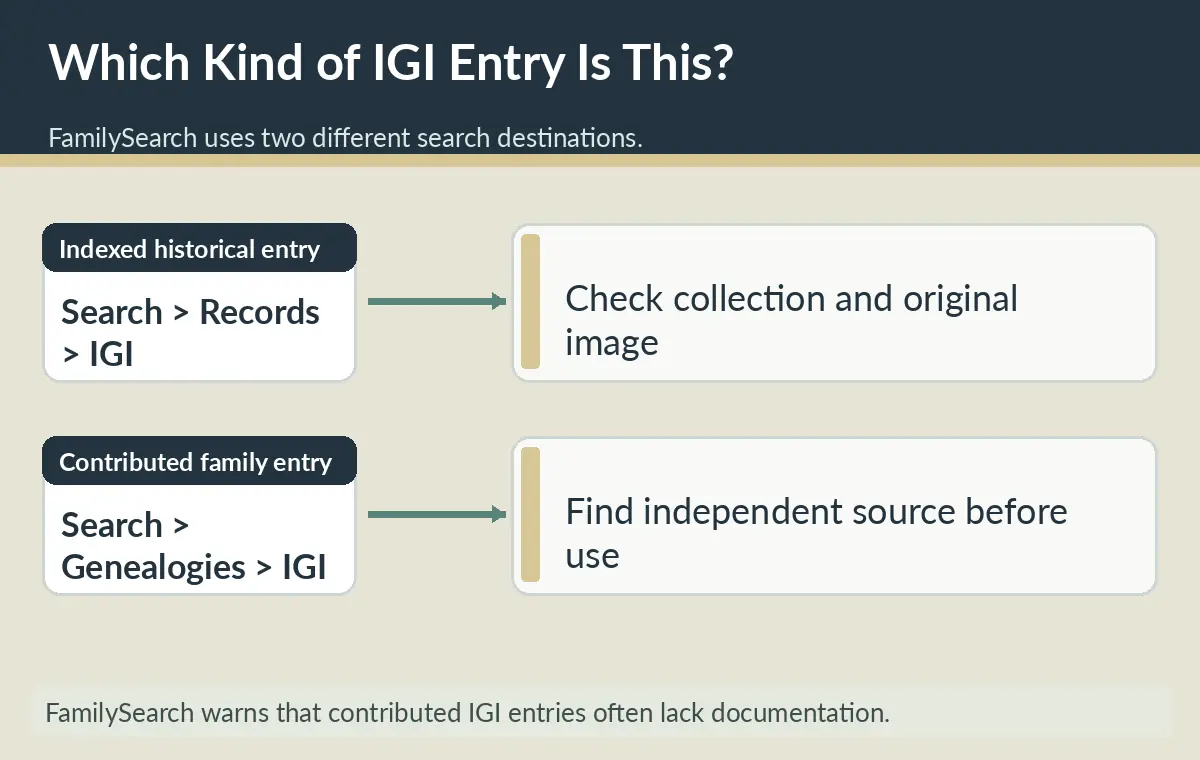
The IGI predates today’s FamilySearch indexing system. Its older content now appears through more than one modern search route. Extracted entries from historical sources are available as indexed historical records; contributed genealogy information is under Genealogies. The latter may preserve valuable clues that would otherwise be lost, but FamilySearch warns that user-submitted names and relationships vary in quality. Before copying any data, label the result ‘indexed historical record’ or ‘contributed genealogy.’ If the page does not make its origin clear, investigate the citation area and collection name rather than guessing.
The FamilySearch IGI explanation notes that historically extracted entries often relate to events from the early 1500s through 1885. That is an approximate collection tendency, not a statement that any particular parish register survives continuously across those centuries. A marriage entry may contain a transcribed name, spouse and date, but that alone does not identify a later emigrant or establish all children. A contributed birth date can be copied repeatedly across online trees without independent documentary support.
Search community indexed material as historical records
For the indexed branch, FamilySearch instructs researchers to sign in, select Search > Records, then use Find a Collection and select ‘International Genealogical Index (IGI).’ Enter a name, the event type and relevant place; add a narrow date range only when you have a dated clue to justify it. The index spans multiple jurisdictions, so a strong place filter can be more useful than a single modern spelling of a surname. Capture the record’s historical collection title and event place as transcribed rather than silently modernizing them.
Open each plausible result. FamilySearch says that if a source image is available, a View Original Document option can appear. Check the original handwriting and surrounding register entries for witnesses, addresses, parents or notes that an index abbreviated or missed. Do not assume every indexed IGI hit has a freely viewable image. Access restrictions, digitization gaps and underlying archive custody vary. A result without an accessible image can still be a useful pointer, but label what you saw and seek the underlying parish, civil or other source by repository and date.
Treat the contributed IGI as a family hypothesis
The contributed IGI instructions route you to Search > Genealogies and the International Genealogical Index collection there. These entries were provided by contributors, often with differing levels of knowledge and source detail. FamilySearch explicitly warns of duplicates and inconsistent data. Search them for possible localities, marriage leads or variant names, but record the entry’s contributor and source fields only if actually supplied. A contributed pedigree entry does not establish a parent-child relationship merely because it appears alongside an ancestor’s familiar name.
Create a small hypothesis table with three columns: statement from IGI; independent record that could test it; status after inspection. A contributed assertion that Hannah Reed married James Gray in a town in 1810 can direct you to the relevant marriage register, but should not be promoted to a documented event until the register or other competent record supports it. If two contributed entries disagree, both are leads, not votes. Count documentary independence, not how many copies of a statement appear online.
Understand batch numbers, film numbers and missing source detail
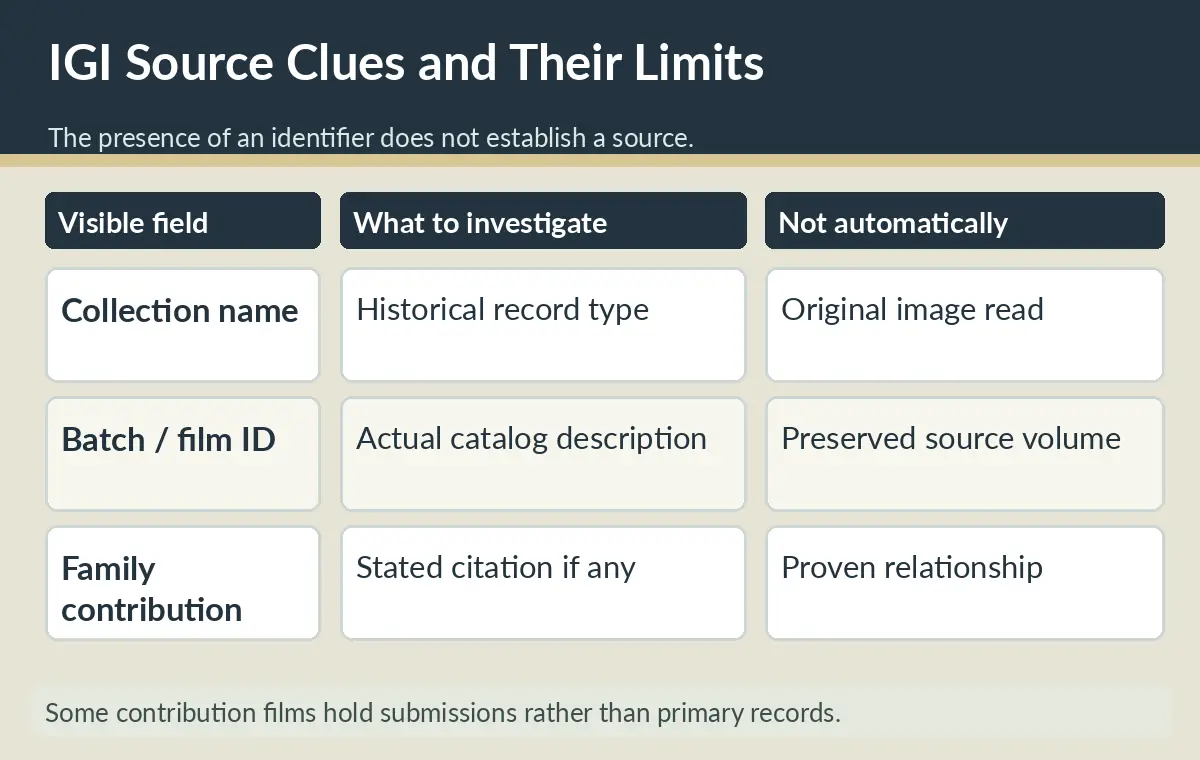
An IGI citation can contain batch numbers, FamilySearch film identifiers or links to a historical collection. These locators are useful only when tied to a known source. FamilySearch’s source-information guidance says most contributed entries have no original source, and some numbered batches reference submissions instead of a preserved register. A film number is not automatically proof that an original parish image is available. Copy the exact citation and ask what physical or digital material it describes.
On a historical indexed result, identify the archive, original volume if stated, locality, event type, date, and image or page number. On a contributed result, look for a traceable source declaration and be prepared to stop if there is none. Some film or fiche access is restricted. Avoid fabricating a page reference to fill a blank and avoid citing an IGI batch as if it were the name of a government archive. A good research log records which interface, date and result generated a candidate and exactly which supporting image could or could not be viewed.
Compare namesakes against the original locality
IGI records can identify several people named John Williams in neighboring parishes in the same decade. Match the event date to other independent records and verify whether a named parent, spouse, witness or occupation is present in the underlying source. If the original merely records a baptism, it establishes the recorded baptism event; it does not by itself fix the child’s exact birthday, later residence or identity as a person in a different country’s census. Likewise, a contributed baptism or birth year cannot be used as precise evidence of the person’s age without a documented basis.
Build two candidate rows when another family has the same parents’ given names. Compare the place, register chronology, siblings, household addresses and later records before merging the people. If handwriting is unclear, preserve the literal reading and a normalized searchable spelling separately. A search result on FamilySearch can change its displayed layout over time, so note the persistent identifiers that actually appear in your view. Keep a contradiction unresolved when neither candidate is strong enough instead of importing the more attractive lineage.

Write the source-based conclusion instead of an IGI label
When you obtain the original register, cite the repository and parish or collection, type of entry, date, folio or page when supplied, image identifier and access platform. An extracted historical record should be described as an index until its original is inspected. For contributed data without a named underlying source, cite the IGI contribution as a suggestion, not a birth certificate or marriage register. Record whether the intended family connection is proven, plausible or unknown, and identify the next source needed to change that evaluation.
FamilySearch’s own guidance makes this a practical two-route method: pursue viewable indexed images and independently re-source contributions. No commercial subscription is assumed for this explanation, though an underlying image may have access conditions determined by its custodian. The site’s general affiliate disclosure explains referral policies and does not turn an index record into stronger evidence. Maintaining source provenance is more useful than carrying the letters ‘IGI’ forward as if they were a single fully original collection.
More Genealogy Tool Guides
How We Research This Collection
We followed FamilySearch’s October 2024 articles on both IGI search routes, the distinction between extracted and contributed entries, and its 2025 guidance on original-image access. The diagrams represent source-origin and evidence-status decisions, not a promise that a batch number provides a filmed original or proves parentage.
Indexed material derives from historical documents; contributed material comes from family submissions and may have no documented source.
Use FamilySearch Search > Records and find the International Genealogical Index collection.
Use FamilySearch Search > Genealogies and choose the contributed IGI collection.
No. Check the actual citation and film description; some contributed submissions do not identify a recoverable original.
No. A documented baptism proves the entry as recorded; an exact birth date needs its own evidence.