
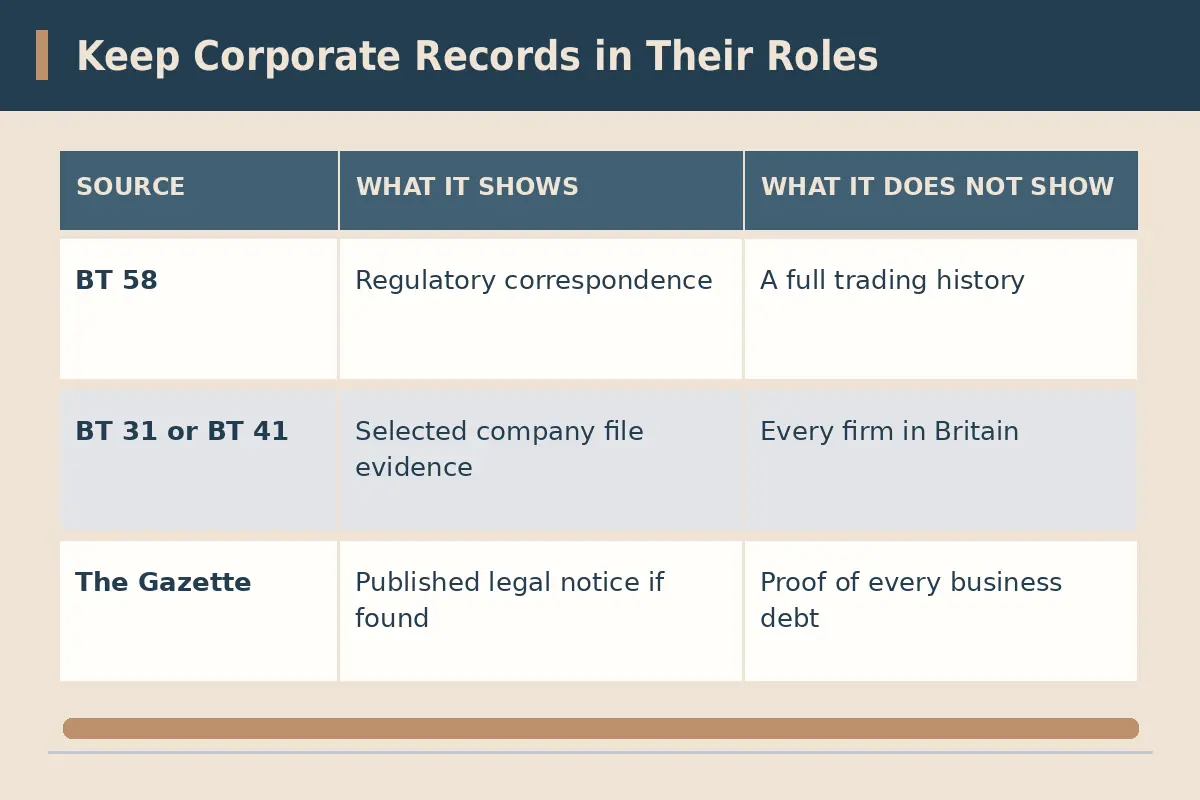
BT 58 contains Board of Trade Companies Department correspondence within the wider history of company regulation. A letter about a firm is not its register of shareholders, proof that it went bankrupt, or an account of every day the business traded. This guide gives a precise source route, identifies what the archive can and cannot show, and names the independent documents needed before a personal or geographic conclusion becomes defensible.
Establish What a Company Letter Actually Says
When a family business appears in Board of Trade correspondence, the discovery is appealing: the government knew the name. But a file can concern a question of registration, a complaint, regulatory reporting, or procedural correspondence without implying financial collapse. The National Archives guide to companies and businesses identifies BT 58 as Companies Department correspondence and dates the series from 1850 to 1986. Those are inclusive series dates, not proof that a particular company had a continuous file over that span. Start by stating the inquiry you want answered rather than writing a company biography from the existence of a file.
Distinguish the firm’s trading name from its registered legal name. A shop might be a sole trader, a partnership, an incorporated company, or a subsidiary, and a familiar sign above a premises cannot establish which form applied. Search with historical spelling, alternative punctuation, addresses and, where documented, the company number. The company number can help discriminate among near-identical names, but should be supported by records from the correct period. In any document, identify the correspondent’s actual role rather than calling every named signatory a director or owner.

Search BT 58 as Correspondence, Not a Register
Use Discovery to search BT 58 for a firm name, company number, town, or specific regulatory subject, and record the covering dates and full piece reference. A low-level catalogue record may provide a detailed file title; a higher-level record may hide individual names in papers that require inspection. Check the department, series, and file description before inferring that a match belongs to your business. If a common company name produces many results, compare incorporation address, officers, and contemporaneous locations using independent records.
When an original case file is available, sequence letters by their actual dates and by their role. Note who wrote to the department, what was requested or alleged, whether officials asked for further information, and what response is documented. An incoming complaint does not prove that the complaint was justified. A docket noting receipt is not evidence of a final decision. Incomplete correspondence requires an explicit “reply not located” marker rather than an imagined response. Reconstruct the procedural history only to the degree supported by surviving papers.
A reusable ledger can place correspondence on one axis and corporate life-cycle events on the other. Fields should include company number, name and address at the time, originator of the letter, subject, response status, legal form, reference and a citation to independent company-status evidence. If a reply is not present in the file, mark the gap. A cluster of complaints can remain unproven allegations despite its volume.
Route Company Status to the Appropriate Source
The companies guide explains that company records are divided among record types with different legal and survival limits. BT 31 contains sampled files for companies dissolved after 1860 under relevant registration regimes, while BT 41 contains files of earlier dissolved joint-stock companies within its defined scope. These are not universal directories of every historical enterprise. Their absence cannot be used as a general argument that a firm never registered or closed. A business could change name or legal form, and company archives differ from the everyday books that management created.
For an actual dissolution or winding-up claim, compare regulatory correspondence with legal notices in The Gazette, court proceedings where applicable, and any preserved company file. Keep separate dates for incorporation, change of name, liquidation petition, dissolution, cessation of trading, and later removal of a brand. A company could stop trading before being formally dissolved, or remain registered after its premises closed. Conversely, a complaint that someone failed to file a return does not equal insolvency. State exactly which event each source demonstrates.
Separate a Director, Shareholder, and Worker
Business records are often approached with a question about an ancestor. A letter signed by a company secretary may establish that they acted in that capacity for that communication; it does not show share ownership, lifelong employment, or kinship with other officers. Where company documents preserve directors or shareholders, report what they say at a specified date. Verify a worker’s employment through person-level records such as payrolls, staff lists, employment correspondence, or other independent documentation. A business address also does not prove that a named director lived at the premises.
Create an identity matrix with full name, named position, dated company address, company number, and separately documented individual characteristics. Do not merge two directors with similar names because they served at different firms in the same town. If a shareholder appears in a list, the recorded interest at that date does not settle whether the person paid for every share or retained it at death. A signature on regulatory correspondence may be important but remains evidence of a specific act, not a complete personal career or genealogical connection.

Publish an Evidence-Based Business Timeline
A clear research product is a dated timeline whose rows identify the event, source type, record reference and what remains uncertain. For example, cite a BT 58 letter as evidence that the department received a request, and cite a separate notice if one establishes winding-up. Avoid “the government closed the company” unless the legal record actually shows that mechanism. Explain why a name search was inconclusive if the company was unincorporated, changed address, or fell outside surviving samples. The archive’s selection history matters just as much as the search terms.
If a piece is unavailable online, note the access route without describing contents you have not seen. Retain correspondence envelopes, later file annotations, and company identifiers in transcriptions because their dates can correct the order of events. Identify what future document would settle the case: a registration entry, a Gazette notice, a court order, or a surviving company ledger. The most persuasive company history is one that preserves the distinction between administrative attention, ownership, employment, financial difficulty, and a legally documented end.
When a business traded under a name different from its registered title, record both as distinct labels with dated evidence. A shop address from a directory can identify a place of business, but it is not a company registration record and may lag the actual move. Place a legal notice alongside, not inside, the directory entry. Keep the public timeline legible about which facts are contemporary and which are later reconstructions.
More Records and Archives Guides
How We Research This Archive Series
This guide starts with the official description in The National Archives’ research guidance, not a claim that we have inspected a particular person’s private file or a specific original piece. The archival statements here concern the series or research method. A hypothetical example is labelled as such; it is not a newly discovered historical event. We use the Discovery search guidance to distinguish keyword matches from archive holdings and document contents, because catalogue descriptions do not transcribe every word of an original.
For every real candidate, record its historical place or person’s name, the creator, document type, date, full BT 58 piece or item reference, access restrictions, and the exact claim being tested. The official citation guide explains how to document those references so another researcher can retrace them. An unread document remains a catalogue lead, never proof of imagined details. If a record is missing, preserve the searched terms and dates and examine survival and alternate custodians before interpreting the gap.
Before sharing a conclusion, audit the difference between original source wording and your interpretation. Require independent evidence for any further claim about an individual, property owner, legal effect, or completed action. Respect archival access limits and living people’s privacy. This website also provides an affiliate disclosure; no paid partnership or commercial access is implied by these archival references.
Companies Department correspondence within Board of Trade records, identified in the official guide as covering 1850–1986.
No. A regulatory inquiry or complaint is not equivalent to a legal bankruptcy or winding-up outcome.
Depending on date and record survival, consult BT 31 or BT 41 and appropriate legal notices.
Only with additional person-level evidence linking the individual to that company and role.
Cite each letter and its documentary status, and cite a separate record for any legal outcome claimed.