
The National Archives identifies NSC 27 as a discrete photographic collection associated with the Post Office Savings Bank, covering approximately 1880–1961. This guide shows how to find the right original record, distinguish the observation it contains from a later claim, and decide what independent evidence must be checked next.
Treat the Photograph as a Place Record First
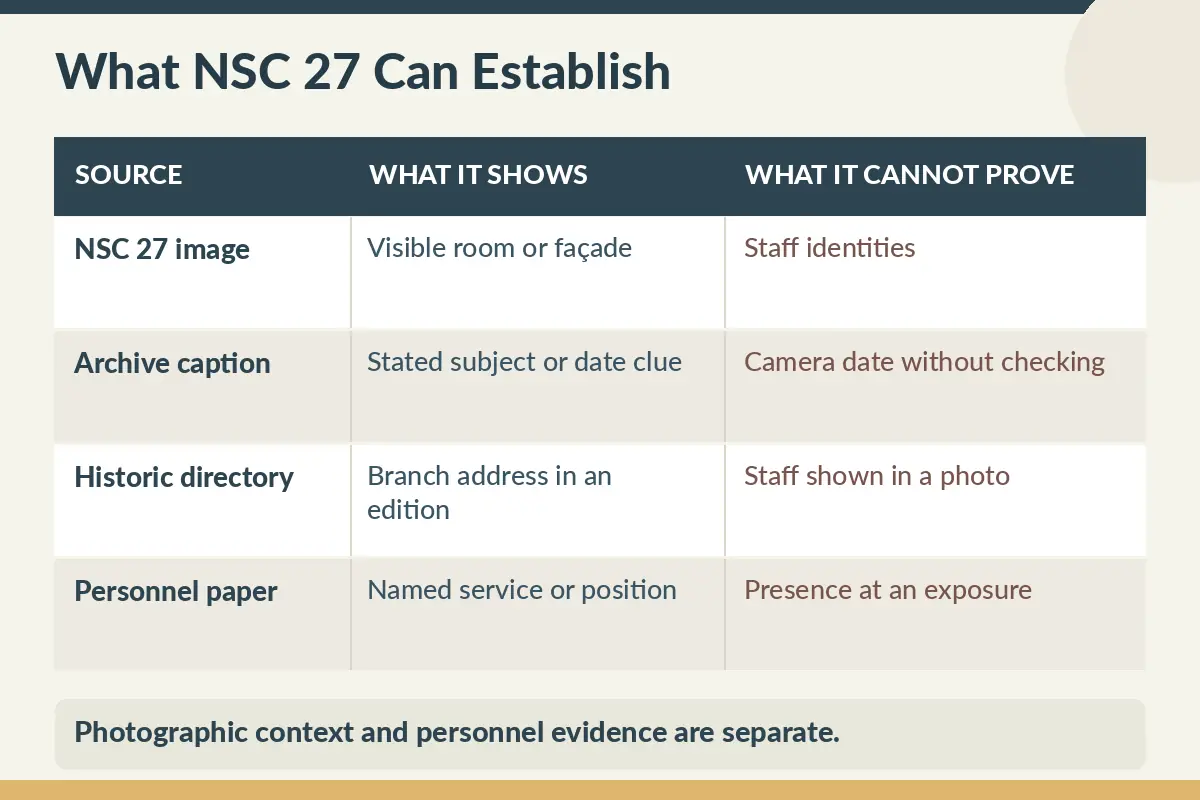
The National Archives identifies NSC 27 as a discrete photographic collection associated with the Post Office Savings Bank, covering approximately 1880–1961. Its photographic guide describes interior and exterior views of buildings and other scenes connected with the savings departments. Such photographs are valuable for locating historic workplaces and understanding their physical settings. They are not an automatic list of tellers, depositors or clerks who were present in a branch on a particular day.
Begin with a building question: which office, what location, roughly when, and what architectural or service change are you trying to document? A family story that an ancestor worked at the Savings Bank is only a reason to investigate a scene. Even when a person appears clearly in a photograph, a visual resemblance or an occupational costume is not proof of their name. Keep photographed-place evidence and people’s identity evidence in separate notes.
Separate the Camera Date from the Archive Date
The dates 1880–1961 define the broad coverage of the NSC 27 collection, not the date of each individual exposure. Record the catalogue title, negative or piece reference, format, caption and any date actually supplied. A date may refer to a building’s construction, an album’s compilation, a photograph’s reproduction or the creation of a finding aid. Only a reliable photograph-specific source can support the claim that the camera captured a scene in a chosen month or year.
Use architectural alterations, furniture types and contemporary signage as supporting clues, but do not assign precise years from style alone. A photograph copied from an older print can have a later archive accession or digitization date. Describe a date range when the evidence only permits a range. If two captions conflict, preserve both with their sources until an independent dated record resolves the discrepancy. This is particularly important when comparing a building before and after its refurbishment.

Identify the Building Before Describing the Workers
A photograph of a bank interior may show a counter, sorting space, public waiting area or back office. An exterior may reveal a façade, neighboring shops and a street setting. These details help match the site to directories, maps and building files. First verify that the captioned building belongs to the branch you are researching; “Post Office Savings Bank” is an institution that operated in multiple locations and roles. Similar counters and uniforms can recur across buildings.
Record the photographed address only if the caption or another source establishes it. Compare nearby shop signs, street numbers, roof lines and window bays to a dated image or map. Construction or alteration plans may show a proposed interior that differs from the photographed one. Keep the two types of evidence distinct: plan for intended layout, photograph for what appears at exposure time, later record for subsequent work. A photo need not show the whole building.
Understand the Limits of People Visible in the Scene
If a person is visible, write an objective description of location within the frame and any discernible activity rather than a guessed name or job title. Someone behind a counter might be a staff member, a visitor or an individual posing for an institutional photograph. Clothing and placement cannot establish payroll status. Use appointment books, staff lists, service papers or documented family photographs to corroborate a proposed identity, matching time and location as closely as possible.
When a caption names a worker, transcribe the label faithfully and record its apparent author or production date. A caption added decades later is secondary testimony whose reliability may differ from a contemporary original. Check people separately from background buildings and avoid revealing sensitive information about living individuals. If no person is shown, the photo may still provide valuable evidence about an ancestor’s workplace or a building connected with their community.
Request the Right Image and Check Its Context
The National Archives recommends keyword searches by place, subject and photo type and emphasizes searching within particular series. Search NSC 27 with branch names, city, “savings bank,” and architectural terms. The photographic guide warns that a large proportion of images are not available online; catalogue entries may describe an album rather than every photograph inside it. Check the holding repository and image-access options, and do not assume a search-result thumbnail is a complete or highest-resolution reproduction.
When you view an original or authorized image, record cropping, mount annotations, handwritten back captions and neighboring album pages where available. These may determine whether a scene is staged, part of a sequence or dated more precisely than its online caption. A narrow crop could conceal a sign that identifies the site. If you reproduce a picture publicly, review repository licensing and rights rather than assuming that age alone makes any digital scan unrestricted.

Report the Building Match and the Identity Gap
A defensible caption might say “NSC 27 photograph depicts the interior of a Post Office Savings Bank building attributed to this location; the date and identities of any visible staff require independent checks.” If a precise address and date are supported, cite the specific source rather than the series alone. That phrasing allows family and local historians to benefit from visual evidence without turning a scene into an invented staff roll.
Build an image record with reference, repository, subject, caption source, location confidence, date confidence, visible details and follow-up documents. Compare it with historic directories, building files, census data or staff records as appropriate. Store the original reference alongside any annotated copy so future readers can separate what the photographer captured from what the researcher inferred. A photograph offers valuable context even when no one in it can be named.
More House and Local History Guides
How We Research, Cite Sources, and Test Limits
We checked the named series, record purpose, broad period and repository guidance in these source descriptions: The National Archives; The National Archives; The National Archives. Collection-level guidance establishes which kinds of papers, maps or photographs may be found and how they should be searched. It does not certify a particular unseen item, a specific ancestor, or an uninspected case. Exact claims must be supported by the original document, its piece-level description and any independent evidence appropriate to the historical question.
Our evidence worksheet distinguishes what the original says, what can reasonably be inferred, and what remains unproved. Dates and categories are transcribed before conversion or comparison. Search absences are reported as gaps in available evidence, not proof that an event never happened. Individual access and reuse rules must be checked against the record’s repository. Read our affiliate disclosure; no paid service or commercial relationship is required to apply this method.
The National Archives lists NSC 27 as a discrete Post Office Savings Bank photographic collection covering 1880–1961.
No. Check the individual catalogue reference and access information; many archival photographs require a visit or copy order.
No. A reliable name requires a separate caption or personnel evidence plus a time-and-location match.
Record both, distinguish exposure from reproduction or annotation, and seek a dated independent source.
Check the specific reproduction permission and rights conditions of the holding institution before publication.