
A disputed will can leave a paper trail much richer than the surviving registered will, but only if the researcher identifies the court that heard the challenge. PROB 18 contains initial allegations in causes before the Prerogative Court of Canterbury (PCC) between 1661 and 1858. It is not a national list of inheritance disputes, nor a record in which every allegation was accepted. Start by establishing the deceased person’s name, approximate death and probate dates, residence, and whether a PCC case is plausible. The date of probate can be years later than the date a will was signed.
Start with the correct probate court
The National Archives’ disputed-wills guide explains that before 1858 probate litigation could also occur in other ecclesiastical courts or in Chancery. Most local probate-court records are elsewhere, and a failed PROB 18 catalogue search cannot prove that nobody challenged a will. Compare the PCC jurisdiction with the deceased’s property and with any court named in family papers, then record which archive may actually hold the case.
Use names to find the first allegation
Search the Discovery catalogue within PROB 18 by the full name of the deceased and by the surnames of the opposing litigants. The catalogue can describe a cause by the parties’ surnames rather than by the testator’s preferred spelling; where necessary, try variants and combine unusual names. Before committing to an identification, compare address, occupation, parish, and associated parties. The name of a litigant is a role in a lawsuit, not proof of blood relationship to the deceased or of entitlement to the estate.
Read the initial complaint as the plaintiff’s position: who filed it, what validity or interpretation of the will was questioned, what the opponent was asked to answer, and what procedure the paper was intended to begin. Allegations can mention witnesses, proposed family relationships, missing documents, undue influence, or disputed execution. Those are statements requiring tests, not established facts. Copy the precise wording and retain the names of both parties; otherwise the sentence “a relative challenged the will” can become an invented genealogy.
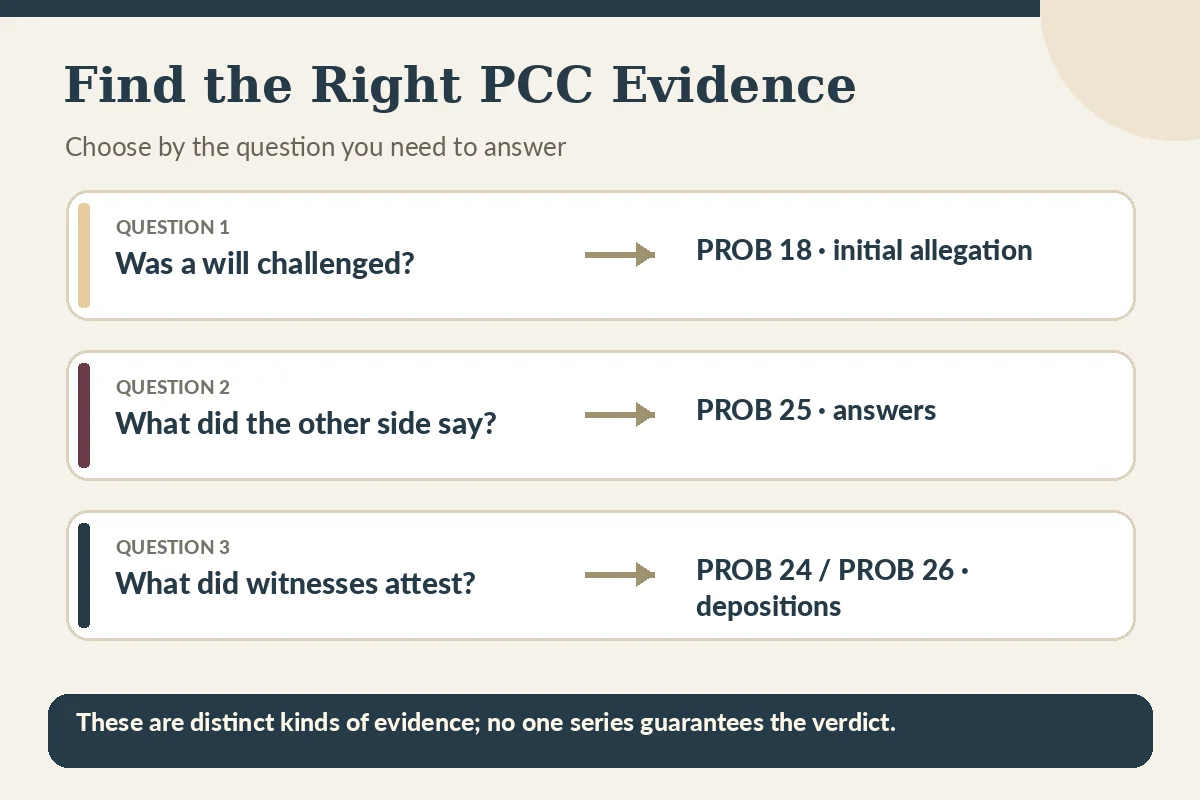
Find the answer and witness statements separately
Once the PROB 18 case is identified, trace a possible response in PROB 25, the defendants’ answers for 1664–1854. The National Archives cautions that access routes differ: early bound volumes have indexes of respondents, whereas later papers are bundled and not uniformly indexed. A defendant’s answer may deny a plaintiff’s account or admit selected details. Both sides can agree about a person’s name while disagreeing about status, capacity, or a contested bequest. Record those agreements and disagreements as separate evidence items.
Witness depositions may survive in PROB 24 and PROB 26. They are the closest the file may come to testimony about an event such as signing a will, although witnesses could be mistaken, influenced, or reporting what others told them. For every quoted statement, note the witness name, statement date, personal knowledge, and question to which the answer responded. A deposition supporting a claim is not the court’s conclusion. Use a simple grid with columns for allegation, denial, witness evidence, and undecided issue rather than flattening the case into one narrative.

Distinguish a procedural act from the outcome
The acts of court in PROB 29 and PROB 30 record procedural stages. They can indicate that a cause moved forward, a document was received, or parties were directed to take an action; none of those acts necessarily means the plaintiff prevailed. Other cause papers may be in PROB 28 or PROB 37, while exhibits in PROB 31 can be approached through indexes in PROB 33. These are different kinds of evidence, not a mandatory sequence in which every case produced every record.
Check the probate result in an appropriate will or administration record. A PROB 11 registered will, a marginal indication of a sentence, or a relevant probate act may help establish what the court recognized. But be precise: the court’s treatment of probate is not necessarily a complete settlement of later property litigation. Cite the actual judgment or grant when available, and label the outcome “not located” if only allegation and procedure survive. Absence of surviving final papers should not be written as proof of withdrawal or defeat.
Build a case ledger instead of a family story
Create a worksheet with the person whose estate was in dispute, each party’s role, the full archival reference, the document’s own date, and the stage of proceeding. Put assertions about kinship in a dedicated “claimed relationship” column. On a separate line, record independent evidence—baptism, marriage, parish, settlement, or contemporaneous deeds—needed to test that relationship. This prevents the surname of a plaintiff or a familiar executor from being promoted automatically into a parent, child, or spouse.
When several wills or administrators are associated with one estate, preserve the chronology. A will written in one year, an allegation filed later, witness evidence produced still later, and a probate grant entered thereafter are not interchangeable dates. Differences in domicile, occupation, or names may be significant but can also reflect spelling variation or repeated names. Explain alternative identifications honestly. A compact source chain is more useful to descendants than a categorical claim that an alleged beneficiary “won the inheritance.”
A hypothetical case shows why this distinction matters. Suppose a catalogue describes a dispute between two people with the same surname about a deceased merchant’s will. The complaint may claim that one person lacked capacity to sign; the answer may deny that claim; a witness may remember the signing. Without the decision or probate grant, the careful conclusion is that the validity of the will was contested and particular testimony survives. It is not that either litigant was vindicated, nor that shared surnames prove kinship.

More Records and Archives Guides
How We Research PCC Disputed-Will Cases
We first search the official PCC wills and administrations guide to verify court jurisdiction, then consult the alleged dispute in PROB 18 and map any surviving response, testimony, acts, exhibits, and probate result. We use the person’s social role and the record’s procedural status as separate fields. Court records contain competing statements; publishing only one side without attribution risks turning advocacy into a fact.
A useful research conclusion states the exact record seen, what it explicitly says, which competing accounts remain, and what other source would settle the question. If the original court papers are not viewed, we say that our conclusion rests on catalogue descriptions or indexes. For editorial transparency and outbound-link information, read the GenHis affiliate disclosure.
No. It contains initial allegations in contested PCC probate cases; registered copies of PCC wills are generally in PROB 11.
No. A litigant’s claim must be compared with answers, testimony, and the applicable probate result.
Look for surviving PCC answers in PROB 25, checking the arrangement and indexes for the case’s period.
Depositions in PROB 24 or PROB 26 offer testimony, not necessarily the judgment.
Check the jurisdiction and consult the local ecclesiastical court, York material, or other relevant repository.