
In 1885 New Mexico was a U.S. territory, not the modern state whose county lines appear on today’s maps. That distinction matters when an old family story names a settlement or parish but a web search supplies only modern counties. A federally supported census survived from 1885 and includes a named population schedule. FamilySearch offers images and a search collection connected to NARA microfilm M846. The useful task is to locate the correct historical district, read the actual form and then decide whether the household fits a documented family. A similar surname alone cannot make that decision.
Map the household to its 1885 jurisdiction
Start with a dated place reference from a marriage record, deed, church register, letter or federal census. Record the place as originally written, then identify which New Mexico territorial county or district administered it in 1885. A modern county label can be helpful for orientation but must not silently replace the historical jurisdiction. Build a location card listing original place name, alternative spellings, approximate event date and suspected county. If your evidence only says ‘near Santa Fe,’ mark the county assignment provisional rather than asserting a precise locality. For a related choice, see our guide “Missouri State Census Records, 1840–1876”.
A settlement could be spelled in English, Spanish or a local form, and transliteration can change the indexing. Search with flexible spelling and with a date range that covers plausible moves. Keep the distinction between residence in an 1880 federal census and residence at the 1885 enumeration: a later document does not retroactively locate the person. Where boundaries changed, consult territorial maps or the relevant county history; do not assume that a present-day search filter represents every 1885 entry in that area.
Search the 1885 images rather than only names
The New Mexico 1885 territorial collection describes searchable names and a browsable population schedule. Enter the least common name first, test nearby spelling variants and investigate another family member if a surname is absent. View the original entry and capture the county, locality and enumeration details that appear on the page. The list is associated with National Archives microfilm M846, which supplies a reproducible series identifier. A result from a different New Mexico collection should not be relabeled as this census.
Look at the full household, not just the matched row. The described fields can include age, marital status, relationship to the head, occupation, birthplace and parents’ birthplaces. Columns are valuable, but they do not all have equal reliability: a person’s birthplace may have been supplied by somebody else, while a reported relationship reflects the household description at that time. Transcribe uncertain handwriting faithfully and keep candidate households separate until the original form and independent evidence support consolidation.

Use language and name variation without inventing kinship
For Spanish-language given names, indexing may retain a spelling such as José or omit an accent; surnames may appear with two parts, a shortened form or changing order. Make a variant matrix instead of guessing which form is correct. Record each candidate literally as it appears and compare age, nearby residents and locality. A woman’s surname in one document need not follow a modern standardized convention. The record’s own naming practice should control transcription while outside evidence tests identity.
Imagine two hypothetical men called Manuel Romero in separate districts. Even if both were described as farmers with parents born in Mexico, those broad traits do not establish that they are one person. Add an earlier baptism, a property conveyance, or a named witness to distinguish them. A place match can narrow a hypothesis; it is not proof of shared ancestry. This restraint also applies when the 1885 page lists a person with an unfamiliar classification: reproduce the historical source accurately while avoiding adoption of the record’s labels as your own present-day judgments.
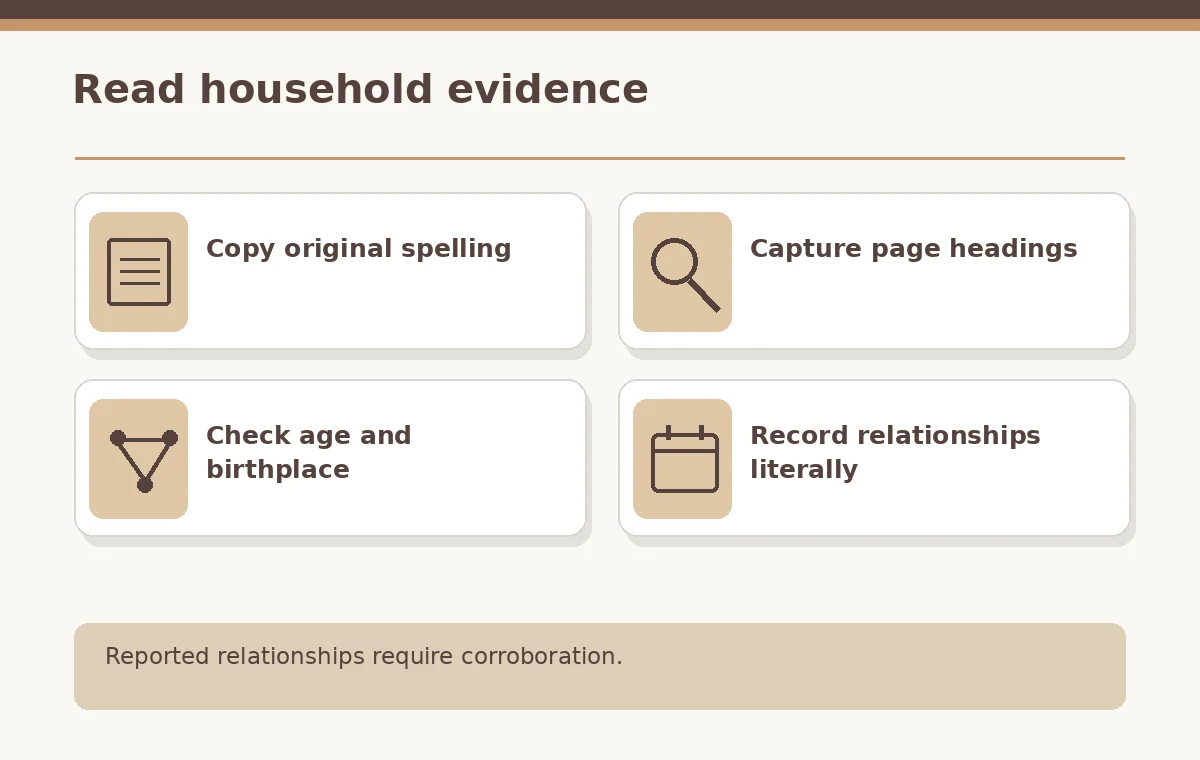
| Research task | What to record | Important limit |
|---|---|---|
| Locate the series | Historical year and jurisdiction | Modern boundaries may differ |
| Read the document | Original headings, image and context | Indexes can omit details |
| Test identity | Age, locality, associates and another source | Same name does not prove same person |
Distinguish population returns from other schedules
NARA’s 1885 census guide identifies New Mexico as a participant in the federally supported mid-decade enumeration and describes agriculture, manufactures and mortality alongside population schedules. These series answer different questions. An indexed population entry locates a named person; an agricultural return may concern a farm operator; a mortality entry pertains to a recorded death during the schedule’s reporting interval. Do not infer a farm or death record exists just because the population page was found.
If seeking a death reported around 1884–1885, note the mortality schedule’s period and inspect the actual headings. The absence of a name is not a complete proof of survival. If searching for an agricultural establishment, correlate the operator and historical place before attributing an acreage figure to your subject. Original schedules may reside on different reels or image sets. Save separate citations for each page even when the name and district seem to agree.

Cite the territorial record and plan a next test
For the final note, specify New Mexico Territory, the 1885 census type, historical county or district, page or image identifier when visible, repository, and M846 if appropriate. Include the full-name spelling exactly as transcribed, with a separate field for normalized modern forms. A downloadable image is a visual copy of a source; it is not itself evidence that all your family-tree relationships have been established. The citation should allow another reader to open the same image and audit the original words. Our guide “North Dakota State Census, 1915 and 1925” covers a related question.
Create three closing columns: confirmed on this page, inferred from context and still unknown. A neighbor with a matching surname belongs in the context column unless a separate record demonstrates a relationship. If a family appears in 1880 but not in 1885, reconsider migration, transcription and local jurisdiction before writing that they left the territory. The next practical step might be a church register, land file or the 1900 federal census rather than another unspecific global name search. For a related choice, see our guide “Nebraska State Census of 1885”.
How We Research the New Mexico territorial census 1885 series
We checked the National Archives’ 1885 federal-assisted census overview against FamilySearch’s New Mexico collection description before using the M846 identifier or describing potential columns. We treated modern place filters as navigation tools, not proof of historical jurisdictions. All sample families are invented and no individual’s membership in a tribe, ethnic group or family is inferred from census classifications.
More Records and Archives Guides
Original record guides and cited sources
National Archives 1885 history supports: NARA documents federally supported 1885 territorial participation and identifies M846 for New Mexico. FamilySearch New Mexico 1885 collection supports: FamilySearch describes names and images, expected population fields and NARA source series M846. Census Bureau state census list supports: The Census Bureau includes New Mexico territorial enumeration years within historical state and territorial series.
The cover is original wordless archival art, and the three diagrams are conceptual research tools rather than archival facsimiles. This guide makes no affiliate claim and does not promise that every digital page is accessible to every viewer. See GenHis affiliate disclosure for site-wide policy.
No. The named census was taken during the territorial period; current county boundaries should not be projected backward without checking.
NARA identifies microfilm publication M846 for the 1885 New Mexico territorial schedules.
FamilySearch lists birthplaces of a person and parents among the potential fields; inspect the original headings and entry.
No. Compare identities through dates, places, household context and independent records.
No. Separate schedules have specific scope and reporting limits; absence in one schedule is not comprehensive negative proof.