
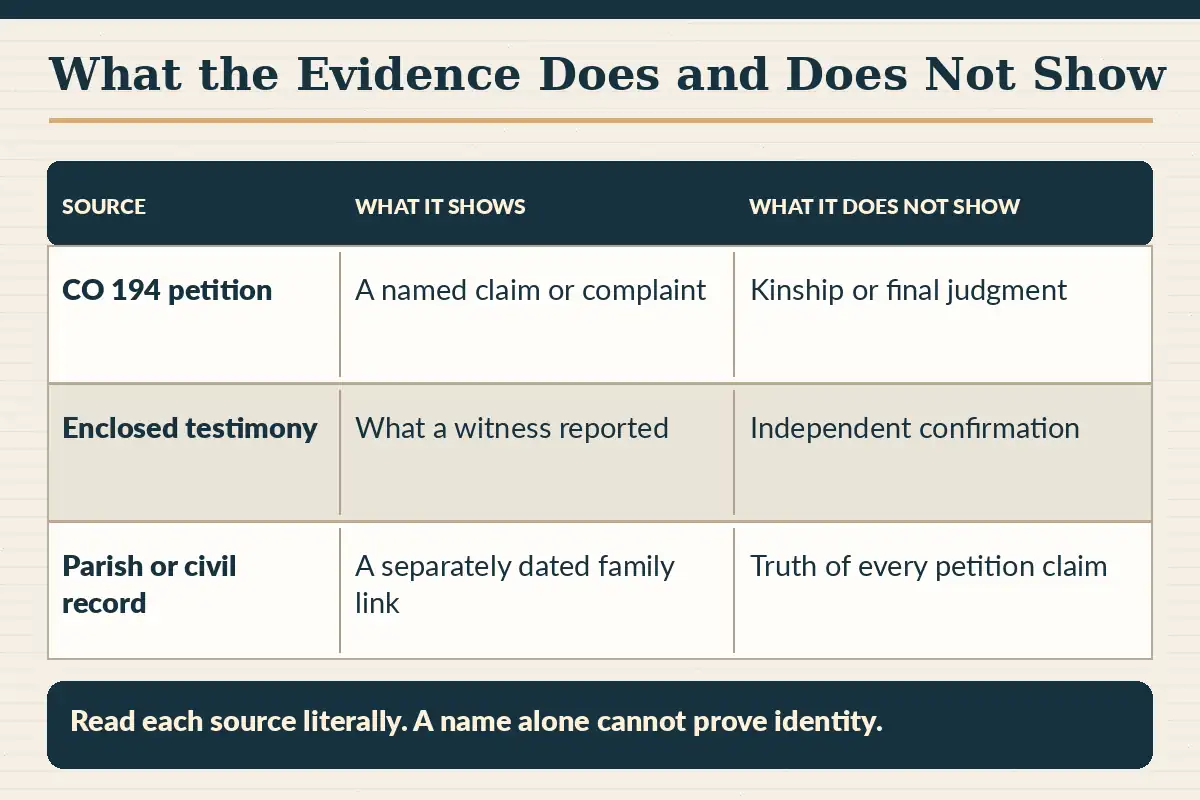
Start Newfoundland colonial research in CO 194 by asking who authored a particular communication and who merely appeared in it. The series preserves original correspondence, despatches and enclosures sent by Newfoundland administrators to British authorities. A petition about a fishery station can identify a petitioner, complainant, official or witness; it does not, by itself, prove that two people of the same surname were relatives.
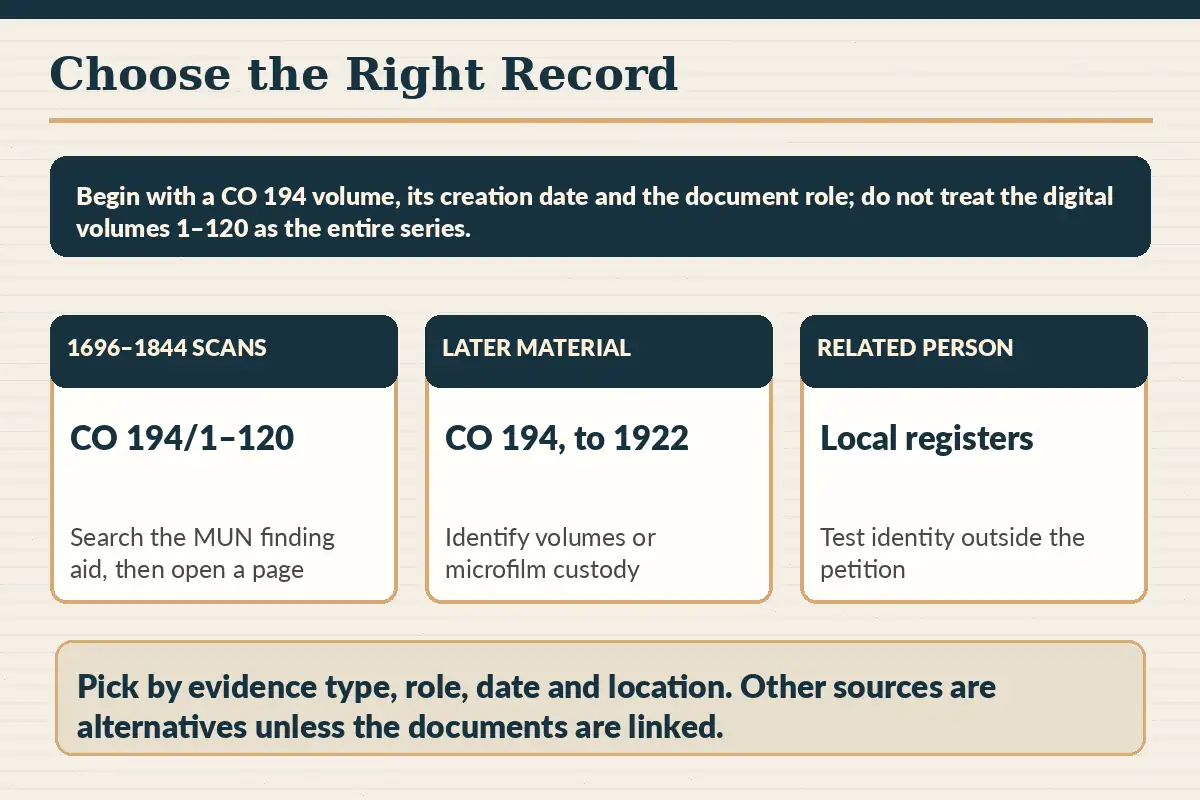
Memorial University of Newfoundland provides digital access to volumes 1–120, covering 1696–1844, and a finding aid to a selection of volumes. Its collection page says the larger CO 194 series continues through volume 303 to 1922 in microfilm. These are different access pathways, not evidence of a complete full-text name index: handwriting and imperfect image text can defeat searches.
Select the Newfoundland correspondence era
Record the period before searching a surname. The Memorial University collection divides early Board of Trade correspondence, including volumes 1–20, from many later despatches directed to the Secretary of State. Its digital selection comprises volumes 1–120, not the whole series. If your event falls in 1880, a missing hit in the online set is not a meaningful failure: you have searched a subset from the wrong period.
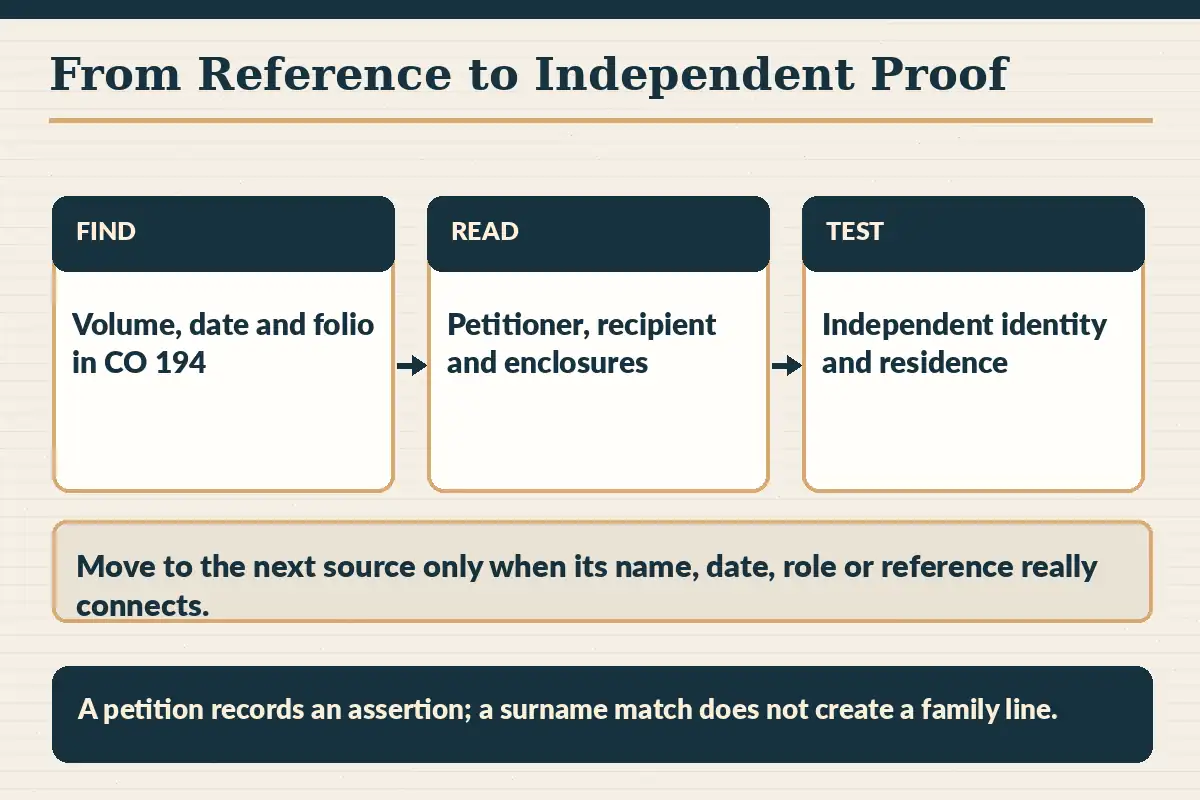
The catalogue description and the physical item are separate things. First establish the date range and volume; then inspect an image of the relevant letter or enclosure. A finding-aid summary may have been written much later than the letter, and a summary can omit names that appear on the page. Record the image page, original folio if shown and the full archival reference.
Match a petition to its administrative purpose
Newfoundland material includes reports and petitions concerning fishery, trade and defense. Decide whether the question is about a fishing room, a merchant, a vessel, an official or the regulation of the fishery. Names in a report are not interchangeable: an administrator reporting a complaint may not know the alleged facts firsthand, and an enclosure can carry a different date from the covering despatch.
Build a small role ledger with columns for author, addressee, person discussed, original date and any requested remedy. A request for redress is not proof that redress occurred. A report about a vessel may be useful for place history even when no crew list survives in the file. Keep these limited findings in a working transcription before trying to place them in a family biography.
Use a finding aid without mistaking it for an original
Memorial University describes a selected finding aid by Olaf Janzen, not an exhaustive text transcription of every volume and page. Search a place, official title, vessel or associated merchant as well as names. The collection notes that handwriting or pale type can defeat machine searching, so failure to find a surname online does not establish absence from an unindexed letter.
Write down where each hit led. If the search result is a volume label, open its images and find the specific passage. Compare the original capitalization and spelling rather than normalizing a distinctive surname too soon. If a scan is blurred, keep that limitation in your evidence notes and seek the microfilm or original instead of silently choosing the most plausible reading.
Distinguish petitions from decisions and events
An official may refer a petition elsewhere, request further evidence or acknowledge receipt without taking the action the petitioner wanted. Identify the verbs in the letter: requested, represented, examined, ordered or completed. The administrative chain might contain a covering letter, enclosures and a later reply, but these are not guaranteed for every case.
Use a chronological document table, not an arrow suggesting every complaint resulted in a ruling. For a claimed seizure or grant, seek the actual order or appropriate local land and court record. A later report that repeats an earlier allegation may be derived from the original petition rather than an independent witness. That dependency matters when you judge the strength of a family narrative.
Test people and settlements against outside records
Historical place descriptions and personal naming in Newfoundland can vary. A station mentioned in one fishery return need not be a permanent household residence. For an individual, compare approximate age, occupation, settlement, associates and chronology against church registers, civil sources where applicable, merchant papers or another independent local collection. Do not assume a recorded petitioner stayed at the location for life.
Suppose two men called William Carter appear a decade apart in separate petitions. Treat them as two candidates unless a document connects them or both can be anchored to a distinctive place and role. A shipmaster, fishing servant and merchant might each sign or be named in an enclosure. A credible conclusion states the particular role and date instead of declaring an undocumented parent-child relationship.
Cite the scanned page and preserve access limits
Record the original reference CO 194, volume and document or folio, the digital repository, the page viewed and the date of access. When using a finding aid rather than reading the document, cite the aid as an aid; do not describe a transcribed summary as the text of the original. Later volumes or poor scans may require a different copy source or an archives enquiry.
The final research log should include searches that failed, spelling variants used and whether the volume was within the online 1696–1844 subset. A precise unresolved result can be valuable: “A fishery petition names John X, but neither the petitioner’s parentage nor the reported decision has been established.” That sentence is stronger scholarship than filling the documentary gap with a plausible family story.
Create a source-linked research ledger
Set up columns for full archive reference, historical creator, actual date of the item, date of the event it discusses, original wording, evidence category, named people and roles, independent comparison source, access limitations and unresolved questions. Begin with a CO 194 volume, its creation date and the document role; do not treat the digital volumes 1–120 as the entire series. Start each new research session by rereading the previous entry rather than depending on memory; this protects subtle differences between an original, a printed summary and a database index. A failed surname search is useful only when the search range and the underlying record coverage are recorded.
Make the narrowest claim supported by your strongest source: A named claim or complaint. Never quietly convert that into kinship or final judgment. Before adding a relative to a tree, compare identifying details, not just a surname and date range. If your documents disagree, preserve the conflict and specify which additional original could settle it. Equally important, describe whether you saw the original image or only an archive guide, catalogue summary or third-party index. This method creates a conclusion that another reader can independently test.
More Place and Jurisdiction Guides
How We Research and Verify the Sources
We checked the archive’s published research description on 2026-11-03. Memorial University identifies the original CO 194 correspondence, digital volumes 1–120 for 1696–1844, and its selected finding aid; later volumes require another access route. The cited description establishes the collection and its limits, not the existence of any particular ancestor in it.
We checked the archive’s published research description on 2026-11-03. The described CO 194/1 copy identifies the 1696–1699 volume and the TNA originals; a digitized page is a copy of an archival document, not a new genealogical certificate. The cited description establishes the collection and its limits, not the existence of any particular ancestor in it.
We distinguish the record route from the family claim and do not represent stylized cover art as an original manuscript. No paid record vendor or partnership is presumed. See our affiliate disclosure.
No. Memorial University shows digital volumes 1–120; the collection describes later microfilm through volume 303.
No. Determine whether it asserts, disputes or records a right, then look for a separate decision and local corroboration.
No. A finding aid and image searches may miss handwriting and unindexed names; page inspection remains necessary.
Not always. Separate the original petitioner, forwarding official, witnesses and anyone mentioned in an enclosure.
Give CO 194 volume and folio or page, document date, the holding archive, digital host and access date.