
Florida’s state censuses offer three unusually useful checkpoints around federal census gaps: 1885, 1935 and 1945. They are not identical projects. The 1885 special enumeration included several distinct schedule types; the 1935 and 1945 returns can place named people between federal decades, subject to missing precincts and imperfect indexes. Use year, county and the actual schedule image to decide what a hit proves. The county and precinct coverage notes matter as much as the surname search.
Select 1885, 1935, or 1945 for the question
If your family moved between the federal censuses of 1880 and 1900, begin with Florida’s 1885 special schedules where preserved. For someone who arrived in the 1930s, compare the 1930 federal census with Florida’s 1935 state count and 1940 federal return. The 1945 return can clarify postwar residence before the 1950 census. These are different temporal questions; combining all years into one surname list erases the reason a particular enumeration is useful.
Write down the ancestor’s most defensible address or county for each search year using an independent source: a marriage license, land record, city directory or school record. Consider nearby counties if boundary changes or mobility make your first choice uncertain. Record the search date and website, but cite the photographed schedule rather than the digital search interface when you actually view an image. Do not claim an address remained constant between enumerations.

Check the unusual 1885 Florida special enumeration
The 1885 Florida enumeration was a federal-assisted special census preserved as NARA microfilm M845. FamilySearch describes population, agriculture, manufactures and mortality schedules, with different coverage by type. Its 1885 collection guide identifies Alachua, Clay, Columbia and Nassau as counties not represented in its county coverage. An unsuccessful search for an ancestor in one of those counties therefore requires other evidence, not a confident assertion that the person had left Florida.
Read the schedule heading before copying figures. A population page can name household residents and may record relationship, age, occupation and birthplace; the agriculture or mortality pages address a different legal or statistical question. Do not interpret a farm’s entry as a full roster of all household members. If a name appears in two schedule types, cite each separately and analyze why the identifying details match rather than declaring it two independent proofs of family identity.
Interpret 1935 Florida household fields cautiously
FamilySearch’s 1935 Florida State Census collection indexes individuals and provides images arranged by county and election precinct. It says all then-existing counties are represented, but some election precincts are missing. Pages may record name, address, age, race as historically categorized, relationship to head, birthplace, occupation, education and tenure. These are enumerator-reported details, not automatically confirmed birth or ownership documents.
Where a surname looks unfamiliar, search without a first name and browse adjacent images in the candidate precinct. An indexed ‘son’ should be understood as a reported relation to the named head; it does not independently prove parentage with both adults in a household. If an address appears ambiguous, compare it with a city directory or an earlier federal page. The census captures a time-specific household arrangement, which can differ from a later family tree. Our guide “1925 Iowa State Census” covers a related question.

| Year | Distinctive records | Coverage warning |
|---|---|---|
| 1885 | Population; also agriculture, mortality, manufactures | Not all then-existing counties survive |
| 1935 | Every-name household and residence data | Some election precincts missing |
| 1945 | Postwar residence, occupation and education | Some precincts missing; historically segregated organization |
Read the 1945 return and its original organization
The 1945 Florida census collection also covers individuals and is organized by county and election precinct, but some precincts are not present. Its historical records were segregated by race in their original organization; that discriminatory arrangement reflects administrative practice of the period, not a genealogist’s recommended way of categorizing families today. Treat such labels as source language and do not infer a person’s current identity from them.
A 1945 candidate can provide a midpoint between 1940 and 1950 and may give age, birthplace, occupation or educational level. Compare the person with adjacent household members and known neighborhood sources. Do not treat a population count as evidence of the date a person first moved to Florida. New arrivals, war service, temporary work and residences outside an enumerated precinct may complicate the apparent sequence.
Diagnose a missing record before changing the timeline
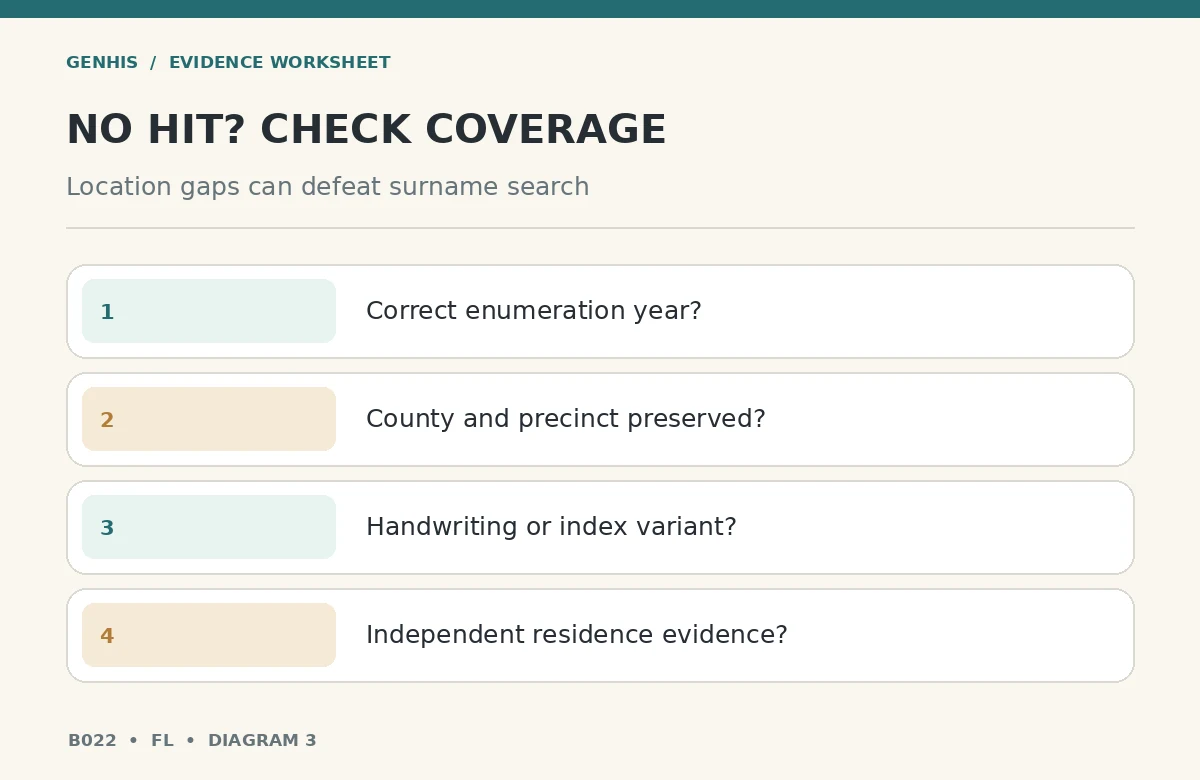
Run a coverage checklist in a fixed order: Was the year correct? Is the ancestor’s historic county represented? Is the required precinct preserved? Could the enumerator have used another spelling or a nickname? Does the source index include all images? Each answer changes your next step. A missing result caused by an omitted precinct is not a documented negative finding about a person’s residence.
Browse the handwritten pages around any candidate rather than relying solely on a linked transcript. Compare ages with tolerance for errors, but never overwrite one reported number with a calculated ‘correct’ age. If two same-name families appear, use other records such as land, church, military or probate to decide which one fits. A race label, occupation or spouse’s name can help distinguish candidates but may itself be inaccurate or changed by context.
Create a Florida three-year residence worksheet
Make rows for 1885, 1935 and 1945 and record the county, precinct, schedule type, residence statement and image citation. Next to each row add a separate conclusion column marked ‘recorded fact,’ ‘working hypothesis’ or ‘unknown.’ For example, ‘listed as resident of a 1935 election precinct’ is a source observation; ‘had resided there for five years’ usually is not supplied by the page and should not be added without independent support.
If a 1935 and 1945 household look like the same family, test the link with intermediate directories, marriage or death records and the 1940 federal census. Preserve evidence that contradicts the proposed identity. Finished correctly, the three-year worksheet tells a reader exactly which Florida enumeration documents a family and where no record survives, without implying that the state’s databases contain everyone. For a related choice, see our guide “1890 U.S. Census”.
How We Research the Record Claims
We examined the FamilySearch collection descriptions of three separate Florida state enumerations and preserved their different organizational warnings. The 1885 special schedules were not treated as one interchangeable list; the 1935 and 1945 precinct deficiencies were not generalized into total county loss. The guide also treats historical racial categories as part of the original record’s administrative context, not as proof of how descendants identify today. It does not invent a common set of columns for all years.
More Records and Archives Guides
Custodian Sources and Practical Disclosure
The 1885 special census inventory describes NARA M845 and its separate schedule types. The 1935 population collection states its county and precinct limitations, while the 1945 guide records precinct arrangement and historical segregation. Recheck each collection’s field list against the photographed page before attributing an address or relationship to a particular person.
The Florida records exercise contains no paid placement; GenHis’s disclosure page covers any future linking arrangements. If a candidate cannot be found, first determine whether the necessary precinct image exists. Household roles should be evaluated with appropriate independent records, particularly where the enumeration’s reported relationships or addresses conflict with later documents.
The preserved 1885, 1935 and 1945 enumerations offer checkpoints between federal census decades.
No. The special census included several schedule types, each with its own content and coverage.
No. FamilySearch notes that some election precincts are missing even though all counties are represented.
The source was organized under a discriminatory historical administrative system; retain the record context without treating those labels as proof of present identity.
A tenure entry may report owner or renter status, but deeds and assessment records should be checked for legal ownership.