
The Board of Excise minute books in CUST 47 are unusually useful when an ancestor was said to be an exciseman. The National Archives identifies minutes dating from 1696 to 1874 and states that they can mention first appointments, later postings, praise and censure. The crucial distinction is between an entry in an index and the decision recorded on the page to which it points. A surname found in an index is a research lead, not evidence of a particular posting until the minute has been read.
Begin with an approximate year and a possible county. A marriage entry calling someone an excise officer, for example, can define a date but may not identify the district of employment. Create a small target card with the name exactly as written, spelling alternatives, earliest and latest known appearances, occupation wording and the question you intend to prove. If the name is common, list the competing people before you search. That prevents an attractive posting from being borrowed from an unrelated namesake.
Start With an Officer, a Time Window, and a Question
Build a working worksheet with columns for the question being tested, document reference, exact recorded wording, event date, recording date and what is still unknown. Treat a catalogue title as a route to evidence rather than a substitute for viewing the item itself. If a source describes a decision, distinguish its wording from the action you hope happened later.
Use the CUST 47 Index Without Skipping the Minute
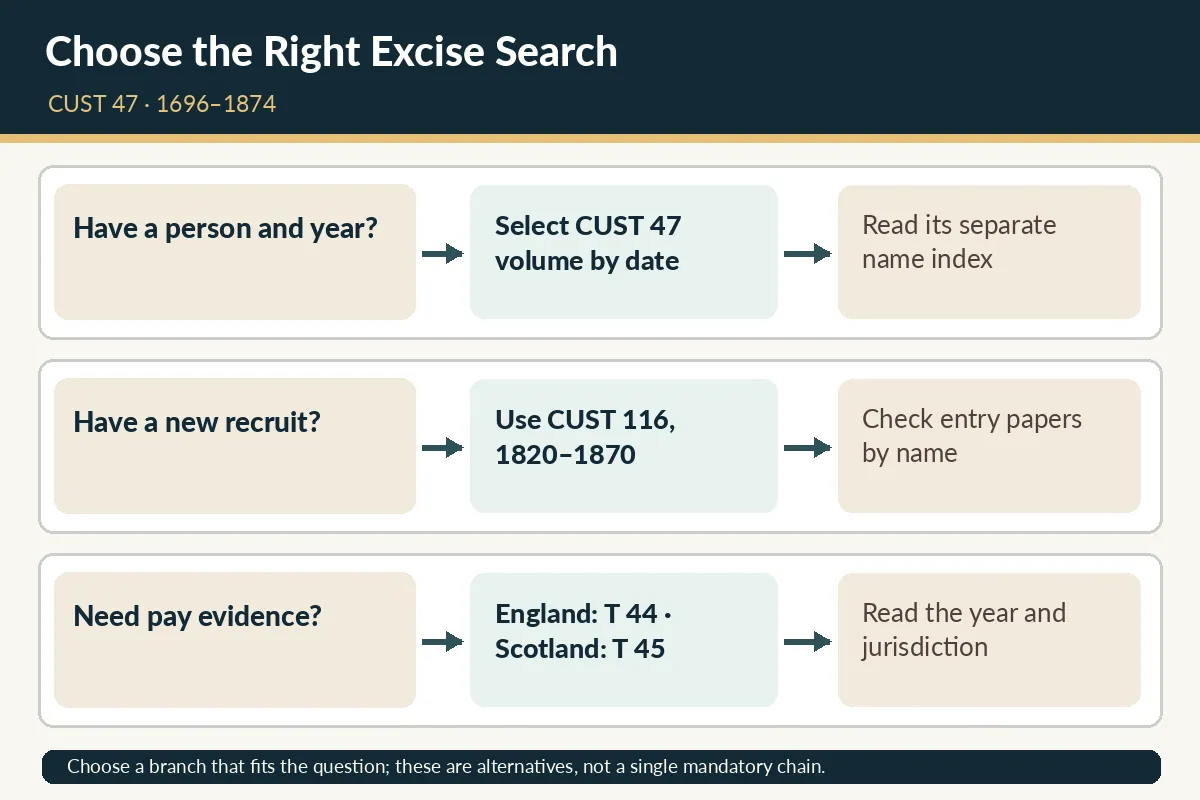
The original CUST 47 volumes are internally indexed, and the index images can be consulted online for individual volumes. The National Archives gives a precise model: CUST 47/345 covers September to October 1785, and its name index is CUST 47/345/1. Search for the volume covering your target month, view the associated index if one is available, and write down the indexed page numbers exactly. An index may supply several page references for a single name; do not collapse those references into one supposed event.
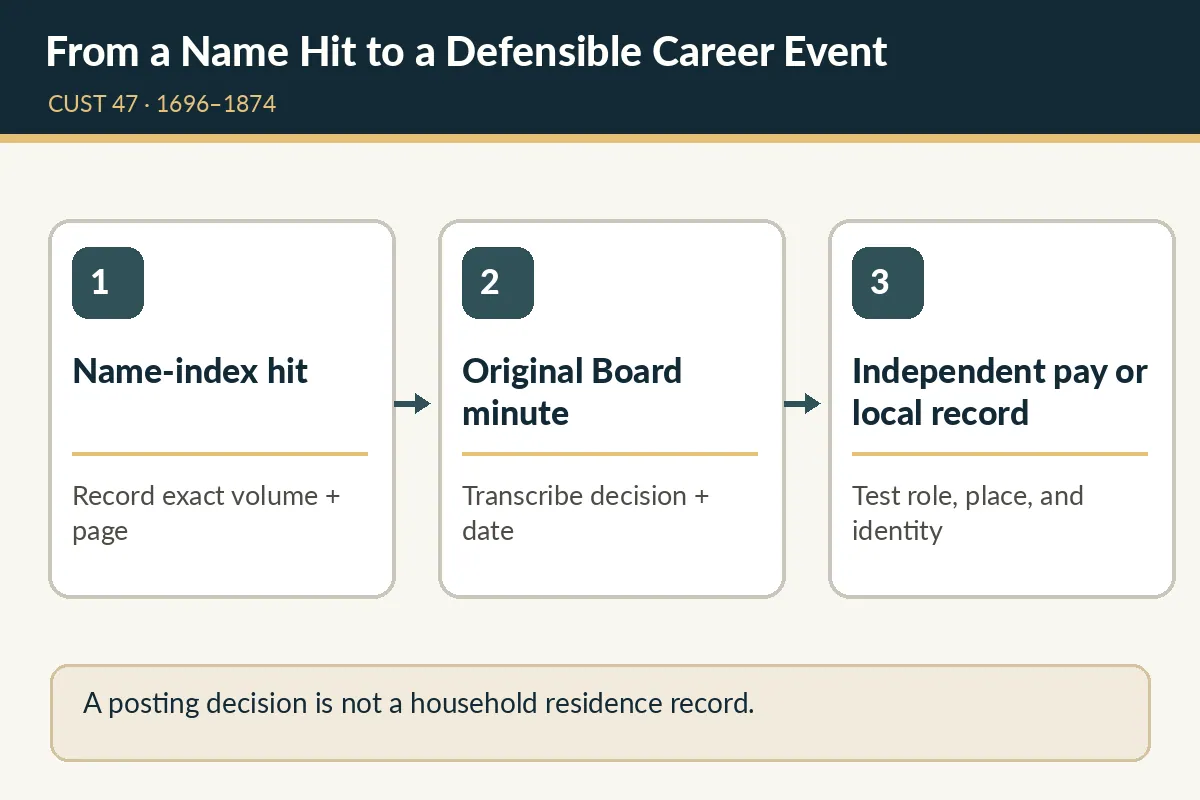
Next obtain the corresponding original minute, ordinarily by consulting the archive or arranging a copy where available. Record the full reference and date, the named person, the verbs used by the Board, the location or duty mentioned and whether the text is a decision or a report awaiting action. Transcribe uncertain words rather than silently modernizing them. A proposed appointment, an instruction to investigate and a confirmed transfer are different acts. Preserve those differences in a career log.

Separate a Posting From Work, Pay, and Residence
A CUST 47 entry can be strong evidence that the Board considered or authorized a specific personnel action, depending on its wording. It does not by itself say where a spouse or child slept that night, or whether the officer remained in the town for the entire year. Build parallel columns for appointment decision, pay evidence and personal address. In the decision column put the actual date and terminology; in the residence column enter nothing until a relevant local or household source supplies an address.
For a second check, the archive guide points to English Excise pay lists in T 44 for 1705–1835 and Scottish lists in T 45 for 1708–1832. These are jurisdiction-specific alternatives, not steps that everyone must follow sequentially. If the Board minute concerns a later date, seek a different contemporary source rather than inventing T 44 coverage. A payment entry strengthens the case that an identifiable officer drew pay, but a salary alone still does not prove uninterrupted duty or an entire family’s movements.
When the Entry Papers or Staff Lists Fit Better
CUST 116 entry papers cover 1820–1870 and may be a more direct starting point when the first question is how a person entered the service. Those entry papers do not replace the later Board record: a recruitment document, a posting decision and a subsequent payment answer different questions. The National Archives also identifies staff lists and pension material in CUST 39 and establishments in IR 147, but their date ranges and indexing differ. Treat each as a separate search based on the historical department and the period under examination.
The administrative labels changed over time. The Board of Excise was joined with the Board of Stamps and Taxes in 1849 to form the Board of Inland Revenue, and excise responsibilities moved to a new Board of Customs and Excise in 1909. Do not assume a modern institutional name describes an eighteenth-century job. A family story calling a man a customs officer could also be imprecise; record the wording of each contemporary source and search the correct record group rather than merging services automatically.
Resolve Namesakes and Record Missing Evidence Properly
Suppose two men share a surname and initials in neighboring decades. Compare the date of the Board decision with parish events, age estimates, known occupations, and independently dated pay or staff entries. An unusual station name can help identify a candidate, but it does not become a personal identifier without supporting details. Grade each match as confirmed, plausible, contradictory or unresolved, and state which single record would most efficiently discriminate between the two candidates.
A search returning no name in one online index cannot prove the man never served. Check whether the relevant volume covers the date, whether a separate name index exists, whether spellings vary and whether the decision would even have appeared in that class of minutes. Distinguish a no-result search from a documented absence in a complete and appropriate record. Close the log with the next volume or alternative series to inspect, not with a global claim that the archive has nothing.
More Records and Archives Guides
How We Research This Record Series
The starting points for this article are the research guidance published by The National Archives: the series-specific guide and the explanation of Discovery catalogue limits. The official descriptions establish which records may be relevant, not that a specific ancestor appears in an unread original. Our workflow deliberately separates source descriptions, primary-document observations and independent corroboration.
For every claim, record the archival reference and the page or image actually consulted, following The National Archives citation guidance. Ask whether the person or place could be a namesake, whether the source was contemporary, whether a second record is genuinely independent, and whether the material is restricted or undigitized. This article does not assert that any illustrative search example identifies a real ancestor. See our affiliate disclosure; no paid referral is required for these steps.
A reproducible conclusion has three parts: the exact fact the source documents, the reasonable but still testable interpretation, and the unresolved point requiring another record. Do not present a missing result from one file as universal absence. Before repeating a secondary account, inspect how it quotes its evidence, whether the dates belong to different stages of administration, and whether it silently turns an application, report or allegation into a completed event.
No. It is the associated name index for the September–October 1785 minute volume CUST 47/345. Read the minute before saying what action occurred.
For the periods covered, T 44 is the English Excise pay-list route and T 45 the Scottish route; choose by place and year.
Not necessarily. First inspect the coverage and any available indexes. An online catalogue description may omit names present on the original pages.
No. Open the original item or a reliable image and read the precise wording, document type, date and author before drawing a conclusion.
Keep the full repository reference, page or folio, original spelling, relevant date, recorded role or place and the words that support your claim.