
The first British Board of Health was established by the Privy Council in February 1805, when officials sought advice on the risk posed by fever in Spain and Gibraltar. According to The National Archives, it met until August 1806. It must not be confused with the consultative and central health boards created in 1831 during a different epidemic scare. Mixing those two bodies can send a family researcher into the wrong department, the wrong decade and the wrong kind of evidence.
The first question should therefore be institutional: what did the government know, what advice was supplied and how did a particular report reach officials? These records are valuable for reconstructing an environment of concern and the circulation of medical intelligence. They are not a personal illness registry. A family story about fever in 1805 needs a separate local record before you can say that a specific ancestor was sick or died because of a disease mentioned by the Board.
Why the 1805 Board Is Not the 1831 Cholera Board
Build a working worksheet with columns for the question being tested, document reference, exact recorded wording, event date, recording date and what is still unknown. Treat a catalogue title as a route to evidence rather than a substitute for viewing the item itself. If a source describes a decision, distinguish its wording from the action you hope happened later.
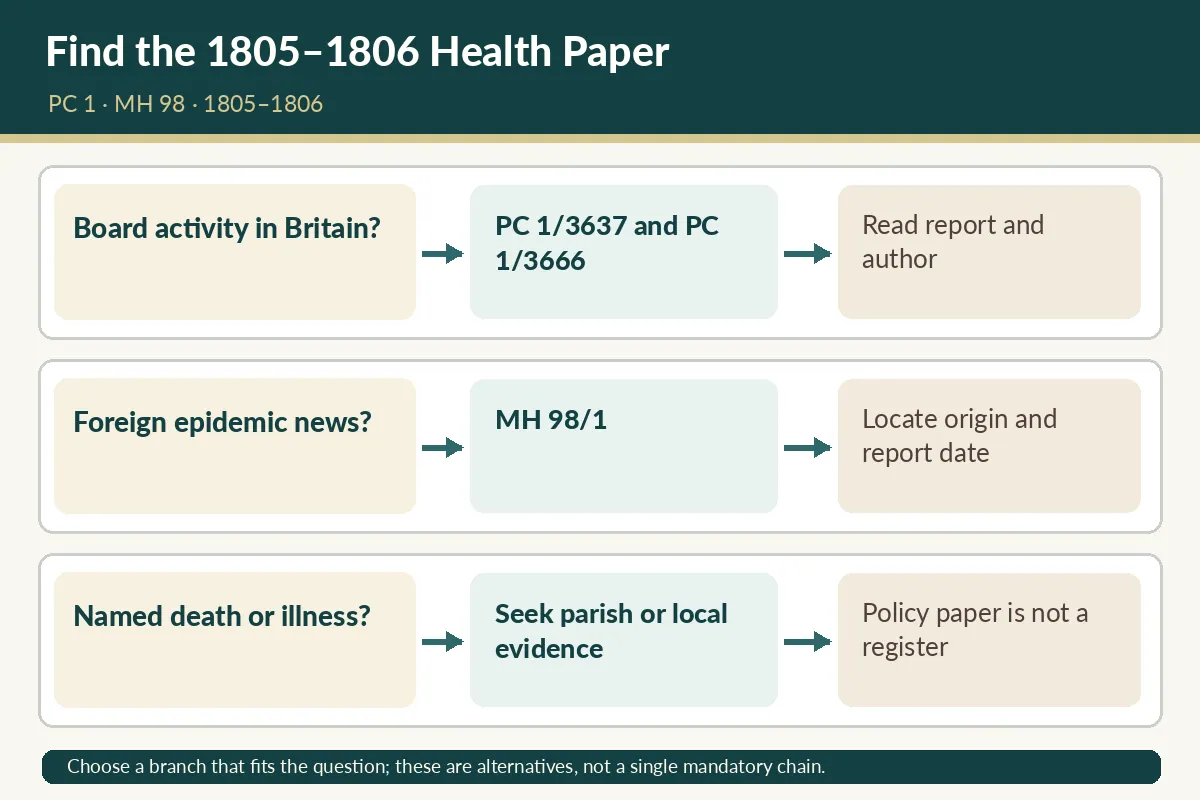
Route the Question to PC 1 or MH 98/1
The National Archives points researchers to the PC 1 series for most papers of the first Board of Health, specifically reports in PC 1/3637 and PC 1/3666. A second path, MH 98/1, contains reports sent to the Board on epidemics abroad. The distinction is functional, not a timeline in which a report necessarily moved from one numbered series to another. Select the record by the origin and kind of information you are tracing.
For each file, write an evidence label before you read: Board report, foreign intelligence, correspondence or later administrative summary. Then extract document date, authorship if given, location discussed, disease terminology and recipient. Words such as fever, contagion or quarantine reflect period categories and should be quoted accurately without retroactively imposing a modern clinical diagnosis. A report about Spain or Gibraltar is evidence of information received, not an eyewitness account of illness in an English parish.
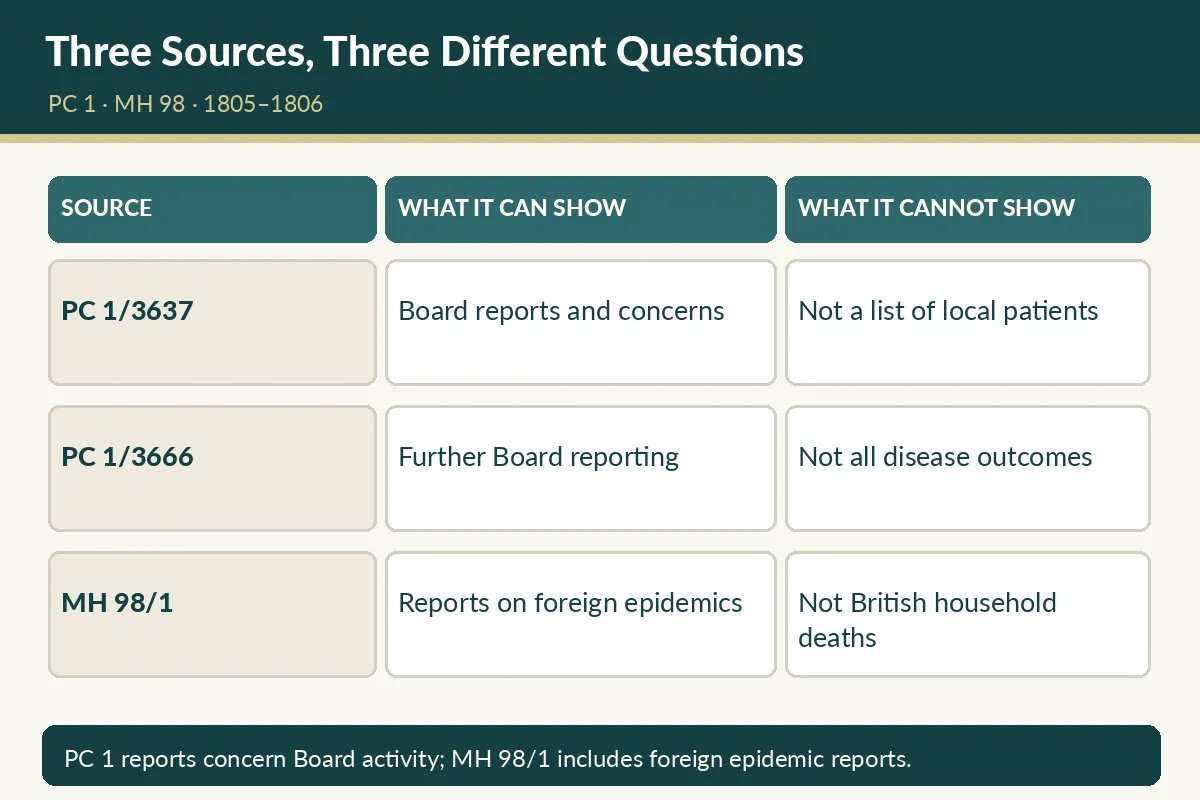
Read Advice, Orders, and Outcomes as Distinct Events
A report may recommend precautions without proving that a port or district enforced them. A central instruction may establish a policy decision without proving compliance in every locality. Give each claim its own status: information received, advice proposed, order issued, implementation documented or individual outcome independently attested. If no corresponding local return survives, leave the implementation column blank rather than filling it from the forceful language of the recommendation.
Where the document mentions a port, ship or institution, record its historical spelling and jurisdiction. Compare it with dated local authority minutes or port administration if those can be found in the appropriate repository. Do not use a national Board paper as a substitute for a specific medical certificate or parish burial entry. The strongest responsible narrative may explain what decision-makers feared while explicitly noting that local impact has not been established for the family in question.
Keep the Short Administrative Timeline Straight
The period February 1805 to August 1806 is a useful boundary for examining the first Board itself. Reports may describe earlier observations and could be filed or summarized later, so record at least three times where available: observed event, date written and date received. A difference between those dates changes what the author could have known at each stage. It can also explain apparently conflicting assessments without assuming that one source is fraudulent.
For comparison, the National Archives separately documents a consultative Board of Health in June 1831 and a Central Board in November that year. Those later initiatives concern a different moment and record environment. If a search result combines them under the broad subject “Board of Health,” filter by exact year, predecessor body and record reference. Distinct eras should not be joined merely because the administrative vocabulary repeats.
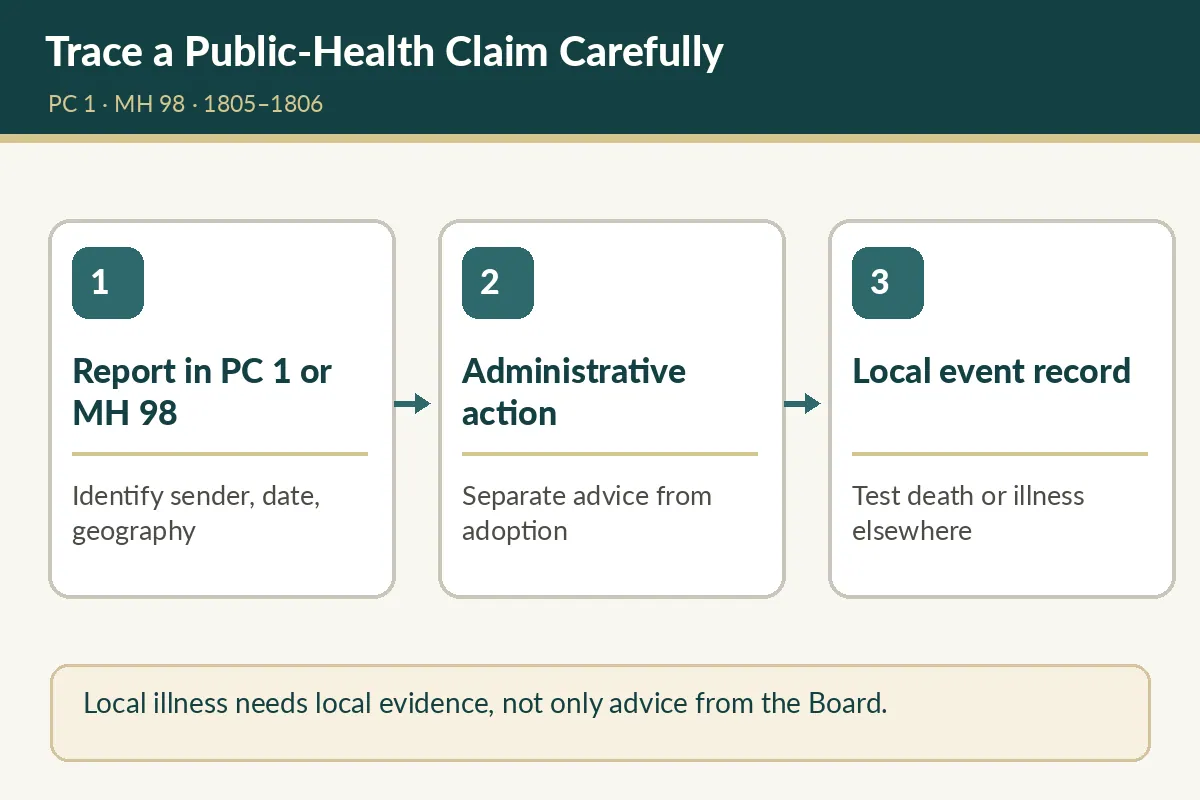
Turn Context into a Responsible Local-History Note
A useful conclusion about a town or family should list two types of evidence side by side: national epidemic intelligence and independent local events. The first can help explain official awareness; the second is needed for a named death, a particular quarantine action or a household disruption. Inspect local burial registers, municipal minutes and contemporary newspapers with careful attention to dates and the reliability of their informants. If the disease in a national report was overseas, say so plainly.
Keep a search ledger for PC 1/3637, PC 1/3666 and MH 98/1 with pages consulted and precise date windows. Discovery searches catalogue titles and descriptions, not every word inside a document. Failure to see a surname in the online catalogue is therefore not evidence that a person or locality is absent from a report. Conversely, finding a place name in an official paper is not proof that the place experienced the exact disease burden it discussed.
More Place and Jurisdiction Guides
How We Research This Record Series
The starting points for this article are the research guidance published by The National Archives: the series-specific guide and the explanation of Discovery catalogue limits. The official descriptions establish which records may be relevant, not that a specific ancestor appears in an unread original. Our workflow deliberately separates source descriptions, primary-document observations and independent corroboration.
For every claim, record the archival reference and the page or image actually consulted, following The National Archives citation guidance. Ask whether the person or place could be a namesake, whether the source was contemporary, whether a second record is genuinely independent, and whether the material is restricted or undigitized. This article does not assert that any illustrative search example identifies a real ancestor. See our affiliate disclosure; no paid referral is required for these steps.
A reproducible conclusion has three parts: the exact fact the source documents, the reasonable but still testable interpretation, and the unresolved point requiring another record. Do not present a missing result from one file as universal absence. Before repeating a secondary account, inspect how it quotes its evidence, whether the dates belong to different stages of administration, and whether it silently turns an application, report or allegation into a completed event.
No. The first Board met from 1805 until August 1806; new boards arose in 1831 in response to a different crisis.
The National Archives identifies MH 98/1 for reports sent to the Board about epidemics abroad, distinct from reports in PC 1.
Not necessarily. First inspect the coverage and any available indexes. An online catalogue description may omit names present on the original pages.
No. Open the original item or a reliable image and read the precise wording, document type, date and author before drawing a conclusion.
Keep the full repository reference, page or folio, original spelling, relevant date, recorded role or place and the words that support your claim.