
Treat a Petition as a Request, Not an Official Finding
SP 35 is the main State Papers Domestic series for George I, 1714–1727. These surviving papers include letters, petitions, intelligence reports, memoranda and papers on finance, trade and unrest after the Jacobite rising of 1715. A petition records what someone wanted an authority to hear. It may convey true events, disputed facts, selective statements or requests expressed in the conventions of eighteenth-century supplication. The presence of a signature is not by itself a verdict, royal order, grant or historical proof that every assertion is correct.
The National Archives documents a concrete example in SP 35/7, folio 34: a 1716 petition by Ann, Countess Dowager of Hume, on behalf of her son James after his trial connected to the rising. Read the archive’s explanation and transcript carefully. The petitioner’s account of her son’s condition and responsibility is her argument for mercy, not a modern clinical finding. Even where a proceeding is mentioned, a petition is not a substitute for the trial record or final pardon.
Begin with the government business you want to explain: compensation for property damage, pardon, office, trade or public security. Fix a date range within 1714–1727 and search both names and localities. The archive’s George I State Papers guide describes the series and its finding aids. Make the specific record type part of your first research question, rather than searching a surname and assuming every result concerns an ancestor.
Move From Catalogue Description to the Individual Folio
Search Discovery within SP 35 by relevant place, person or subject, with spelling variants. The National Archives notes that manuscript calendars and List and Index Society publications remain important, and that the index of names and places for SP 35/1–76 does not cover every possible record. Volume 173 is a named index among the supporting publications; the guide also identifies volumes 136, 144, 155 and 165. Do not claim that a no-result keyword search covers every manuscript in the series.
A calendar entry is a description made by a later editor, not the full original. Copy the exact SP 35 piece and folio or item reference, date as presented and any indication of a reverse side or endorsement. Then read the surviving image or order the manuscript. An editor’s summary may compress a conditional statement into a confident sounding sentence. An original annotation can change the interpretation of who endorsed a claim and when it reached an office.
The National Archives offers some records through State Papers Online, which can require institutional access or onsite use. Discovery descriptions may not be equally detailed. If you only saw a catalogue entry, label it as catalogue evidence. If you read a contemporary manuscript, state which folio and whether the verso was visible. Avoid using the publication date of a later calendar as the historical date of the petition.

Separate the Petitioner, Allegation and Government Response
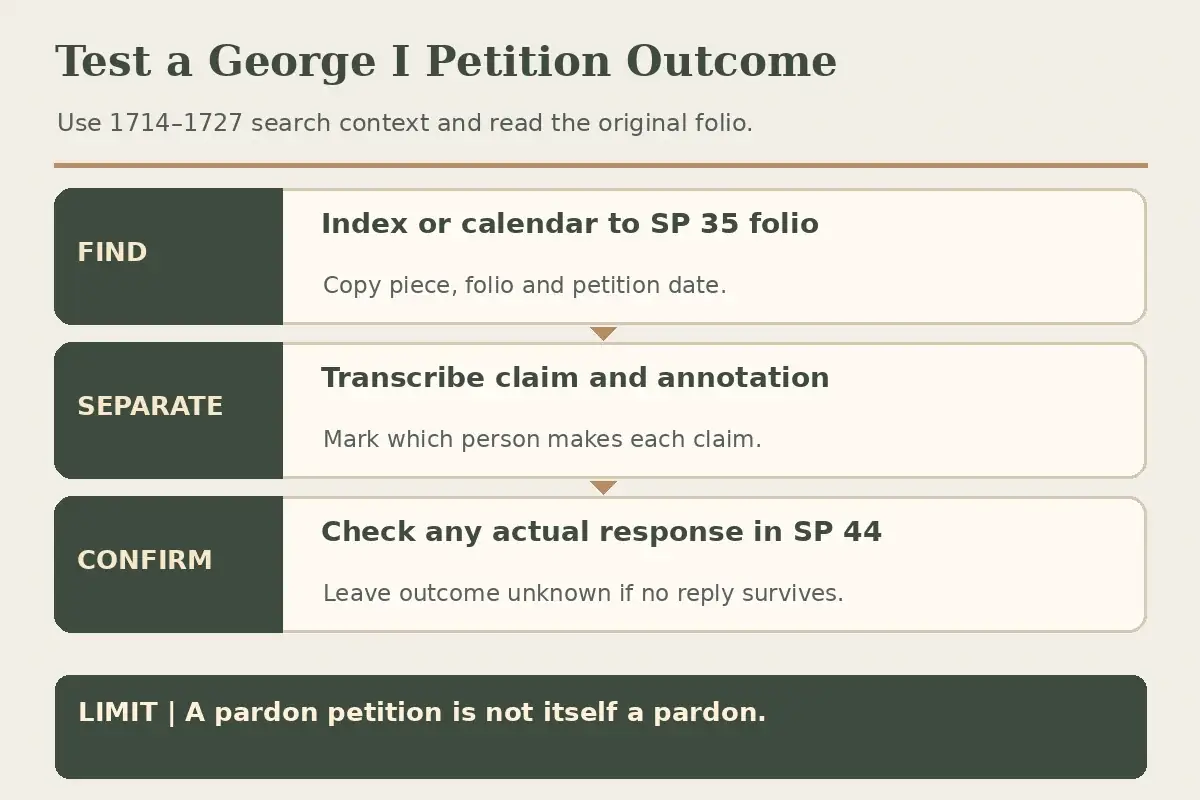
Create three evidence rows. First, identify the petitioner: a named signer or author, acting for themselves or for another person. Second, transcribe the operative request and its allegations, including descriptions of loss, guilt, service or loyalty. Third, look for the documented response: a minute, recommendation, warrant, letter or entry book. Do not place an arrow from REQUEST directly to GRANTED without an observed decision document.
In some circumstances, SP 44 domestic entry books can preserve copies of outward letters, warrants or authorizations, while related correspondence may appear in SP 43, SP 45 or another state-paper series. Those are potential independent routes, not compulsory next documents for every petition. Search by name, topic and date rather than assigning an imaginary cross-reference. Cite the separate record that actually contains a reply.
Family-history conclusions should preserve both time and voice. Write “the petition stated that a house was burned in 1715,” not “the house was certainly burned by the named group” unless other records corroborate it. A petitioner asking for a pardon may acknowledge a trial, but the formal trial result must be examined separately. Conversely, rejection of a claim does not logically prove the described suffering never occurred.

Test the Story With Other Document Types
If a petition names an address, property or family member, use a second source with its own purpose. A local property record may support the location, a contemporary court record the legal outcome, and a tax account a different aspect of landholding. A petition signed on someone’s behalf may give useful relationship clues; treat these as claims until independent documents establish the precise connection.
For Jacobite-era material distinguish the rising of 1715 from the later rising of 1745. The latter belongs principally to the reign of George II and SP 36, not to a convenient extension of SP 35. A deposition, pardon application, government intelligence report and family account could describe the same event with conflicting agendas. Keep the records separate so the conflict remains visible instead of smoothing the accounts into a single narrative.
Do not infer that everyone mentioned as an associate supported a cause. Words such as “rebels,” “loyal” or “suspected” were politically loaded contemporary descriptions. Transcribe exactly when essential but distinguish quoted historical language from the modern historian’s conclusion. A useful timeline records incident, petition, endorsement, decision and any later action as independently dated events.
More Records and Archives Guides
How We Research George I Petition Evidence
Our practical worksheet has columns for CLAIMANT, CLAIM, DOCUMENT DATE, ANNOTATION, DECISION SOURCE and CORROBORATION. Record manuscript damage and uncertain readings rather than silently expanding abbreviations or reconstructing a missing outcome. The diagram labels are explanatory and are not intended to imitate an authentic eighteenth-century folio. The existence of a petition alone proves the request was made or recorded, not that officials agreed.
When a catalogue search fails, broaden period spelling and search personal roles, estates and subjects; consult the listed calendars where keyword descriptions are incomplete. For any source used, copy its complete SP 35 reference and identify whether the evidence is an original folio, calendar or later scholarly interpretation. An 1716 petition and an 1720 endorsement should not be reported as the same historical event.
Confirm current access arrangements through the archive before visiting or purchasing copies. This article is a method for evaluating historical petitions, not evidence for a particular modern person’s reputation. The affiliate disclosure explains our general commercial transparency policy. A better story is one that identifies the voice of each source and openly leaves the government decision unproven when it is missing.
SP 35 is the principal State Papers Domestic series for George I, 1714–1727.
No. It establishes a request or statement; the disposition needs separate documentary evidence.
No. A calendar is a summary and may omit endorsements or qualifications.
Check relevant records such as SP 44 entry books or other linked state papers, but do not assume a reply survives.
No. Distinguish reported suspicion, testimony, charge, verdict and later action.