
Establish What the Forfeited Estates Commission Was Examining
Following the Jacobite rising of 1715, a commission dealt with estates forfeited to the Crown in England and Wales. The National Archives identifies the papers of the Commissioners in FEC 1 and their books in FEC 2. Such records can illuminate property, financial interests, prior deeds, claims by creditors or tenants, and administrative handling. They do not automatically prove that a person named on a piece of paper was an owner in residence at the time of the rising.
A crucial date trap is that FEC 1 includes documents created before and after the commission’s work. A National Archives cataloguing report describes deeds and documents relating to the estates of people attainted for the 1715 rebellion, with documents dated 1552–1770 across the collection. Thus 1552 is not the establishment date of the commission, and a sixteenth-century deed in the file is not direct evidence of an eighteenth-century occupation. Write the document date and the commission context in separate fields.
Use the official Jacobite risings guide as the starting route. It identifies FEC 1 and FEC 2 and notes that descriptions may be searched by keyword. Set a question such as “what interest did this named claimant assert in this specified estate?” rather than “did my ancestor own a castle?” without a known property reference.
Select a File by Estate, Place, Person and Document Type
Begin with a historic estate name, township, manor, parish or county, and note changes in spelling. Use person names as an additional route, not the sole filter. The collection is organized by administrative provenance, and a name mentioned as a witness or debtor is not necessarily the forfeited owner. Once a candidate is located, record the full item reference, document date, creator and the precise relationship described between the person and estate.
FEC 1 papers can include supporting deeds and claims presented to the commission; FEC 2 books may supply a different administrative perspective. They should not be treated as an automatic chronological sequence of “FEC 1 first, FEC 2 second.” Ask whether each document is a title instrument, an inventory or valuation, a petition, a report, a receipt, or a commission entry. The type determines the strongest claim it can support.
The commission after 1715 must also be distinguished from confiscations and other forfeiture processes following the rising of 1745. The National Archives notes a smaller related collection in T 64 for the later rising. Do not stretch a 1715 FEC 1 title trail to a 1746 event simply because the family tradition says “Jacobite.” Separate the rising, locality and administrative authority.

Build a Deed-to-Commission Ownership Ledger
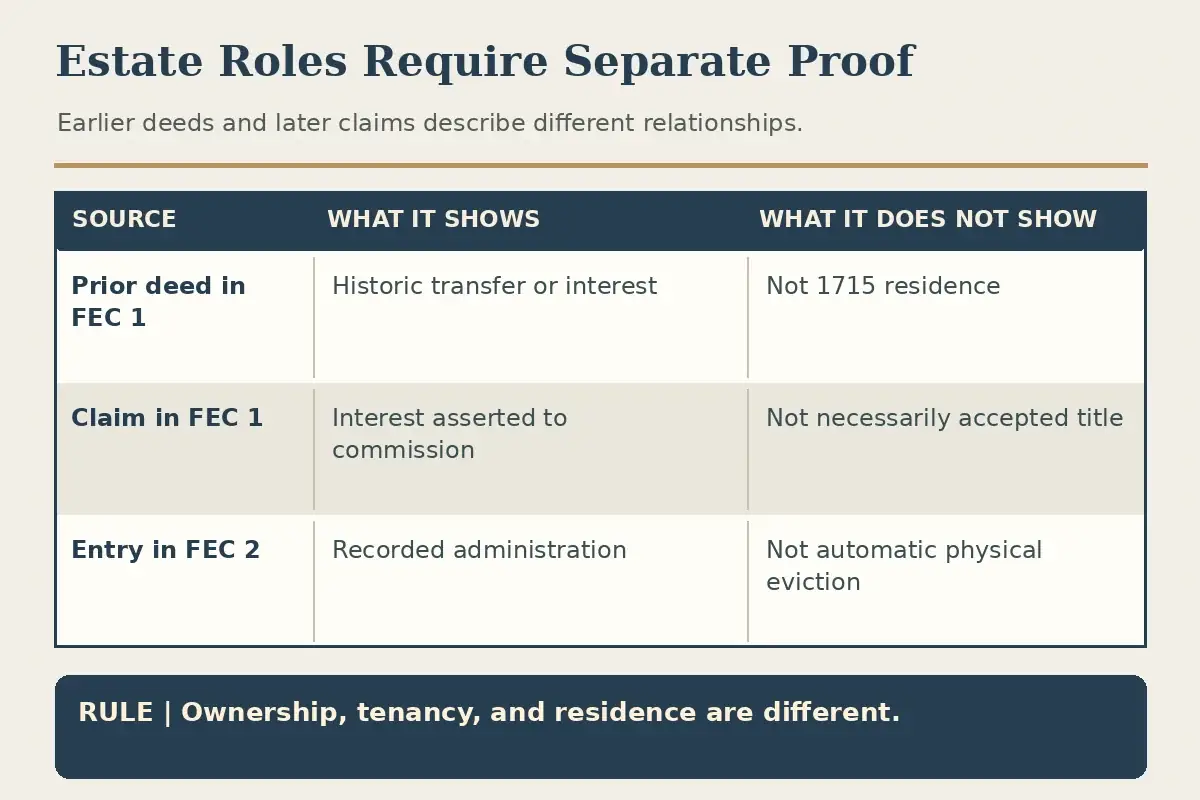
Make a ledger with columns DOCUMENT TYPE, ORIGINAL DATE, FEC REFERENCE, NAMED ROLE, CLAIMED INTEREST, REPORTED ACTION and INDEPENDENT CHECK. A 1690 deed may identify people in an earlier transaction. A 1718 petition may describe someone else’s claim about the same holding. A later commission minute may record that the claim was considered. These statements differ and cannot be flattened into one owner or one event.
Ownership, beneficial interests, leasehold, tenancy, mortgage, creditor status and receipt of rent are not synonyms. If a person supplied a bond or was a witness, that connection deserves mention, but does not establish residence or title. Even when a claimant states that an estate “belonged” to a relative, establish the exact meaning with a surviving conveyance, manor court record, probate document or other locally appropriate source.
An item may preserve an official valuation or schedule of land. That number is evidence of the valuation as made in its administrative context; it is not necessarily the sale price ultimately realized or the property’s market value on the day of forfeiture. Read qualifications, date ranges and units carefully. If a record states arrears or expected revenue, do not convert it into a completed cash payment without further accounting evidence.
Confirm the Property Beyond the Forfeiture File
Look for a matching deed, estate map, parish rate book, manor rental or probate document with the same person and property descriptors at an appropriate date. Independent evidence can distinguish a named tenant from an unrelated namesake. Where the estate was divided, connect field or tenement names, adjoining owners and acreage cautiously; similar names across villages may denote different holdings.
A residence claim needs its own evidence, even if the family owned the estate. A forfeited proprietor could live far away while a tenant farmed the land; a manager might sign documents without living there. Conversely, a tenant in a disputed property could remain after an administrative seizure. Keep at least three columns: LEGAL INTEREST, REPORTED OCCUPATION and INDEPENDENT ADDRESS PROOF.
If the question concerns later beneficiaries or the use of the lands, consult subsequent records only when their dates and archival descriptions connect. The guide also mentions Greenwich Hospital papers for the Derwentwater estates, but those are a particular historical path, not a universal destination for every FEC 1 search. Write a cautious conclusion when the chain ends: “a claim concerning the property was lodged,” rather than “the family lost its ancestral home.”

More House and Local History Guides
How We Research Forfeited Estate Claims
We search property first, set the rising and jurisdiction, then read the document type before assigning a role to any person. The FEC 1/FEC 2 comparison is a question-led cross-check and does not imply that both series contain every estate. The accompanying diagrams distinguish earlier deed dates from the commission’s post-1715 work. They are original explanatory graphics, not reproductions of archival deeds.
Our citations preserve the document and folio reference where available, plus an explanation of whether we actually saw the original, an image or a catalogue description. A record dated 1660 cited as part of a 1718 enquiry needs both dates. If namesakes or altered boundaries prevent a secure link, state the unresolved alternatives and what additional record could decide them.
Check current item-level access and copy conditions through the archive; the presence of an online description does not promise a downloadable manuscript. The affiliate disclosure provides our commercial policy. The central lesson is narrow but powerful: forfeiture administration explains how a property interest was examined, not automatically who owned, occupied or inherited a particular home.
FEC 1 contains papers and FEC 2 books of the post-1715 Forfeited Estates Commissioners for England and Wales.
No. Earlier deeds could be preserved as evidence in the post-1715 administrative files.
No. Names can belong to tenants, creditors, witnesses, relatives or officials.
Not simply by naming them. Seek separate dated household, tax, rental or residency evidence.
The National Archives identifies separate material in T 64; do not assume a FEC 1 file covers the later rising.