
Royal Marines attestation papers in ADM 157, dating from 1790 to 1925, can preserve a Marine’s original enlistment details even when a later service-register search fails. The important distinction is between the man’s signed entry form, a register compiled or reconstructed later, and a name index that points only to another document. For family history, start with the Marine’s name, likely dates and division, then inspect the actual form and compare it with ADM 159, not merely a matching database heading. A form recording service is not automatically evidence of every ship posting or every family claim.
Why ADM 157 Is Not the Same as ADM 159
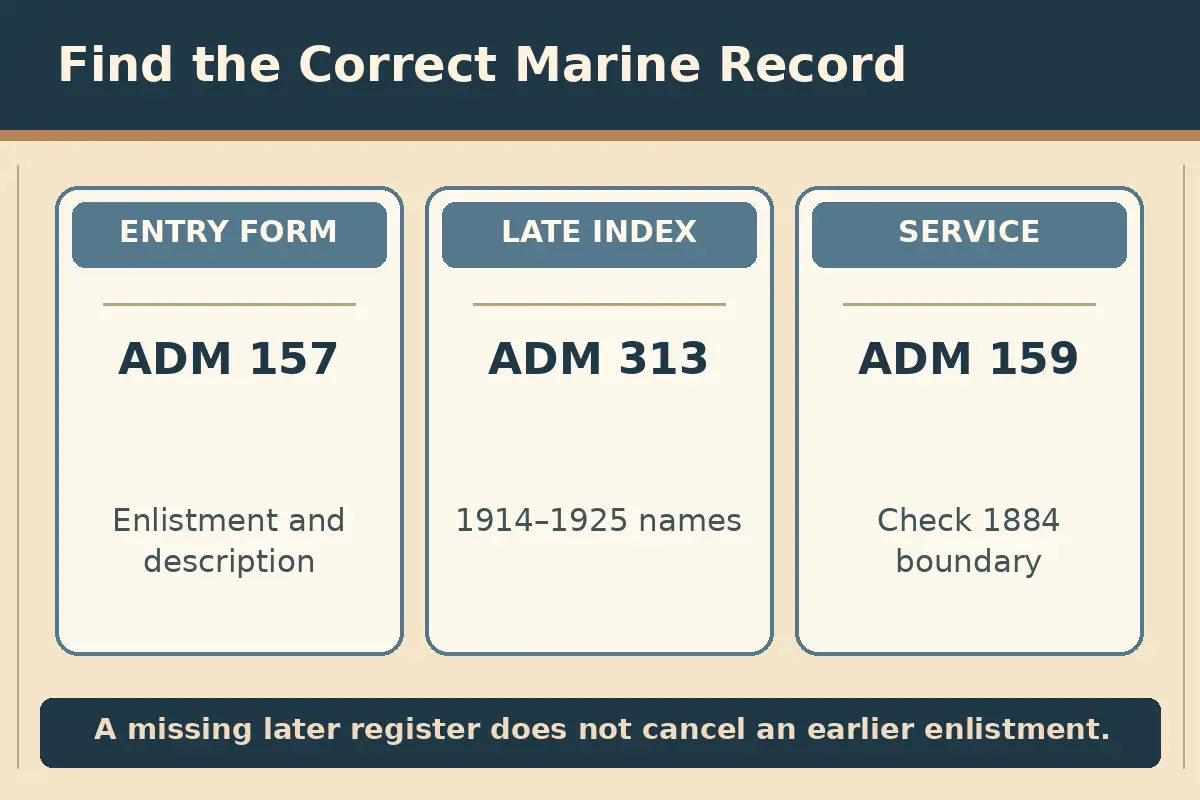
The National Archives identifies ADM 157 as attestation and discharge forms, 1790–1925. Such papers were compiled when a Marine joined, and may carry later notes. ADM 159 is a different series: service registers for approximately 110,000 men joining between 1842 and 1925, originally created in 1884, including retrospective entries for men who were still serving then. A man who left before 1884 may therefore lack the expected later register without having been absent from the Marines. Do not translate a missing ADM 159 result into a negative conclusion about an earlier enlistment.
An officer should be routed to the officer records associated with ADM 196, not inserted into an enlisted man’s attestation sequence. Identify the contemporary wording for rank, division and enlistment status before searching. An ancestor described as a “marine” in a parish register could be serving aboard a ship, assigned ashore, or named by a family informant long after service. Build a preliminary timeline from independent documents rather than assigning him to a famous vessel on the strength of one occupational label.
Locate a Named Form and Recover an Index Failure
Search Discovery for the person in ADM 157, using a quoted full name first and then spelling variants, initials and date limits. The official guide cautions that a catalogue search can match words anywhere in a description, not necessarily a personal-name field: a surname that is also a place name may produce misleading hits. Record the entire piece reference and date span before deciding a candidate is plausible. A result card does not provide the same certainty as reading the form’s signature and personal particulars.
For enlistments from 1914 to 1925, consult the index in ADM 313/1–26 if no individual form appears in name search. The archive also recommends browsing the relevant ADM 157 files. The index is a finding aid, not a substitute attestation or a list proving that all contemporaneous forms survived. A negative name search should therefore be reported as the particular terms and ranges searched; it is not evidence that the person never enlisted or that his name was always spelled one way.
Transcribe the Fields and Identify the Informant
An original attestation may report birthplace, previous work, physical description and a service history. Check what this particular form actually records rather than assuming a standard field list is complete for all dates. If an age is given without a birth date, calculate a cautious birth interval and keep the stated age as original evidence. Distinguish the recruit’s declaration from the recruiting officer’s additions or later administrative annotations. A birthplace reported years after the event is a useful lead but not a verified baptism.
Photograph or transcribe the complete heading, page, dates, service number where present, company or division, and exact spelling of the name. If the document names a relative, identify whether that person is described as next of kin, an emergency contact or someone in another capacity. A listed contact may be outdated. Use original civil or parish registers to test family relationships; do not make the attestation into an imaginary full birth or marriage certificate.

Connect Division and Service Without Inventing a Voyage
The same person may appear in ADM 157 and ADM 159 with changes to his division, service number or clerical spelling. Create a side-by-side comparison of identity fields and the dates each document was created. ADM 159 entries retrospectively compiled in 1884 need special care: a retrospective career summary is not necessarily contemporaneous with every event it records. A division identifies an administrative organization; it cannot alone place the Marine aboard a specific ship on a specific day.
Where service notes include a vessel or shore station, seek a dated independent muster, log or administrative source appropriate to that period. A ship’s documented movement does not establish a particular Marine’s personal participation in an engagement, landing or casualty. Search for transfer notes and gaps rather than filling blank dates with the ship’s entire itinerary. In a namesake case, compare consistent birth details, division number and service dates before linking the two archive entries.
Evaluate Gaps, Access and Alternative Collections
The National Archives describes ADM 157 forms as available through catalogue search but not necessarily immediately viewable as full digital images. Check each piece’s actual access and copy options rather than promising a free download. ADM 313 covers a defined late period; failure to find a man in that index says little about service in the nineteenth century. Retrospective ADM 159 coverage has its own historical boundary. Use those differences as alternative routes, not as a single uninterrupted institutional register.
If no original attestation survives, examine the Royal Marines description books in ADM 158 where relevant and compare surviving naval administration or civilian records. Note the precise spelling, division and dates searched for each attempt. When a candidate shares the correct surname but an incompatible birthplace or service interval, retain both possibilities. Report an unresolved identity rather than forcing two record systems into a biography that their surviving evidence cannot support.

More Records and Archives Guides
How We Research an Enlisted Marine’s Identity
We begin with a dated name and plausible rank, then use ADM 157 to find a contemporaneous enlistment form. When the search is inconclusive, the 1914–1925 ADM 313 index and the browse structure in ADM 157 offer defined alternatives. We compare the original particulars with ADM 159 only when its service-register coverage makes sense. Each evidence statement identifies whether it comes from the applicant, a clerk, a later compilation or independent civil records.
The National Archives guides to Royal Marines other ranks and ADM 159 service records explain the different date systems and archive routes. Neither guide proves any individual family connection without the original entry. Include the full reference and whether the form was personally inspected. Our affiliate disclosure applies to research links; access providers do not change evidentiary standards.
No. ADM 159 was created in 1884 and may omit earlier men who left service before that year.
For 1914–1925, check ADM 313/1–26; also browse relevant ADM 157 pieces.
Not without the specific posting and date, checked against other contemporary service records.
It is supporting evidence, best compared with dates, birthplace and division rather than used alone.
Officers have different archival routes, including ADM 196; verify the rank first.