
E 101 royal wardrobe accounts can name medieval servants in livery and expense lists. Locate the correct account first and verify identity outside the court. Start at the original repository’s guide and note its stated series coverage. See our affiliate disclosure before comparing paid record platforms.
Start With an Office, Date and Type of Account
The medieval Royal Wardrobe did far more than store clothing. It handled expenditure and accounted for payments, supplies, gifts, journeys and the work of household staff. The National Archives assigns major Exchequer records of these activities to E 101. Some surviving material includes lists of people issued summer or winter robes as livery, names of craftsmen, wage payments and accounts kept by household officers. A family historian should therefore search for the role of an individual and a plausible court, not treat E 101 as an alphabetical register of all royal servants.
Build a search profile with the person’s given name and byname, possible office, monarch or reign, region and estimated dates. Consider that medieval spelling varies, and a title such as clerk, messenger or tailor might describe the same person in different accounts. A wardrobe entry can make a valuable dated attestation of service or a transaction, but it cannot automatically identify the person with a namesake known in a parish, manor or tax roll.
Use Printed E 101 Finding Aids Before Claiming a Name Hit
The Archives recommends published finding aids for E 101, including the Public Record Office Lists and Indexes volume covering Exchequer accounts and the household and wardrobe guide for the reigns of John through Edward I. These provide the subject and name pathways needed to reach a specific archival reference. An online Discovery description may identify a long account by reign and subject without indexing each servant on every manuscript page. A failed modern keyword search is not a negative search of the physical material.
Record both the route used to locate the account and the final E 101 piece reference. Search a variant name and a likely office, then inspect the document where access allows. Medieval records can be in Latin, French or abbreviated accounting language. Do not silently translate uncertain terms into a specific modern trade or family relationship. Preserve the original spelling and note whether an entry came from the medieval manuscript, a printed calendar or a later database transcription.
Decide What Livery and Pay Actually Demonstrate
A livery list records clothing or an allowance associated with service, not a formal modern employment contract. An account for a court event may include suppliers who were paid once, craftsmen hired for a task, office holders and permanent household servants. The distinction matters: a named person receiving cloth may not have lived within the royal residence year-round. An expense on a coronation or journey gives the date and administrative reason for payment, not a complete itinerary or proof that a relative accompanied the court.
Design a worksheet with account heading, original name, occupational descriptor, goods or money, transaction date, payee role and uncertainty. Separate the person who supplied something from the person named as recipient. If an officer disbursed wages to others, do not relabel every name as that officer’s staff without an explicit statement. A surname shared with a known household figure is not sufficient to infer parentage, marriage or even a continuous term of royal service.
Cross-Check Other Exchequer and Household Series
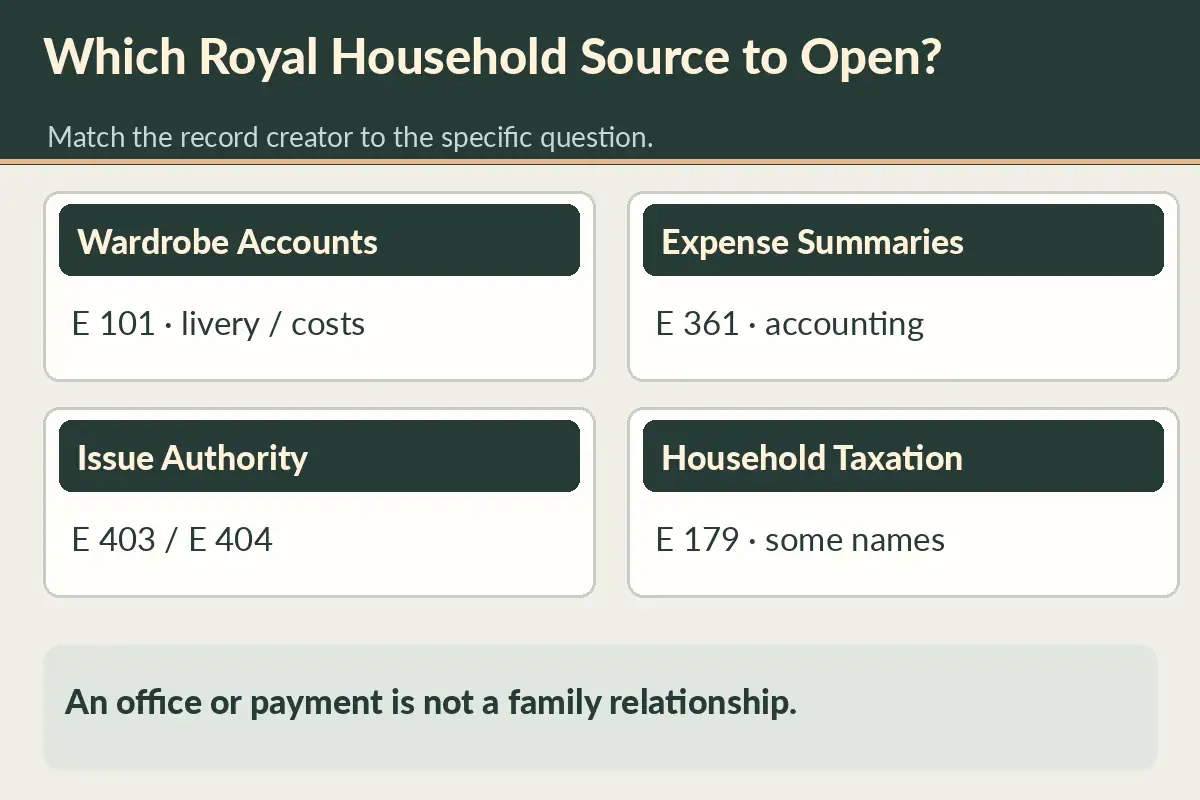
The National Archives identifies related material in E 36, E 315, E 361, E 403/404 and E 179, but each class records something different. E 361 may summarize household and wardrobe expenses, E 403 and E 404 can concern payments and authority, and E 179 includes certain taxation returns with members of the household. This is not a linear chain in which every royal employee automatically appears. First decide whether the research question is about a recorded payment, official appointment, documented presence or the identity of a person.
Compare E 101 with independently created sources for the same period, such as a local deed, an administrative appointment or a tax entry. Keep dates in their original form and distinguish a financial year from an event date. If a manuscript says a messenger received funds for travel, it may identify a duty, but does not prove the details of the journey unless stated. The strongest matches combine a rare role, locality, date and unique name pattern across distinct creators.

Handle Medieval Names and Dating Without False Precision
A medieval name can appear in Latinized form, with a patronymic, place-name or office description. It may not be a fixed hereditary surname. Royal accounts may group payments by feast, regnal year or accounting period rather than by a familiar January–December calendar. If the date is converted, show the original and explain the conversion convention. Failure to do so can shift an apparent payment year and make two different records seem to concern separate people.
Build at least two competing identity hypotheses when a common name appears. In one column list positive anchors such as same office or region; in another list conflicts such as a fifteen-year gap or different status. Look for transactions that bridge the gap before joining the entries. Service to a monarch does not prove residence in London, noble status or kinship with other royal servants. For genealogists, the question is which precisely identified historical person the entry documents, not whether the story sounds prestigious.
Cite the Account, Not Just the Finding Aid
A useful final citation gives E 101, the account or piece number, an appropriate folio or page, the repository and the date and wording that support the claim. Also document the finding aid used, but do not treat a printed contents list as a transcription of an unseen manuscript. If you have not viewed the original, explicitly say that a secondary reference points to a possible entry. When available, preserve an image and diplomatic transcription with expanded abbreviations marked rather than silently normalizing personal names.
Present results as supported statements: an E 101 account records a payment; an original livery list names a servant; another source may or may not identify that person with an ancestor in a documented line. Note gaps caused by survival, languages and indexing. The archive’s broad date range for wardrobe accounts is not evidence that identical household records survive for every year or reign. A modest, well-cited occupational clue is more valuable than an unsupported royal connection.

How We Research This Archival Record Class
We first establish why an office created the record, the years and people actually covered, and its current custody and access status. A searchable catalogue description is not the original document, and a provider index may omit names or normalize dates. We record a positive finding exactly as written and distinguish it from inferences about identity, residence, family relationship or legal outcome. Every plausible namesake gets a separate comparison based on contemporary identifiers. Negative searches include what series, piece, years and spelling variants were really checked. A claim is accepted only when the evidence supports that narrow wording; gaps remain visible.
More Records and Archives Guides
Official Research Sources and Evidence Limits
The custodian’s collection guide confirms Identifies E 101 Exchequer household/wardrobe accounts, livery lists and two published finding aids needed for piece references.. Additional archive guidance confirms Explains that surviving civil or Crown servant personnel files are selective and that royal household records vary by period, creator and access.. These describe surviving series, not an individual ancestor’s case. Check the actual Discovery entry for piece-by-piece access and current closure information, and cite the original page where possible rather than copying a later index entry without inspection.
No. It is a collection of accounts that includes some servants, suppliers and payments.
No. It records an issue or allowance, with context that must be checked.
No. Use published finding aids and piece-level descriptions; many names are not indexed.
No. Test identity, date, office and independent genealogical links.
The exact piece and location, document date, original wording and the repository.