
Researching Native American ancestry requires more than finding a familiar surname on a historical roll. Indigenous nations are distinct sovereign communities with their own histories, governments and record practices. Start with named ancestors and documented places, then ask whether evidence connects a person to a particular tribe, band or community during a specific period. Federal records can be informative, but they reflect administrative policies that were often imposed on Indigenous people. DNA ethnicity estimates and generic ancestry lists do not establish tribal citizenship or prove a specific family relationship.
Start with a documented person and specific community
Work backward from independently identified ancestors using available vital records, household enumerations, school or employment documents, and family-held materials. Record original spellings, dates, residences and relatives without imposing a tribal label that no source supports. A family account is a lead worth preserving, but it is not equivalent to a contemporary record. If an ancestor lived in several regions, trace each move before deciding which tribal or federal office might have recorded them.
Ask what a family tradition means in its own context. It may refer to kinship, a particular nation, residence near a reservation, shared community life or an identity conveyed orally. Avoid translating such descriptions into a modern enrollment category without evidence. Respect people who do not wish to discuss or disclose family histories, particularly when the documents concern living relatives. Publication and access to culturally sensitive records deserve separate consent and community guidance.
Use federal rolls only within their historical scope
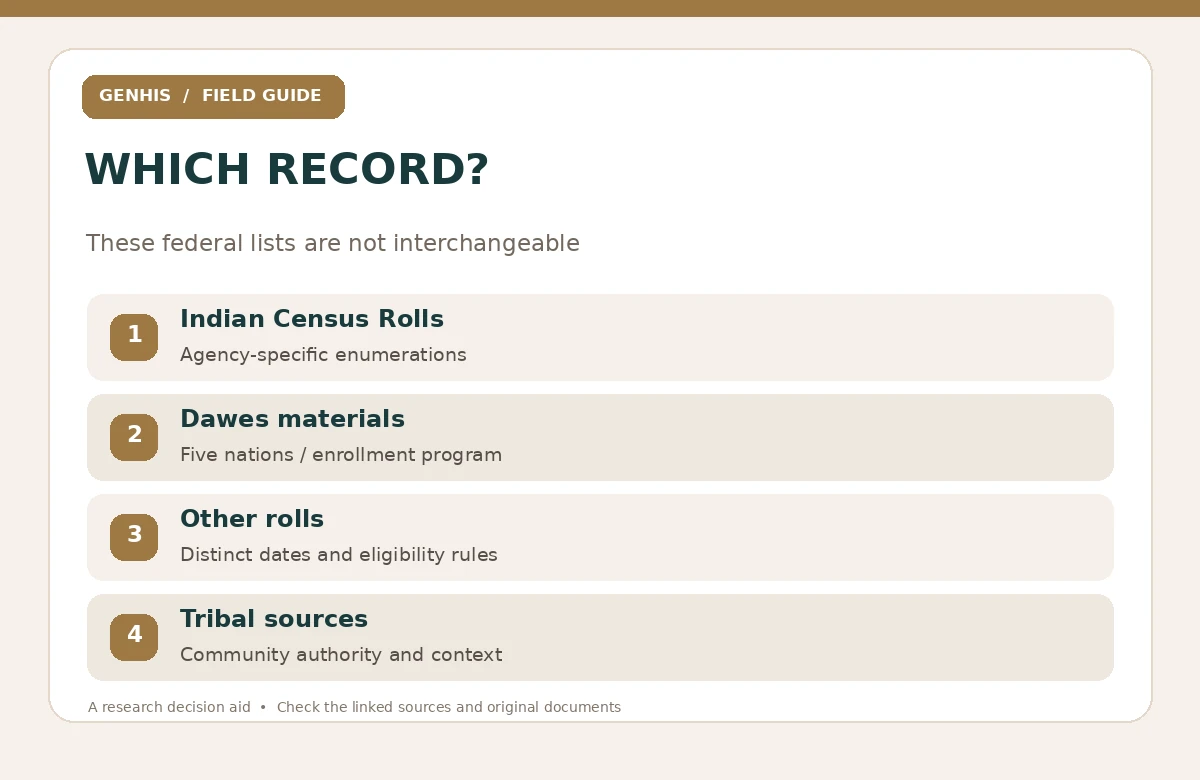
The National Archives lists different Bureau of Indian Affairs rolls assembled for different purposes, including census, allotment, judgment and enrollment programs. The Indian Census Rolls cover particular agencies and years; they are not a national census of every Indigenous person. The Dawes Rolls concern particular nations in Indian Territory during a late nineteenth- and early twentieth-century enrollment process. Other series, such as Baker or Guion Miller rolls, answer different administrative questions.
Before searching any roll, write down who created it, its years, the geographic and tribal scope, categories covered and whether it is complete or only a transcription. A negative result may mean the person was outside that administrative system, recorded under another spelling or excluded by the rules of the time. Do not convert absence from an imposed government register into a judgment about someone’s community identity or family tradition.

Separate archival evidence from tribal citizenship
The Bureau of Indian Affairs explicitly explains that each federally recognized tribe determines its own enrollment requirements. The BIA does not maintain a master database of tribal members and does not conduct genealogy research for applicants. A genealogist can document descent using historical records, but cannot independently determine who qualifies for citizenship in a nation. Current official requirements, acceptable documentation and contact procedures must come directly from the relevant tribal government. If you want the full process, read how to research African American genealogy across the 1870 divide.
Blood-degree notations in historical government rolls were administrative classifications; they do not provide a universal, scientific measurement of identity. Consumer DNA ethnicity estimates cannot replace a paper trail or the decisions of a sovereign tribal nation. Avoid advising a living person to submit private identity documents publicly, and never present a particular roll entry as a membership certificate. When the goal is enrollment rather than historical research, consult the tribe’s official enrollment office.
Interpret names and relationships in their context
People may appear under English-language names, original-language names, translated forms, aliases, married names or inconsistent spellings. Government clerks sometimes altered or standardized entries. Keep each version attached to its own document and date. Search household and associate names where appropriate, but refrain from assuming that every person grouped on an enrollment card is a biological relative. Read field labels, amendments and references to related files carefully.
Historical categories such as “by blood,” “Freedmen” and adopted citizenship arose within particular colonial and tribal political circumstances. These words may carry consequences that the modern reader cannot infer from an index alone. Identify the issuing body and the law or process, while recognizing that tribal histories and perspectives matter in understanding those records. If you encounter disapproved or contested cases, explain the status shown on the document, not a blanket conclusion about ancestry. Our guide to Freedmen’s bank records covers a related question.
| Record or source | Useful evidence | Critical limit |
|---|---|---|
| Family records | Document persons, places and relationships | Tradition is a lead, not a certificate |
| BIA agency roll | Government enrollment or census context | Limited by agency and historical program |
| Tribal archive | Community-specific historical perspective | Policies and access vary by nation |
| Current tribal enrollment office | Official citizenship requirements | Only the sovereign tribe decides |
Build a respectful source-and-jurisdiction worksheet
Create a timeline with one row for each place, nation or agency named by evidence. Add the ancestor’s name as written, source date, archive series, possible alternate jurisdiction, what the record actually states and any contradictions. This guards against searching a famous roll unrelated to the ancestor’s residence. A county deed, school record and federal roll might document different aspects of a person’s life; none automatically substitutes for the others.
For example, a family tradition points to a Cherokee ancestor, while the earliest proven relative is in a different state decades after allotment. Rather than choosing a similar name in the Dawes database, establish the intervening parent-child links and migration route. Only then evaluate whether a specific federal series or tribal archive would be relevant. Record searches that return nothing, including exact filters, so future researchers know whether the expected collection was actually examined.
Consult tribal archives and protect sensitive details
A nation’s own archives, cultural center, historic preservation office or genealogical guidance may be more appropriate than an uncontextualized federal database. Follow its published policies and ask before requesting restricted materials. Some records were produced through removal, boarding-school systems or other harmful policies; do not portray official paperwork as a neutral or comprehensive account of Indigenous families. If you want the full process, read how to research Jewish genealogy across names, towns, and archives.
When writing a family narrative, distinguish a documented birthplace or agency residence from membership, kinship and personal identification. Keep confidential documents belonging to living people out of published trees and avoid attributing specific cultural practices to an ancestor unless supported. A careful final finding may be that a federal record shows a name and date while the alleged tribal connection remains unproven. That is useful research, not a failure to discover an identity.

How We Research These Historical Records
We used Indian Affairs’ current genealogy guidance alongside NARA’s descriptions of agency rolls to separate archival questions from the authority of Indigenous governments. The displayed decisions concern where a historical document could be found; they do not establish contemporary citizenship or adjudicate the identity of a particular family. Federal classifications reflect particular administrative systems and may be inaccurate or harmful. Specific tribal policies, culturally sensitive collections, and access rights require consultation with the community that maintains them.
More Research Method Guides
Sources, Privacy and Editorial Disclosure
Checked repository material: Sovereign tribal enrollment requirements, BIA records limitations and genealogical process.; NARA’s different tribal and agency roll series, dates and documentary contexts.; Particular scope of Dawes enrollment, cards, jackets and approved/disapproved records.; Historical federal census enumeration limits and its difference from agency rolls.. Respect tribal control over citizenship decisions and access to culturally restricted collections; historical classifications are not DNA measures. This article does not request or publish living applicants’ identity paperwork. It contains no paid enrollment service or affiliate recommendation. Details of site funding are listed in the GenHis disclosure statement.
No. Consumer ethnicity estimates do not establish a documented ancestor or tribal citizenship; the sovereign tribe decides its own criteria.
No. The BIA says it has no universal member database and does not perform individual genealogical research.
No. Those rolls concern particular nations and a particular enrollment process, not all tribes or all historical periods.
Preserve the story, establish the named family line and historical places, then consult appropriate community and archival sources without inventing a connection.
The tribal government applies its own citizenship or enrollment rules; historical indexes cannot replace that process.