
Spring Grove Cemetery’s official Locate a Loved One map helps a researcher locate an interment at Spring Grove Cemetery in Cincinnati or at the separately listed Oak Hill Cemetery. The interface can supply a mapped location, ground-level views, and historic or modern digital burial cards. Start by confirming which cemetery the result names, then compare the card with an independently dated death or funeral source. A mapped person is not automatically the same individual as the ancestor in your family tree.
Choose Spring Grove Rather Than Oak Hill Before Interpreting the Map
The locator includes two cemetery destinations, each with its own address and search route. Spring Grove Cemetery is on Spring Grove Avenue in Cincinnati; Oak Hill Cemetery is on Princeton Pike. Search the cemetery name displayed with the result, not simply the shared brand of the online interface. Record the spelling of the person’s name, interment date where provided, and location notation before opening driving or walking directions. Similar names occurring in both grounds remain distinct candidates until external records permit a match.
Use a documented death place, funeral home notice or last residence as a starting clue rather than a rule that fixes burial location. Families can arrange burial outside their home neighborhood, and a person may have more than one memorial. If the map pin seems inconsistent with a known burial order, save what the interface displays and ask the cemetery whether a move or a later administrative revision explains it. Do not overwrite conflicting evidence with the pin alone.

Read a Digitized Burial Card as an Administrative Source
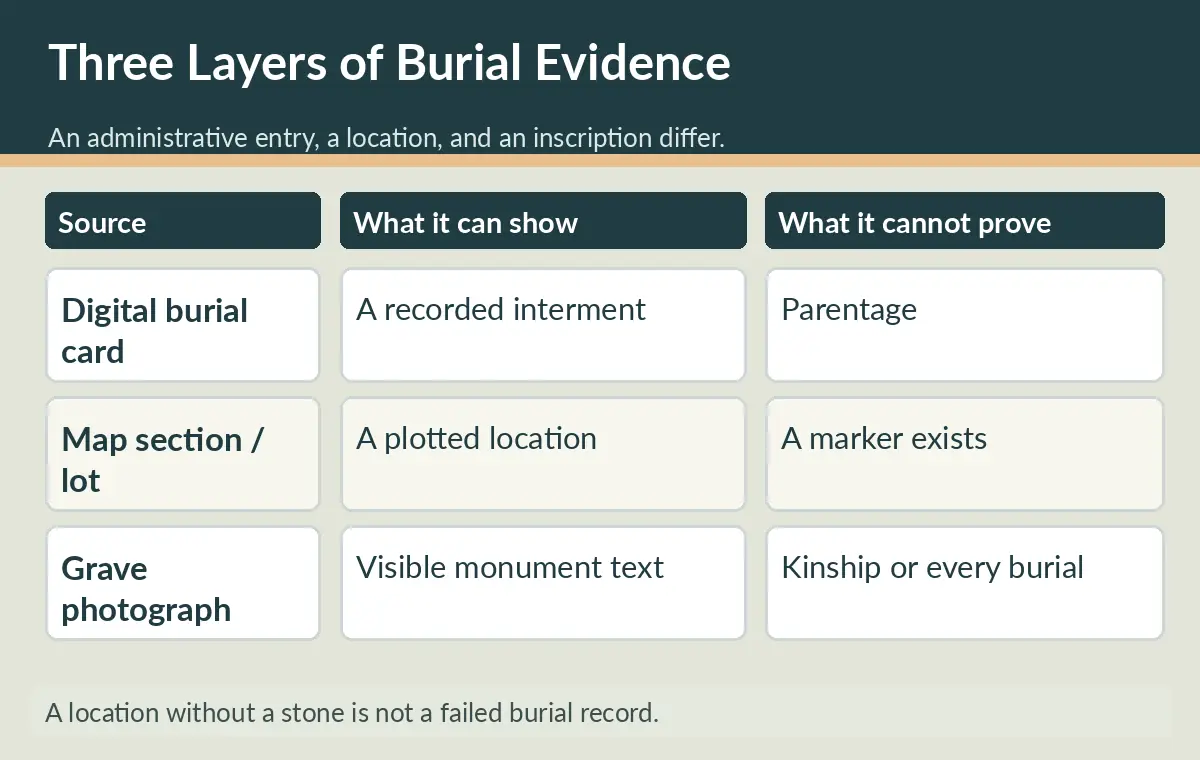
Spring Grove states that its search can lead to archived and modern digital burial cards. Open the card, if available, and transcribe only the fields actually shown: names, dates, locations or administrative notes might vary between cards and eras. Write down the precise name form and any card identifier. A card is generated for cemetery administration; it is not necessarily an original civil death registration, family Bible or direct statement from a close relative.
Compare each card claim with a second record from a different process. For a nineteenth-century burial, a newspaper notice or cemetery funeral entry may supply the surrounding chronology; for a later death, a jurisdictional death record may provide different informant details. Distinguish the person’s actual date of death, date of interment, any later reinterment and the date a card was updated. A disagreement may be meaningful and should remain visible in the research log.
Translate Section and Lot Evidence Into a Physical Visit
The official search advertises interactive maps, step-by-step directions and 360-degree ground views. Those features are excellent for planning a visit, but they are aids to locating a plot, not guarantees that a monument still stands. Copy the section or locator fields exactly and take the current office map into the visit. Before visiting, check the cemetery’s current visitor rules; map interfaces and vehicle access routes may change independently of historical burial files.
When photographing the site, record the photograph date and what is physically present. If a marker exists, make a literal transcription that preserves uncertain letters rather than inventing an age or an additional surname. If no stone is visible, the burial may still be recorded. The cemetery notes explicitly that some graves lack markers; lack of a monument is not a reason to reject a documented interment or claim that staff records are false.
Ask the Cemetery Office for a Targeted Genealogy Search
The cemetery’s own history dates Spring Grove to 1845, while its Oak Hill location page dates that separately operated site to 1910. When the search screen is inconclusive, identify the cemetery and provide the suspected interment decade, full name and spelling alternatives. Ask which historical card, burial ledger or related file can be inspected and whether a particular location has later entries. A narrow request is more reproducible than asking staff to construct a pedigree around a common surname.
Not all archival materials are open or suitable for release, and staff time or reproduction rules can vary. Ask which historical material can actually be inspected and whether access limits apply. Do not assume an archive can supply heirs, plot-right owners or all personal correspondence. Record an unsuccessful search with the date, scope and repository response, and follow up with a death registration or local press issue rather than treating a negative online result as final.
Keep Plot Rights, Memorial Text and Kinship in Separate Columns
Create a worksheet with three columns: a burial administration claim, a physical site observation and an independent genealogical claim. A burial card or register may document an interment; a stone photograph records words in a particular place; a civil or church record might identify spouses or parents. Even where three family surnames appear on a shared marker, the relationships among them need evidence from records that actually state or imply those links in a testable context.
A separate plot or lot-holder reference may describe the person authorized to arrange an interment, but its legal implications depend on the cemetery’s own records. Do not treat cemetery rights as a real-estate deed or a proof of biological kinship. For two people with the same name, create side-by-side rows for age, dates, cemetery, neighborhood and linked independent source. If the fields remain ambiguous, retain two candidates instead of merging them.

Preserve the Search Trail and Cite the Exact Record Layer
In the citation for an online result, include the cemetery, name as displayed, screen or card details, plot locator if shown, the official search URL and the date accessed. A second citation should describe any image of a historical burial card or letter from staff. If you make a site visit, cite the inscription or photograph separately with the location and your observation date. This prevents later researchers from assuming you saw an original book when you only opened a map card.
For related research practice, use the affiliate disclosure to understand the site’s commercial transparency; this guide does not claim a paid relationship with Spring Grove. Close with one unresolved question: was the mapped person the ancestor, what record independently confirms it, and does the surviving document record burial rather than only a memorial? A well-scoped negative result is useful when it names the precise search and date.
More Records and Archives Guides
How We Research This Collection
We checked Spring Grove’s current public locator against the operator’s separate cemetery histories, identified the two cemetery destinations and the different purposes of mapping and archival cards, and compared those with general evidence distinctions. We did not claim access to any named family’s private records. All illustrative family comparisons are hypothetical; the cemetery remains the authority for its own interments and plot details.
Yes. The official locator offers both Spring Grove Cemetery and Oak Hill Cemetery; record which one a match belongs to.
No. They may contain useful administrative details, but kinship requires independent evidence appropriate to the claim.
A burial location and a surviving monument are separate facts; the cemetery specifically warns that some graves lack a marker.
Ask Spring Grove staff for the relevant archive search, supplying the cemetery, name variants and a narrow date interval.
Keep the exact displayed name, cemetery, locator, relevant card details, URL and access date, plus any conflicting evidence.