
A 1900 census entry in Cherokee Nation, Indian Territory, does not by itself prove Cherokee Nation citizenship, a particular tribal enrollment category, or kinship. The federal enumeration can locate a household in a dated jurisdiction, while special American Indian schedule questions may give additional reported information where applicable. The National Archives explains the 1900 change in American Indian enumeration. Start with a documented place and household, examine the actual schedule and treat federal census statements separately from sovereign tribal enrollment records.
Find the Geographic Jurisdiction Before the Name Index
In 1900 the Cherokee Nation was part of Indian Territory, not the modern state of Oklahoma. An ancestor’s later Oklahoma county cannot be pasted directly onto a pre-statehood census district without testing the geography. Use a known settlement, post office, household or district label from a contemporary document, then search the federal 1900 population census for Indian Territory. Keep the historical jurisdiction visible in your notes: territory and nation labels on a census are administrative context, not a statement of one individual’s legal citizenship.
Name indexes are convenient but not a complete substitute for browsing nearby sheets. Transcriptions can confuse similar Cherokee, English and other surnames; households can be split over pages; reported ages may be approximate. Record the district, enumeration district or page identifiers supplied by the source image. If only a modern search screen is available, do not invent an original folio number. A search without success has to name the places and spelling variants it covered before being considered a meaningful negative result.
Distinguish the General Census Form and Special Questions
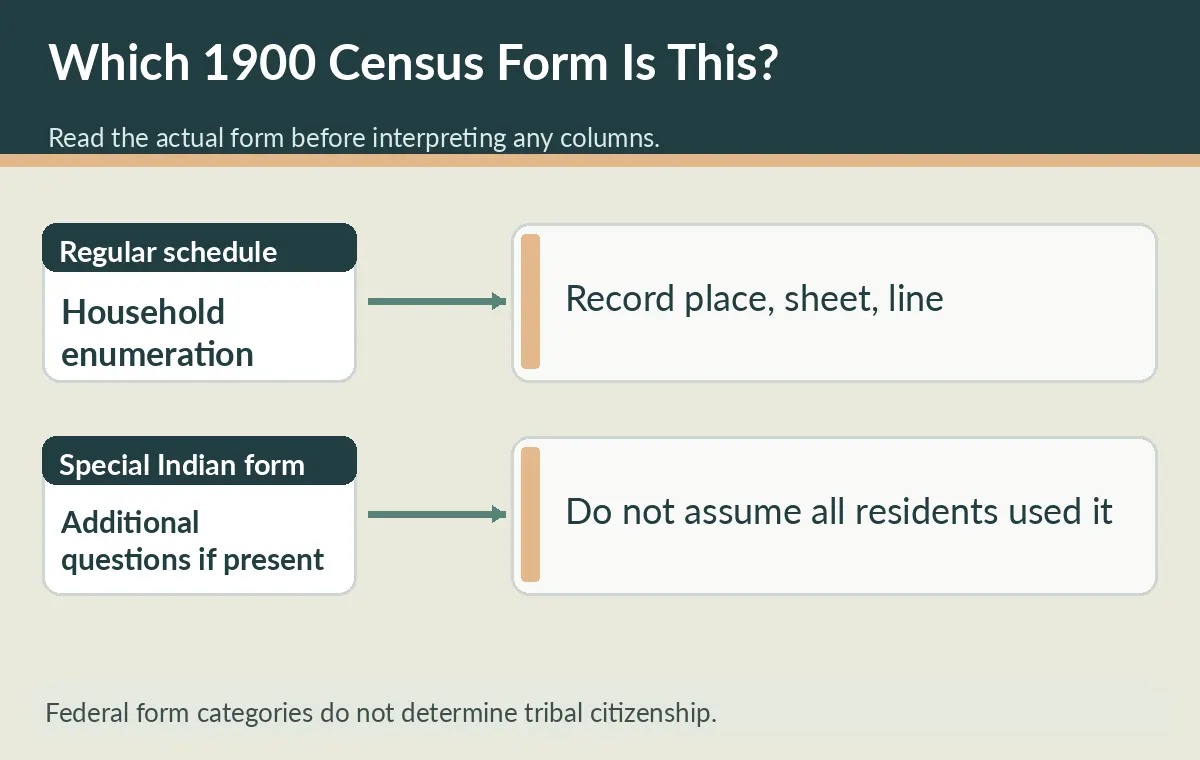
According to the National Archives guide to the decennial census, 1900 and 1910 used additional questions for enumerated American Indians that were not present on the ordinary form. Inspect the full surviving schedule to determine which questions were actually asked for your candidate. Do not claim that every resident of a Cherokee Nation district used the same special form or had answers in every field. Form type is an observation to record before interpreting identity information.
An ordinary household entry can place named people in a reported family or residence configuration. A special schedule may record additional reported tribal or ancestry information, depending on the form and enumerator. The form is a historical federal classification, not a final ruling of a sovereign nation. Transcribe contested historic terminology only when necessary to describe the source, and identify it as the original government’s wording rather than adopting it as a modern label for a person.
Read Household Relationships as Reported Evidence
The federal census may report household roles, ages, marital status, birthplaces and other characteristics. Those descriptions were supplied through an enumerator and an unknown or incompletely known informant. A person labeled ‘daughter’ might be a household relationship as reported on the form, but biological parentage and the identities of both parents may require birth, marriage, estate or other records. A shared surname is still weaker evidence than a stated relationship.
When a census line sits at a page boundary, inspect preceding and following images. Repeat given names, duplicate initials and translated or anglicized forms can create two different candidate people. Use a table comparing years of birth, partners, household members and known place evidence from another date. Do not automatically collapse a 1900 Cherokee Nation resident into a similarly named person on a later Dawes roll or in a family tree compiled generations afterward.

Keep Federal Enumeration Apart From Tribal Enrollment
An assertion of membership or citizenship within a sovereign tribe must be grounded in the applicable nation’s records and its own historical or current rules. Federal schedules, allotment documents and specific tribal rolls were created under different legal schemes; a mention in one does not automatically confer the status associated with another. The National Archives’ Fort Worth finding aid lists specialized series that should be identified individually, not grouped under the vague name ‘Indian census.’
If your research question specifically concerns Dawes-era enrollment, first establish the individual and community using original records, then locate the actual enrollment category and supporting case materials appropriate to the person and date. Do not infer any person’s tribal identity from a DNA estimate, a surname, an isolated federal race code or the location of a home. A published historical census can be sensitive; avoid building profiles or disclosing information about living relatives without consent.
Investigate an Apparent Census Absence Carefully
A negative result in one surname index can arise from name variants, misclassification, page damage, a move, an enumerator’s omission or the wrong geographic unit. Try a place-first browse if the approximate settlement is independently known. Search neighbors and adjoining sheets for recognizable associates while retaining a strict distinction between neighbor and relative. An enumerated adult may have been away from home, and relatives may be reported in different households rather than as one coherent genealogical unit.
Do not assume the failure to locate a person in Cherokee Nation means the person lived outside Indian Territory. There were other nations and administrative divisions, and modern county terminology was not in use in the same way. Identify the exact 1900 jurisdiction searched and the records searched outside it. Cross-check with independently dated land, church, marriage or correspondence evidence before claiming an interstate migration or a change of citizenship.

Cite Page, Schedule and Jurisdiction Without Overclaiming
A strong citation for the census names the 1900 United States census, Indian Territory, recorded jurisdiction, enumeration district, sheet or page, household and person line where legible, image provider, and date viewed. If a special schedule exists, specify the special form rather than silently treating it as part of the ordinary columns. Keep a separate citation for each distinct tribal enrollment document you actually inspect. Citation precision helps prevent a modern database from erasing territorial context.
The GenHis affiliate disclosure is included for transparency and does not indicate a partnership with the National Archives or any tribal government. End with a bounded claim such as ‘person listed in this household in Indian Territory in 1900; tribal citizenship not established by this census.’ That limited, supportable finding is more useful than a surname-based ancestry assertion.
More Records and Archives Guides
How We Research This Collection
We checked National Archives guidance on 1900 federal enumeration of American Indians, ordinary and special schedule questions, and the distinct Fort Worth Native American record series. We treated census jurisdiction as a historical location and preserved sovereign tribal enrollment as a separate evidentiary question. We did not inspect private tribal files or claim anyone’s identity from a name or federal classification.
No. A census location or federal classification is not itself a tribal enrollment determination.
No. Inspect the actual form and applicable schedule for the specific person.
No. The territorial and nation jurisdictions predate Oklahoma statehood in 1907.
It is reported census evidence that should be tested against other original records.
No. These are distinct record series created for different purposes and classifications.