
Identify the CE Portrait Series Before Naming an Officer
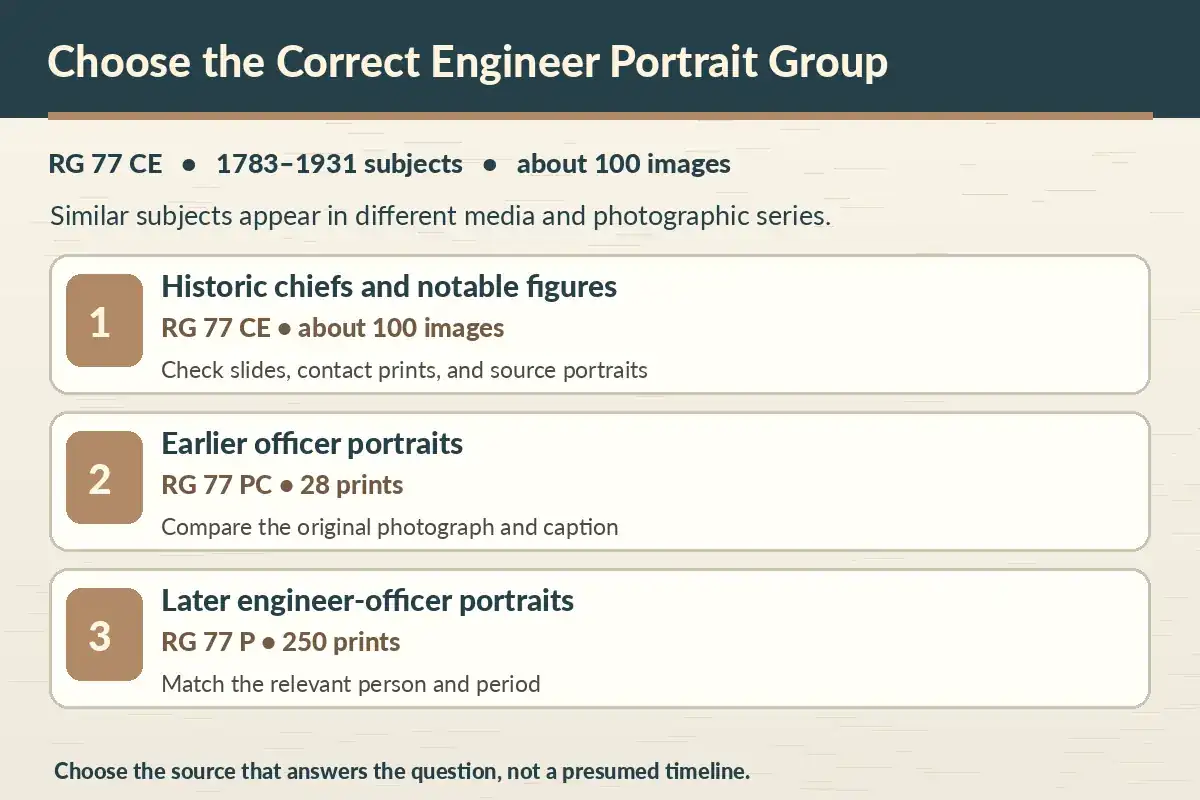
The National Archives describes approximately 100 lantern slides and contact photographic prints under RG 77 CE, with portraits of Chiefs of Engineers and other notable people whose historical subjects span 1783–1931. This is a useful entry point for institutional biography and identification of officer portraits. It does not mean that every slide was created during those years or that an original photograph was taken in the eighteenth century. Identify the subject, the medium, and the underlying source image before drawing a career conclusion.
The same RG 77 guide separately lists PC, a small earlier chief-engineer photographic portrait series, and P, a larger group of engineer-officer portraits dated 1927–1938. Those are alternative research paths, not necessarily copies of each other. A precise name on a slide label is a promising lead, but appointment notices, official registers, service records, and a verified original portrait are still needed for a defensible attribution.
Find CE Without Confusing It With PC and P
The NARA guide identifies CE as a lantern-slide and contact-print group with roughly 100 images and subjects dated 1783–1931. It also describes PC as 28 prints of chiefs and prominent officers associated with 1789–1884, and P as 250 portraits of various engineer officers in 1927–1938. The overlap in names or office titles does not make these three designations interchangeable.
When searching, enter RG 77 with the exact two-letter or single-letter series. Record the local item identifier, printed name, rank, caption source, and physical medium. A contact print may reproduce another photograph, while a lantern slide may reproduce a painted portrait or engraving. The guide gives an approximate count; do not infer a complete named person index or promise that every image is available online.
Keep the Date of the Person Apart From Image Creation
The CE entry covers historical subjects back to 1783. Photography did not exist as an everyday portrait-making medium in that early period. A depiction of an eighteenth-century engineer may therefore derive from a painting, engraving, or later copy. Record the subject’s lifetime and service dates separately from the original artwork date, the slide production date, and the date of the current digital reproduction.
Without item evidence, never apply a range endpoint like 1783 to the photographic exposure of a slide. Captions may have been compiled for an institutional lecture or retrospective display. Note whether the object is labeled as a likeness, portrait, print, photographic reproduction, or slide. Each medium offers a different answer to the question of when and how the image was created.
Test the Identity Against Independent Officer Records
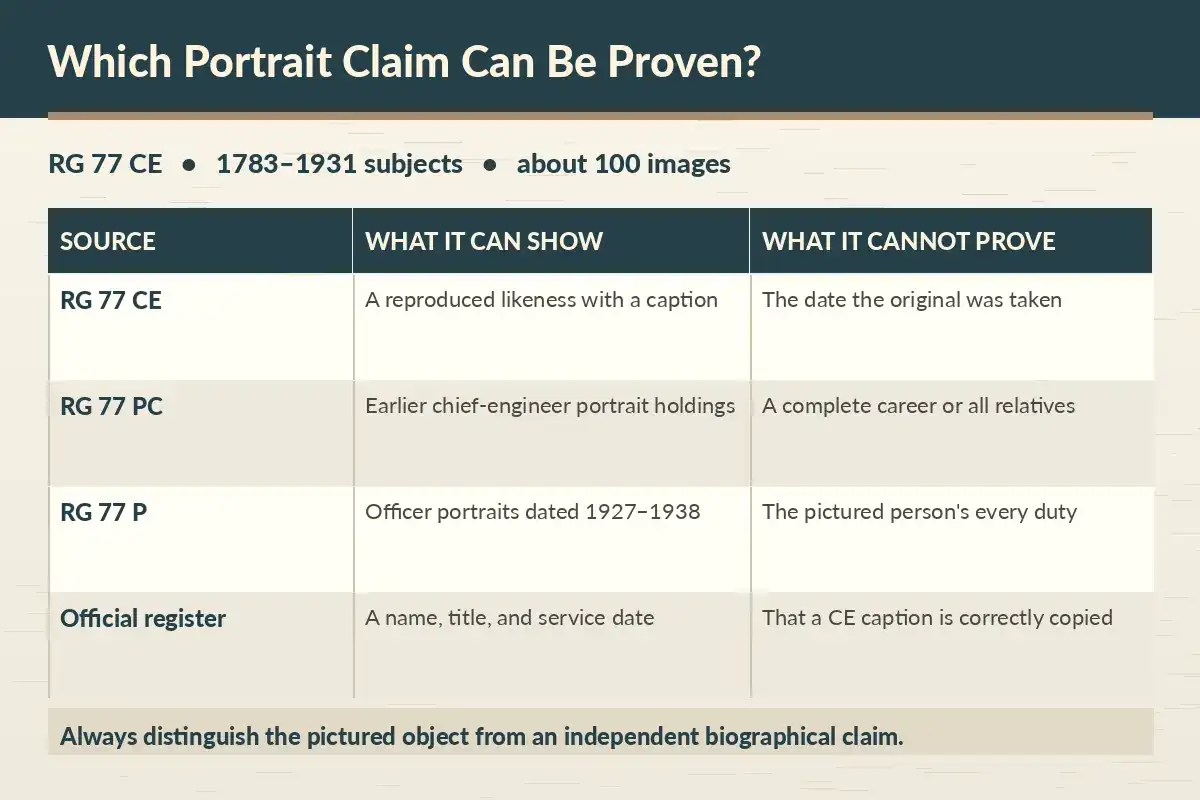
An official-looking caption may give a full name, abbreviated initials, rank, and a prominent title. The same person may have held several ranks at different dates. Verify the name and exact office tenure in an independent contemporary appointment record, officer register, or the Corps’ institutional history. Be careful with ranks added retrospectively to commemorate a lifetime career rather than the rank held when the source portrait was made.
For individuals with similar names, compare birth and death dates, military branch, commissioning year, appointments, and known locations. A single surname on a portrait mount is insufficient. A family history should distinguish the record that proves a relationship from the record that proves an officer’s service. A public institutional portrait, even of a well-known person, does not document spouses, children, or heirs by itself.
Trace the Source Portrait and Its Reproduction Chain
Try to find the earliest known portrait on which the CE image was based. Compare framing, facial orientation, uniform details, insignia, signatures, and any studio markings. If a CE slide reproduces an engraving, identify the engraving’s publisher or artist when possible. A caption that says a person’s name may be reliable while the image itself reflects artistic conventions rather than a contemporary photographic sitting.
When a copy is reversed, retouched, cropped, or reused in a commemorative publication, preserve that fact. A later print can omit a studio border that contained an important attribution. Keep separate citations for the CE slide, the supposed source print, and the service record. This prevents one uncertain attribution from being repeated as if three independent sources had confirmed it.
Do Not Turn a Portrait into a Career Narrative
A portrait is evidence that someone or some institution represented a person in a particular way. It is not a record of every project supervised or every military campaign attended. Even a printed office title must be placed in the correct years. Engineering reports, assignment orders, correspondence, and official registers are needed to link an officer to construction works, surveys, or specific posts.
If a family account says an ancestor served under a chief engineer, a portrait of that chief adds background but does not name the subordinate. Find a roster, appointment letter, pay record, or unit document linking the relative to the relevant office. Keep “associated with the Corps,” “served at this post,” and “worked directly for this chief” as distinct statements with their own citations.
Create a Reliable Caption and Research Trail
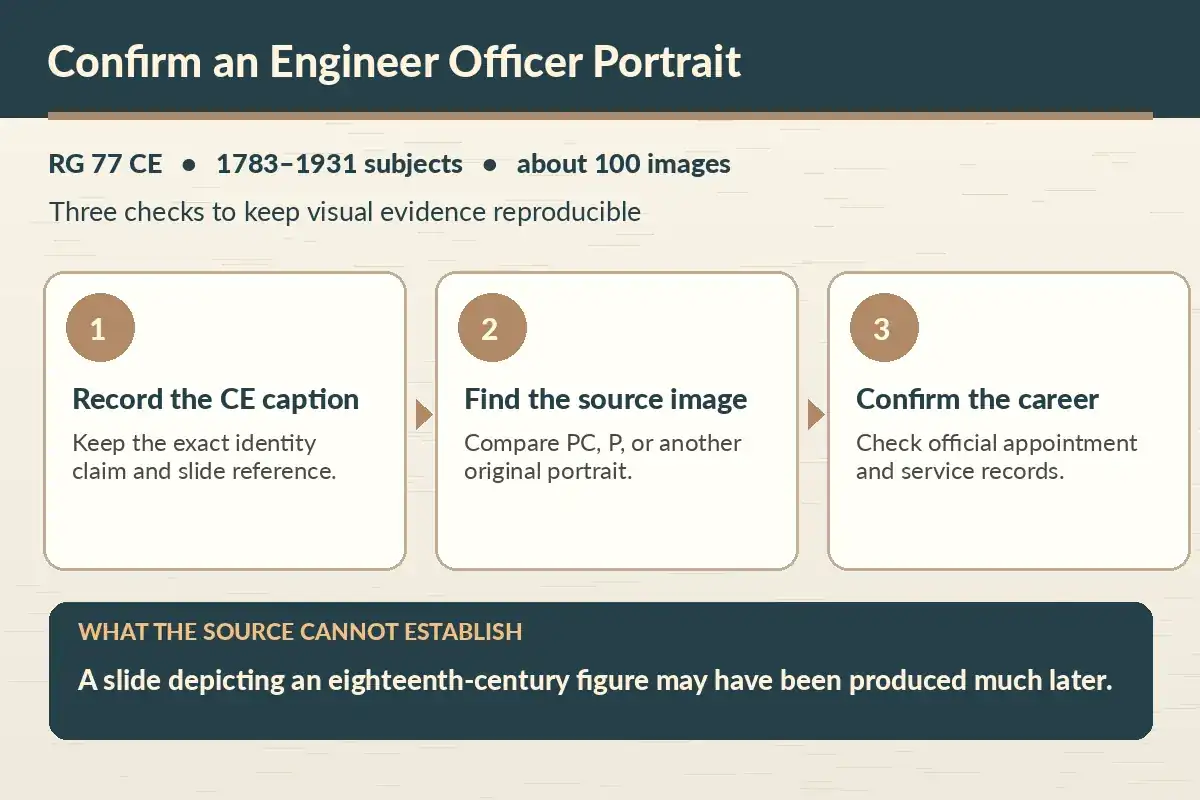
The final image citation should identify the National Archives, RG 77 CE, full available item identifier, original caption, medium, and the consulted reproduction. Include a separate source for an officer’s birth date, rank, or appointment; do not let the caption silently absorb those claims. If a picture is known only from a catalog group entry, describe its attribution as provisional until the actual slide can be examined.
For public-facing writing, prefer a formulation such as: “A CE slide reproduces a portrait identified with this engineer; an independent officer register confirms the individual’s appointment years.” When the source portrait remains uncertain, state that explicitly. The result can still be a useful guide for descendants and local historians, because it reveals the exact next record needed rather than concealing an evidentiary gap.
More Research Method Guides
How We Research This Collection and Its Limits
The series-specific count, dates, and record designation were checked against the National Archives federal records guide on November 16, 2026. Independent context was compared with a second official research source, while NARA still-picture citation guidance establishes the information needed to locate an exact image. The site topic list and earlier production titles were compared for duplication. A series description does not identify every subject, date, or object in every frame, and access to a fully digitized item cannot be assumed. The figures in this guide are newly drawn explanatory editorial illustrations, not historical negatives or genuine reproductions. We make no unverified claims of commercial endorsements. See the affiliate disclosure for site policy.
Approximately 100 lantern slides and contact prints.
Not necessarily. The 1783–1931 span describes historical subjects and does not date each image’s creation.
NARA describes CE as slides and contact prints, PC as 28 earlier portrait prints, and P as 250 officer portrait prints from 1927–1938.
Use an independent official appointment record or officer register to verify the title and dates.
RG 77, CE, its local reference, original caption, image medium, and any independent evidence supporting the identification.